
If FRANCE is coded as 654321 and GERMANY as 9158437, then how is YEMEN coded?
71813
Solving Letter Coding Puzzles
This problem is a classic example of a letter coding puzzle where each letter is assigned a unique numerical digit. To solve this, we need to carefully observe the given codes for the words "FRANCE" and "GERMANY" and determine the numerical value assigned to each letter.
Analyzing the Given Codes
We are given the following codes:
- FRANCE is coded as 654321
- GERMANY is coded as 9158437
Let's break down the codes for each letter based on the given words:
| Word | Letters | Code | Individual Letter Codes |
|---|---|---|---|
| FRANCE | F, R, A, N, C, E | 654321 | F=6, R=5, A=4, N=3, C=2, E=1 |
| GERMANY | G, E, R, M, A, N, Y | 9158437 | G=9, E=1, R=5, M=8, A=4, N=3, Y=7 |
Now, let's check for consistency for letters that appear in both words:
- The letter 'R' is coded as 5 in both FRANCE and GERMANY.
- The letter 'A' is coded as 4 in both FRANCE and GERMANY.
- The letter 'N' is coded as 3 in both FRANCE and GERMANY.
- The letter 'E' is coded as 1 in both FRANCE and GERMANY.
The coding is consistent across both words. This confirms that it's a direct letter-to-digit substitution cipher.
Coding the Word YEMEN
Now we need to find the code for the word "YEMEN" using the individual letter codes we've identified from FRANCE and GERMANY.
- For 'Y', look at the code for GERMANY: Y = 7
- For 'E', look at the code for FRANCE or GERMANY: E = 1
- For 'M', look at the code for GERMANY: M = 8
- For 'E', look at the code for FRANCE or GERMANY: E = 1
- For 'N', look at the code for FRANCE or GERMANY: N = 3
Putting the codes for each letter of YEMEN together:
- Y → 7
- E → 1
- M → 8
- E → 1
- N → 3
So, the code for YEMEN is 71813.
Final Coded Word
The code for YEMEN is 71813.
Revision Table: Letter Coding Analysis
| Letter | Code | Source Word(s) |
|---|---|---|
| F | 6 | FRANCE |
| R | 5 | FRANCE, GERMANY |
| A | 4 | FRANCE, GERMANY |
| N | 3 | FRANCE, GERMANY |
| C | 2 | FRANCE |
| E | 1 | FRANCE, GERMANY |
| G | 9 | GERMANY |
| M | 8 | GERMANY |
| Y | 7 | GERMANY |
Additional Information: Understanding Coding-Decoding
Coding-decoding questions are common in reasoning ability sections of competitive exams. They test your ability to decipher a pattern or rule applied to letters, words, or numbers and then apply that rule to find a missing term. Common types include:
- Letter Coding: Letters are replaced by other letters or numbers based on a specific rule (e.g., shifting positions in the alphabet, direct substitution as in this problem).
- Number Coding: Words are coded into numbers based on rules like letter positions in the alphabet, vowel/consonant counts, or assignment of fixed values to letters.
- Symbol Coding: Letters or words are coded using symbols.
The key to solving these problems is careful observation of the given examples to identify the underlying pattern or rule. Once the rule is found, apply it consistently to the question asked.
Similar Questions
Which one of the following statements best reflects the most logical and rational message conveyed by the author of the passage?
With reference to the above passage, the following assumptions have been made:
I. There is no need for the State to be involved in any manner in the handloom sector.
II. Handloom products are no longer appealing and attractive in the rapidly changing modern world.
Which of the above assumptions is/are valid?Which one of the following statements best reflects the central idea conveyed by the passage?
Which one of the following statements best reflects the central idea conveyed by the passage?
Which one of the following statements best reflects the critical message conveyed by the author of the passage?
With reference to the above passage, the following assumptions have been made:
I. Path-dependent green investments will eventually most likely benefit growth as well as public finances in a country like India.
II. If other green technologies follow the same pattern as that of solar energy, there will most likely be an easy green transition.
Which of the above assumptions is/are valid?A natural number N is such that it can be expressed as N = p + q + r, where p, q and r are distinct factors of N. How many numbers below 50 have this property?
Team X scored a total of N runs in 20 overs. Team Y tied the score in 10% less overs. Had Team Y’s average run rate (runs per over) been 50% higher, the scores would have been tied in 12 overs. How many runs were scored by Team X?
Consider the following statements:
I. If A ≤ B > C < D > E > F ≥ G = H; then B is always greater than E.
II. If P > Q = R ≥ S = T ≤ U = V > W; then S is always less than V.
Which of the statements given above is/are correct?Consider the first 100 natural numbers. How many of them are not divisible by any one of 2, 3, 5, 7 and 9?
Important Questions from Miscellaneous Topics
- In communication the word 'Haptics' signifies :
- Which of the following statements best defines the scope of semiotics?
The compound interest on Rs. 75,000 for three years, at successive interest rates of 4%, 6% and 9% for each year respectively is:
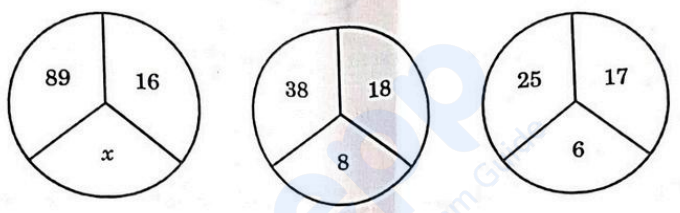
The value of x in the following figures is :
When a child reaches adolescence, there is apt to be a conflict between the parents and the child, since
the latter considers himself to be by now quite capable of managing his own affairs, while the former
are filled with parental solicitude, which is often a disguise for love of power. Parents consider, usually,
that the various moral problems which arise in adolescence are peculiarly their province. The options
they express, however, are so dogmatic that the young seldom confide in them, and usually go their
own way in secret.



