
If 5 \(\sqrt{3}\) + \(\sqrt{75}\) = 17.32, then the value of 14 \(\sqrt{3}\) + \(\sqrt{108}\) is:
34.64
Calculating Expressions with Square Roots
The problem asks us to find the value of an expression involving square roots, given the value of another similar expression. We are given that \(5 \sqrt{3} + \sqrt{75} = 17.32\) and we need to find the value of \(14 \sqrt{3} + \sqrt{108}\).
Simplifying the Square Root Terms
First, let's simplify the square root terms that are not in the form \(\sqrt{3}\). We can do this by finding perfect square factors inside the square roots.
- For \(\sqrt{75}\): \(75 = 25 \times 3\). So, \(\sqrt{75} = \sqrt{25 \times 3}\). Using the property \(\sqrt{ab} = \sqrt{a} \times \sqrt{b}\), we get \(\sqrt{25} \times \sqrt{3} = 5 \times \sqrt{3} = 5\sqrt{3}\).
- For \(\sqrt{108}\): \(108 = 36 \times 3\). So, \(\sqrt{108} = \sqrt{36 \times 3}\). Using the property \(\sqrt{ab} = \sqrt{a} \times \sqrt{b}\), we get \(\sqrt{36} \times \sqrt{3} = 6 \times \sqrt{3} = 6\sqrt{3}\).
Using the Given Information
The given equation is \(5 \sqrt{3} + \sqrt{75} = 17.32\). Substitute the simplified value of \(\sqrt{75}\) into this equation:
\(5 \sqrt{3} + 5 \sqrt{3} = 17.32\)
Combine the terms with \(\sqrt{3}\):
\((5+5) \sqrt{3} = 17.32\)
\(10 \sqrt{3} = 17.32\)
From this, we can find the approximate value of \(\sqrt{3}\):
\(\sqrt{3} = \frac{17.32}{10} = 1.732\)
Calculating the Value of the Required Expression
Now, we need to find the value of \(14 \sqrt{3} + \sqrt{108}\). Substitute the simplified value of \(\sqrt{108}\) into this expression:
\(14 \sqrt{3} + 6 \sqrt{3}\)
Combine the terms with \(\sqrt{3}\):
\((14+6) \sqrt{3} = 20 \sqrt{3}\)
Now, substitute the value of \(\sqrt{3} \approx 1.732\) that we found from the given information:
\(20 \times 1.732\)
Perform the multiplication:
\(20 \times 1.732 = 34.64\)
So, the value of \(14 \sqrt{3} + \sqrt{108}\) is approximately 34.64.
| Expression | Simplified Form | Value (approx) |
|---|---|---|
| \(5 \sqrt{3} + \sqrt{75}\) | \(5 \sqrt{3} + 5 \sqrt{3} = 10 \sqrt{3}\) | 17.32 (Given) |
| \(\sqrt{3}\) | - | \(\frac{17.32}{10} = 1.732\) (Derived) |
| \(14 \sqrt{3} + \sqrt{108}\) | \(14 \sqrt{3} + 6 \sqrt{3} = 20 \sqrt{3}\) | \(20 \times 1.732 = 34.64\) (Calculated) |
Revision Table: Key Concepts in Solving Square Root Problems
| Concept | Description | Example |
|---|---|---|
| Simplifying Radicals | Find the largest perfect square factor of the number under the square root sign. | \(\sqrt{50} = \sqrt{25 \times 2} = 5\sqrt{2}\) |
| Adding/Subtracting Radicals | Radicals can be added or subtracted only if they have the same term under the square root (like terms). | \(3\sqrt{5} + 2\sqrt{5} = 5\sqrt{5}\) \(7\sqrt{2} - 4\sqrt{2} = 3\sqrt{2}\) |
| Using Given Information | An equation involving radicals can help find the value of the basic radical term (like \(\sqrt{2}\) or \(\sqrt{3}\)) to use in evaluating another expression. | If \(2\sqrt{5} = 4.47\), then \(\sqrt{5} = 2.235\). |
Additional Information: Properties of Square Roots
Understanding the basic properties of square roots is essential for solving problems like this. Some important properties are:
- Product Property: \(\sqrt{a \times b} = \sqrt{a} \times \sqrt{b}\) (where a, b \(\ge\) 0)
- Quotient Property: \(\sqrt{\frac{a}{b}} = \frac{\sqrt{a}}{\sqrt{b}}\) (where a \(\ge\) 0, b > 0)
These properties allow us to simplify complex radical expressions and combine like terms, making calculations easier.
Similar Questions
Two different positions of the same dice are shown, the six face of which are numbered from 1 to 6. Select the number that will be on the face opposite to the face having the number '3'.
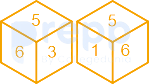
Two orientations of a dice are shown. This dice can be obtained by folding which of the option figures along the lines?

Important Questions from Cube and Cube Root
- Find the smallest natural number N such that the product $288 \times N$ is a perfect cube.
- Find the least number by which 6250 should be multiplied, so that it becomes a perfect cube.
- The square root of 18769 consists of how many digits?
- The square root of $1\frac{11}{25}$ is:
Two different positions of the same dice are shown, the six face of which are numbered from 1 to 6. Select the number that will be on the face opposite to the face having the number '3'.



