
Prime Factorization of 288
To find the smallest natural number N such that $288 \times N$ is a perfect cube, we first find the prime factorization of 288.
- $288 = 2 \times 144$
- $144 = 12 \times 12 = (2^2 \times 3) \times (2^2 \times 3) = 2^4 \times 3^2$
- Therefore, $288 = 2 \times (2^4 \times 3^2) = 2^5 \times 3^2$.
Perfect Cube Condition
A number is a perfect cube if all exponents in its prime factorization are multiples of 3.
- The prime factorization of 288 is $2^5 \times 3^2$.
- The exponent for the prime factor 2 is 5. The next multiple of 3 is 6. We need $6 - 5 = 1$ more factor of 2.
- The exponent for the prime factor 3 is 2. The next multiple of 3 is 3. We need $3 - 2 = 1$ more factor of 3.
Determining the Smallest N
To make $288 \times N$ a perfect cube, N must supply the missing factors.
- N must contain $2^1$.
- N must contain $3^1$.
- The smallest natural number N is the product of these required factors: $N = 2^1 \times 3^1 = 6$.
Checking the result:
$288 \times N = 288 \times 6 = (2^5 \times 3^2) \times (2^1 \times 3^1) = 2^{5+1} \times 3^{2+1} = 2^6 \times 3^3$.
Both exponents (6 and 3) are multiples of 3, confirming $2^6 \times 3^3$ is a perfect cube.
Similar Questions
- Find the least number by which 6250 should be multiplied, so that it becomes a perfect cube.
- The square root of 18769 consists of how many digits?
- The square root of $1\frac{11}{25}$ is:
Evaluate \(21^3 + (-2)^3 + (-19)^3\)
- What is the least positive integer that should be subtracted from 2750, so that the difference is a perfect cube?
- The cube root of 150 will lie between:
- Find the product of square root of 16 and square of 4?
- The value of $\sqrt{142884}$ is:
- The number by which 62557 can be divided to make it a perfect cube is:
- What is the value of $99^3$?
Important Questions from Cube and Cube Root
- Find the least number by which 6250 should be multiplied, so that it becomes a perfect cube.
- The square root of 18769 consists of how many digits?
- The square root of $1\frac{11}{25}$ is:
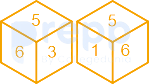
Two different positions of the same dice are shown, the six face of which are numbered from 1 to 6. Select the number that will be on the face opposite to the face having the number '3'.
What is the cube root of 1728?



