
Question
The cube root of 150 will lie between:
This question was previously asked in
RRB NTPC 2019 CBT 1 Question Paper (8-Mar-2021) (Shift 2)
The correct answer is
5 and 6
Estimating the Cube Root Range for 150
To find the range where the cube root of 150 lies, we need to find two consecutive integers whose cubes bracket 150.
Cube Root Estimation
Let the number be '$N = 150$'. We are looking for a value '$x$' such that $x^3 = N$. We can test the cubes of integers:
- Calculate the cube of 5: $5^3 = 5 \times 5 \times 5 = 125$.
- Calculate the cube of 6: $6^3 = 6 \times 6 \times 6 = 216$.
Determining the Range
We observe that 150 falls between the calculated cubes:
$125 < 150 < 216$Substituting the integer cubes back:
$5^3 < 150 < 6^3$Taking the cube root of all parts of the inequality:
$\sqrt[3]{5^3} < \sqrt[3]{150} < \sqrt[3]{6^3}$ $\implies 5 < \sqrt[3]{150} < 6$Therefore, the cube root of 150 lies between 5 and 6.
Was this answer helpful?
Similar Questions
- Find the smallest natural number N such that the product $288 \times N$ is a perfect cube.
- Find the least number by which 6250 should be multiplied, so that it becomes a perfect cube.
- The square root of 18769 consists of how many digits?
- The square root of $1\frac{11}{25}$ is:
Evaluate \(21^3 + (-2)^3 + (-19)^3\)
- What is the least positive integer that should be subtracted from 2750, so that the difference is a perfect cube?
- Find the product of square root of 16 and square of 4?
- The value of $\sqrt{142884}$ is:
- The number by which 62557 can be divided to make it a perfect cube is:
- What is the value of $99^3$?
Important Questions from Cube and Cube Root
- Find the smallest natural number N such that the product $288 \times N$ is a perfect cube.
- Find the least number by which 6250 should be multiplied, so that it becomes a perfect cube.
- The square root of 18769 consists of how many digits?
- The square root of $1\frac{11}{25}$ is:
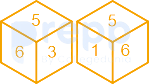
Two different positions of the same dice are shown, the six face of which are numbered from 1 to 6. Select the number that will be on the face opposite to the face having the number '3'.
Need Expert Advice?
Test Series

Railways
RRB NTPC Under Graduate 2026 New Mock Test Series
1612 Tests 1 Tests Free
687 Attempts
4.3(510)
English, Hindi, Telugu +7 More
More Questions from RRB NTPC


