
If 4, 5, 6, 6, 6, 6, 6, 6, 6, 7 be a random sample from a Poisson population with parameter λ, then an unbiased estimate of λ is:
5.8
Understanding the Unbiased Estimate for Poisson Parameter $\lambda$
The question asks for an unbiased estimate of the parameter $\lambda$ for a Poisson population, given a specific random sample. The Poisson distribution is a discrete probability distribution that expresses the probability of a given number of events occurring in a fixed interval of time or space if these events occur with a known constant mean rate and independently of the time since the last event.
The parameter $\lambda$ (lambda) represents the average rate of occurrence of events in the given interval. For a Poisson distribution, a key property is that its mean is equal to its variance, and both are equal to $\lambda$. That is, $\text{E}(X) = \lambda$ and $\text{Var}(X) = \lambda$ for a random variable $X$ following a Poisson distribution.
What is an Unbiased Estimator?
An estimator is a statistic used to estimate a population parameter. An estimator is said to be unbiased if its expected value is equal to the true value of the parameter being estimated. In simpler terms, on average, the estimator gets the value of the parameter right.
Finding the Unbiased Estimator for Poisson $\lambda$
For estimating the population mean ($\mu$) of any distribution, the sample mean ($\bar{X}$) is a commonly used estimator. A fundamental result in statistics is that the sample mean is an unbiased estimator for the population mean, i.e., $\text{E}(\bar{X}) = \mu$.
Since the mean of a Poisson distribution is equal to its parameter $\lambda$ (i.e., $\mu = \lambda$), the sample mean ($\bar{X}$) is an unbiased estimator for $\lambda$.
So, to find an unbiased estimate of $\lambda$ from the given sample, we need to calculate the sample mean.
Calculating the Sample Mean from the Given Data
The given random sample from the Poisson population is:
4, 5, 6, 6, 6, 6, 6, 6, 6, 7
The number of observations in the sample is $n=10$.
The sample mean, denoted by $\bar{X}$, is calculated as the sum of all observations divided by the number of observations:
$\bar{X} = \frac{\sum_{i=1}^{n} x_i}{n}$
First, let's find the sum of the observations:
$\sum x_i = 4 + 5 + 6 + 6 + 6 + 6 + 6 + 6 + 6 + 7$
$\sum x_i = 9 + 7 \times 6 + 7$
$\sum x_i = 9 + 42 + 7$
$\sum x_i = 58$
Now, divide the sum by the number of observations ($n=10$):
$\bar{X} = \frac{58}{10}$
$\bar{X} = 5.8$
Therefore, the sample mean is 5.8.
Conclusion: The Unbiased Estimate of $\lambda$
Since the sample mean ($\bar{X}$) is an unbiased estimator for the Poisson parameter $\lambda$, the unbiased estimate of $\lambda$ based on this sample is the calculated sample mean, which is 5.8.
| Observation ($\boldsymbol{x_i}$) | Frequency |
|---|---|
| 4 | 1 |
| 5 | 1 |
| 6 | 7 |
| 7 | 1 |
| Total | 10 |
| Calculation Step | Value |
|---|---|
| Sum of observations ($\sum x_i$) | 58 |
| Number of observations ($n$) | 10 |
| Sample Mean ($\bar{X} = \frac{\sum x_i}{n}$) | $\frac{58}{10} = 5.8$ |
The unbiased estimate of $\lambda$ is 5.8.
Revision Table: Key Statistical Concepts
| Term | Definition/Concept | Relevance to Problem |
|---|---|---|
| Poisson Distribution | A discrete probability distribution describing the probability of a number of events occurring in a fixed interval of time or space, given the average rate. | The population is stated to be Poisson. |
| Parameter ($\lambda$) | The average rate of events in the Poisson distribution. It equals both the mean and variance. | This is the parameter we need to estimate. |
| Estimator | A statistic used to estimate a population parameter. | The sample mean $\bar{X}$ is used as an estimator for $\lambda$. |
| Unbiased Estimator | An estimator whose expected value equals the true parameter value. $\text{E}(\text{Estimator}) = \text{Parameter}$. | We are looking for an unbiased estimate of $\lambda$. The sample mean is an unbiased estimator for the mean, which is $\lambda$ in this case. |
| Sample Mean ($\bar{X}$) | The average of the values in a sample. Calculated as sum of values divided by sample size. | The sample mean is the unbiased estimator for $\lambda$ in a Poisson distribution. |
Additional Information: Other Estimators and Properties
- Maximum Likelihood Estimator (MLE) for $\lambda$: For a Poisson distribution, the Maximum Likelihood Estimator for $\lambda$ is also the sample mean, $\bar{X}$. MLEs are often preferred due to properties like consistency and efficiency, although they are not always unbiased. In the case of the Poisson distribution, the sample mean is both an unbiased estimator and the MLE.
- Consistency: A consistent estimator is one that converges in probability to the true parameter value as the sample size increases. The sample mean is a consistent estimator for the population mean (and thus for $\lambda$).
- Efficiency: An efficient estimator is an unbiased estimator that has the smallest possible variance among all unbiased estimators. The sample mean is an efficient estimator for $\lambda$ in the Poisson distribution.
- Sufficiency: A sufficient statistic is one that captures all the information about the parameter that is available in the sample. The sample sum ($\sum x_i$) or equivalently the sample mean ($\bar{X}$) is a sufficient statistic for $\lambda$ in the Poisson distribution.
Similar Questions
Suppose in a certain large group, the height is approximately normally distributed with a mean of 160 cm and the standard deviation is 10. For a sample of size 16, the sampling distribution of sample mean has standard error equal to:
Which of the following is NOT an example of the probability sampling technique?
A completely randomised design is based on the principles of ______ and randomisation only.
A sample of 30 latest returns on UTI stock reveals a mean return of $4 with a sample standard deviation of $0.13. The estimated standard error of the sample mean is:
In a cluster sampling wherein the units within same cluster are highly correlated, suppose \(S_w^2\) represents the variance within the clusters and \(S_b^2\) between clusters, then which option is correct?
In some of the real-life situations, a researcher has to explore two or more treatments at the same time. This type of experimental design is referred to as:
In the construction of cost of living index, commodities are selected by:
The data taken from the publication "sankhya" will be considered as:
Important Questions from Sampling Theorems
Four red balls, four green balls and four blue balls are put in a box. Three balls are pulled out of the box at random one after another without replacement. The probability that all the three balls are red is
Three cards were drawn from a pack of 52 cards. The probability that they are a king, a queen, and a jack is
A population (with mean $\mu$) follows normal distribution. Ten samples (N) are drawn at random with a mean value of “x” and standard deviation of “S”. Following table provides the confidence limits, C(t) of the cumulative probability function for Student's t - distribution two-tailed test with degree of freedom, D.
C(t)
D 0.9 0.95 0.975 9 1.38 1.83 2.26 10 1.37 1.81 2.23 11 1.36 1.80 2.20 Which one of the following expression is correct for testing the null hypothesis $H_0: \mu = 0$ at $10\%$ significance level?
- If the sample size ($n$) is 25 and the standard deviation ($\sigma$) of population is 2, then the standard error (SE) of sample mean, (rounded off to one decimal place), is ________.
The probability distribution function of a random variable $X$ is shown in the following figure.
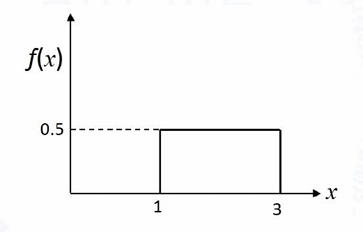
From this distribution, random samples with sample size $n = 68$ are taken. If $\bar{X}$ is the sample mean, the standard deviation of the probability distribution of $\bar{X}$, i.e. $\sigma_{\bar{X}}$ is ________ (round off to 3 decimal places).



