
The probability distribution function of a random variable $X$ is shown in the following figure. From this distribution, random samples with sample size $n = 68$ are taken. If $\bar{X}$ is the sample mean, the standard deviation of the probability distribution of $\bar{X}$, i.e. $\sigma_{\bar{X}}$ is ________ (round off to 3 decimal places).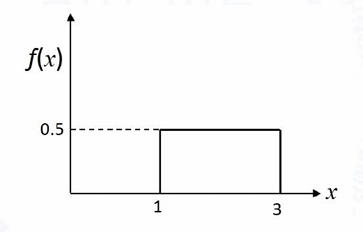
The given probability distribution depicts a uniform distribution over the interval [1, 3]. The uniform distribution has a constant probability density function (pdf) and is defined as:
$$ f(x) = \frac{1}{b-a} $$
For the interval [1, 3], the pdf is:
$$ f(x) = \frac{1}{3-1} = \frac{1}{2} $$
The standard deviation of a uniform distribution over [a, b] is given by:
$$ \sigma = \sqrt{\frac{(b-a)^2}{12}} $$
Substituting the values of a = 1 and b = 3:
$$ \sigma = \sqrt{\frac{(3-1)^2}{12}} = \sqrt{\frac{4}{12}} = \sqrt{\frac{1}{3}} $$
The standard deviation for the sample mean, \( \bar{X} \), with sample size \( n \) is given by:
$$ \sigma_{\bar{X}} = \frac{\sigma}{\sqrt{n}} $$
Substitute \( \sigma = \sqrt{\frac{1}{3}} \) and \( n = 68 \):
$$ \sigma_{\bar{X}} = \frac{\sqrt{\frac{1}{3}}}{\sqrt{68}} = \frac{1}{\sqrt{204}} $$
Calculate the value:
$$ \frac{1}{\sqrt{204}} \approx 0.070 $$
This value falls within the given range of 0.069 to 0.071. Thus, the standard deviation of the probability distribution of \( \bar{X} \), rounded to three decimal places, is:
0.070
Important Questions from Sampling Theorems
Four red balls, four green balls and four blue balls are put in a box. Three balls are pulled out of the box at random one after another without replacement. The probability that all the three balls are red is
Three cards were drawn from a pack of 52 cards. The probability that they are a king, a queen, and a jack is
A population (with mean $\mu$) follows normal distribution. Ten samples (N) are drawn at random with a mean value of “x” and standard deviation of “S”. Following table provides the confidence limits, C(t) of the cumulative probability function for Student's t - distribution two-tailed test with degree of freedom, D.
C(t)
D 0.9 0.95 0.975 9 1.38 1.83 2.26 10 1.37 1.81 2.23 11 1.36 1.80 2.20 Which one of the following expression is correct for testing the null hypothesis $H_0: \mu = 0$ at $10\%$ significance level?
- If the sample size ($n$) is 25 and the standard deviation ($\sigma$) of population is 2, then the standard error (SE) of sample mean, (rounded off to one decimal place), is ________.
The standard deviation of population P is two times the standard deviation of population Q. The size of a random sample from population P is four times the size of a random sample from population Q. If $e_P$ and $e_Q$ denote the standard error of means of the samples from P and Q, respectively, then the ratio of $e_P$ to $e_Q$ is________.


