
Standard Error Calculation Explained
The question asks for the standard error (SE) of the sample mean, given the sample size ($n$) and the population standard deviation ($\sigma$).
The formula used to calculate the standard error of the sample mean is:
$ SE = \frac{\sigma}{\sqrt{n}} $
Step-by-Step Calculation
- Identify Given Values:
- Sample size, $n = 25$
- Population standard deviation, $\sigma = 2$
- Apply the Formula: Substitute the given values into the standard error formula.
$ SE = \frac{2}{\sqrt{25}} $
- Calculate the Square Root: Find the square root of the sample size.
$ \sqrt{25} = 5 $
- Compute the Standard Error: Divide the population standard deviation by the square root of the sample size.
$ SE = \frac{2}{5} = 0.4 $
- Rounding: The result is 0.4. Rounded to one decimal place, it remains 0.4.
Therefore, the standard error of the sample mean is 0.4.
Important Questions from Sampling Theorems
Four red balls, four green balls and four blue balls are put in a box. Three balls are pulled out of the box at random one after another without replacement. The probability that all the three balls are red is
Three cards were drawn from a pack of 52 cards. The probability that they are a king, a queen, and a jack is
A population (with mean $\mu$) follows normal distribution. Ten samples (N) are drawn at random with a mean value of “x” and standard deviation of “S”. Following table provides the confidence limits, C(t) of the cumulative probability function for Student's t - distribution two-tailed test with degree of freedom, D.
C(t)
D 0.9 0.95 0.975 9 1.38 1.83 2.26 10 1.37 1.81 2.23 11 1.36 1.80 2.20 Which one of the following expression is correct for testing the null hypothesis $H_0: \mu = 0$ at $10\%$ significance level?
The probability distribution function of a random variable $X$ is shown in the following figure.
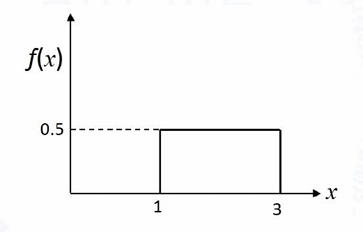
From this distribution, random samples with sample size $n = 68$ are taken. If $\bar{X}$ is the sample mean, the standard deviation of the probability distribution of $\bar{X}$, i.e. $\sigma_{\bar{X}}$ is ________ (round off to 3 decimal places).
The standard deviation of population P is two times the standard deviation of population Q. The size of a random sample from population P is four times the size of a random sample from population Q. If $e_P$ and $e_Q$ denote the standard error of means of the samples from P and Q, respectively, then the ratio of $e_P$ to $e_Q$ is________.


