
Identify the correct option in which the compound is not named as per IUPAC
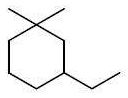 ; 1-Ethyl-3, 3-dimethyl cyclohexane
IUPAC rules: the principal functional group (suffix) gets the lowest locant; then the set of locants of all substituents must be the lowest at the first point of difference; alphabetical order decides only when locant sets tie.
Dimethyl–ethyl cyclohexane: numbering from the carbon bearing both methyls gives locants {1,1,3}; numbering from the ethyl carbon gives {1,3,3}. At the first point of difference 1 is lower than 3, so the correct name is 3-ethyl-1,1-dimethylcyclohexane – the given name 1-ethyl-3,3-dimethyl cyclohexane is wrong.
Cyclohex-2-en-1-ol: \(\mathrm{{-}OH}\) (suffix) takes C1, then the double bond gets 2 – correct.
2-Chloro-1-methyl-4-nitrobenzene: the possible locant sets are {1,2,4}, {1,2,5} and {1,3,4}; {1,2,4} is lowest and arises only with methyl at C1 – correct.
4-Ethyl-1-fluoro-2-nitrobenzene: sets {1,2,4}, {1,2,5}, {1,3,4}; {1,2,4} with fluoro at C1 – correct.
Hence, ; 1-Ethyl-3, 3-dimethyl cyclohexane.
Similar Questions
Identify the compounds which can react with chloroform and alcoholic KOH and give substances with offensive odour, from the following
I. N, N - Dimethyl aniline
II. 2, 4 - Dimethyl aniline
III. N - Methyl - o - methyl aniline
IV. p - Methyl benzyl amine
The correct answer is
Which of the following has lowest \(pK_a\) value?
Which of the following is not an example of antibiotic?
Observe the two polymerization reactions I and II given below
I. \(\mathrm{A+B\rightarrow X}\) (polymer)
II. \(\mathrm{C+D\rightarrow Y}\)(polymer)
In reaction I, monomer (A) reacts with NaOH and in reaction II monomer (C) reacts with \(\mathrm{NaHCO_3}\). What are X and Y respectively?
A and B are two position isomers of an alkene \(\mathrm{C_5H_{10}}\). Both A and B do not exhibit cis-trans isomerism. Addition of HBr with A forms X (major product) and B adds HBr to form Y (major product). What are X and Y respectively?
What are X and Y in the following reaction sequence?
\(\text{Ethanal}\ \xleftarrow[\mathrm{(ii)\ Zn\,+\,H_2O}]{\mathrm{(i)\ O_3}}\ \mathrm{C_4H_8}\ \xrightarrow[\mathrm{(ii)\ X}]{\mathrm{(i)\ Br_2/CCl_4}}\ \mathrm{Y}\)
Given below are two statements
Statement I: The groups \(\mathrm{{-}NHCOCH_3}\) and \(\mathrm{{-}OCOCH_3}\) deactivate the benzene ring for electrophilic attack when present on it
Statement II: \(\mathrm{{-}OH}\) and \(\mathrm{{-}CH_2CH_3}\) groups activate the benzene ring for electrophilic attack when present on it
The Correct answer is
Match the following
List - I (Reaction) List – II (Product) A) \(\mathrm{CH_3COONa\xrightarrow[\Delta]{NaOH-CaO}}\)
B) \(\mathrm{CH_3COONa\ (aq)\xrightarrow{Electrolysis}}\)
C) \(\mathrm{CH_3CH_2OH\xrightarrow[443\ K]{Conc.H_2SO_4}}\)
D) \(\mathrm{CH_2Br-CH_2Br\xrightarrow[(ii)\ NaNH_2]{(i)\ alc.KOH}}\)I) \(\mathrm{C_2H_6}\)
II) \(\mathrm{C_2H_4}\)
III) \(\mathrm{CH_4}\)
IV) \(\mathrm{C_2H_2}\)The correct answer is
Identify X in the following reaction sequence
\(\underset{\mathrm{(X)}}{\mathrm{C_4H_9Br}}\xrightarrow{\mathrm{OH}}\mathrm{C_4H_{10}O}\xrightarrow[\mathrm{573\ K}]{\mathrm{Cu}}\mathrm{C_4H_8}\)
Consider the following reaction and statements given about X
1-Ethylcyclohexene + HBr \(\rightarrow\) X (major product)
I. It undergoes nucleophilic substitution generally in polar protic solvents
II. C-Br bond is cleaved in rate determining step in its nucleophilic substitution reaction
III. The rate of its nucleophilic substitution depends on concentration of nucleophile
Correct statements are
Important Questions from Organic Chemistry
- In Dumas method for estimation of nitrogen, 0.50 g of an organic compound gave 70 mL of nitrogen collected at 300 K and 715 mm pressure. The percentage of nitrogen in the organic compound is ______ %.
(Aqueous tension at 300 K is 15 mm). - $0.25 \text{ g}$ of an organic compound "A" containing carbon, hydrogen and oxygen was analysed using the combustion method. There was an increase in mass of $\text{CaCl}_2$ tube and potash tube at the end of the experiment. The amount was found to be $0.15 \text{ g}$ and $0.1837 \text{ g}$, respectively. The percentage of oxygen in compound A is ______ %. (Nearest integer)
(Given: molar mass in $\text{g mol}^{-1}$ $\text{H} : 1, \text{C} : 12, \text{O} : 16$) - Grignard reagent $\text{RMgBr (P)}$ reacts with water and forms a gas $\text{(Q)}$. One gram of Q occupies $1.4 \text{ dm}^3$ at STP. (P) on reaction with dry ice in dry ether followed by $\text{H}_3\text{O}^+$ forms a compound $\text{(Z)}$. 0.1 mole of $\text{(Z)}$ will weigh _________ g. (Nearest integer)
- Consider all the structural isomers with molecular formula $\text{C}_5\text{H}_{11}\text{Br}$ are separately treated with $\text{KOH(aq)}$ to give respective substitution products, without any rearrangement. The number of products which can exhibit optical isomerism from these is ___________.
Consider the following reactions sequence
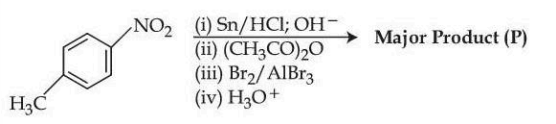
When the product (P) is subjected to Carius analysis using $\text{AgNO}_3$, $1.0\text{ g}$ of the product (P) will produce __________ g of the precipitate of AgBr. (Nearest Integer)
(Given : molar mass in $\text{g mol}^{-1}$ C : 12, H : 1, O : 16, N : 14, Br : 80, Ag : 108)


