
Identify X in the following reaction sequence \(\underset{\mathrm{(X)}}{\mathrm{C_4H_9Br}}\xrightarrow{\mathrm{OH}}\mathrm{C_4H_{10}O}\xrightarrow[\mathrm{573\ K}]{\mathrm{Cu}}\mathrm{C_4H_8}\)
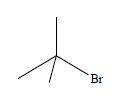
Hydrolysis converts the bromide \(\mathrm{C_4H_9Br}\) into the corresponding alcohol \(\mathrm{C_4H_9OH}\) (\(\mathrm{C_4H_{10}O}\)).
Over hot copper at 573 K, primary alcohols are dehydrogenated to aldehydes and secondary alcohols to ketones (both \(\mathrm{C_4H_8O}\) here), whereas a tertiary alcohol, having no α-hydrogen on the carbinol carbon, is dehydrated to an alkene.
The product is \(\mathrm{C_4H_8}\), an alkene, so the alcohol is tertiary: 2-methylpropan-2-ol, which gives 2-methylpropene, \(\mathrm{(CH_3)_2C{=}CH_2}\).
Hence X is 2-bromo-2-methylpropane, \(\mathrm{(CH_3)_3CBr}\). 1-Bromo-2-methylpropane would give 2-methylpropanal, 2-bromobutane would give butanone and 1-bromobutane would give butanal – all \(\mathrm{C_4H_8O}\), not \(\mathrm{C_4H_8}\).
Hence, .
Similar Questions
Identify the compounds which can react with chloroform and alcoholic KOH and give substances with offensive odour, from the following
I. N, N - Dimethyl aniline
II. 2, 4 - Dimethyl aniline
III. N - Methyl - o - methyl aniline
IV. p - Methyl benzyl amine
The correct answer is
Which of the following has lowest \(pK_a\) value?
Which of the following is not an example of antibiotic?
Observe the two polymerization reactions I and II given below
I. \(\mathrm{A+B\rightarrow X}\) (polymer)
II. \(\mathrm{C+D\rightarrow Y}\)(polymer)
In reaction I, monomer (A) reacts with NaOH and in reaction II monomer (C) reacts with \(\mathrm{NaHCO_3}\). What are X and Y respectively?
A and B are two position isomers of an alkene \(\mathrm{C_5H_{10}}\). Both A and B do not exhibit cis-trans isomerism. Addition of HBr with A forms X (major product) and B adds HBr to form Y (major product). What are X and Y respectively?
What are X and Y in the following reaction sequence?
\(\text{Ethanal}\ \xleftarrow[\mathrm{(ii)\ Zn\,+\,H_2O}]{\mathrm{(i)\ O_3}}\ \mathrm{C_4H_8}\ \xrightarrow[\mathrm{(ii)\ X}]{\mathrm{(i)\ Br_2/CCl_4}}\ \mathrm{Y}\)
Given below are two statements
Statement I: The groups \(\mathrm{{-}NHCOCH_3}\) and \(\mathrm{{-}OCOCH_3}\) deactivate the benzene ring for electrophilic attack when present on it
Statement II: \(\mathrm{{-}OH}\) and \(\mathrm{{-}CH_2CH_3}\) groups activate the benzene ring for electrophilic attack when present on it
The Correct answer is
Match the following
List - I (Reaction) List – II (Product) A) \(\mathrm{CH_3COONa\xrightarrow[\Delta]{NaOH-CaO}}\)
B) \(\mathrm{CH_3COONa\ (aq)\xrightarrow{Electrolysis}}\)
C) \(\mathrm{CH_3CH_2OH\xrightarrow[443\ K]{Conc.H_2SO_4}}\)
D) \(\mathrm{CH_2Br-CH_2Br\xrightarrow[(ii)\ NaNH_2]{(i)\ alc.KOH}}\)I) \(\mathrm{C_2H_6}\)
II) \(\mathrm{C_2H_4}\)
III) \(\mathrm{CH_4}\)
IV) \(\mathrm{C_2H_2}\)The correct answer is
Consider the following reaction and statements given about X
1-Ethylcyclohexene + HBr \(\rightarrow\) X (major product)
I. It undergoes nucleophilic substitution generally in polar protic solvents
II. C-Br bond is cleaved in rate determining step in its nucleophilic substitution reaction
III. The rate of its nucleophilic substitution depends on concentration of nucleophile
Correct statements are
What are X and Y in the following set of reactions respectively?
\(\mathrm{(C_{15}H_{31}COO)_3C_3H_5\xrightarrow{NaOH}X}\)
\(\mathrm{CH_3(CH_2)_{10}CH_2OH\xrightarrow[(ii)\ NaOH\ (aq)]{(i)\ H_2SO_4}Y}\)
Important Questions from Organic Chemistry
- In Dumas method for estimation of nitrogen, 0.50 g of an organic compound gave 70 mL of nitrogen collected at 300 K and 715 mm pressure. The percentage of nitrogen in the organic compound is ______ %.
(Aqueous tension at 300 K is 15 mm). - $0.25 \text{ g}$ of an organic compound "A" containing carbon, hydrogen and oxygen was analysed using the combustion method. There was an increase in mass of $\text{CaCl}_2$ tube and potash tube at the end of the experiment. The amount was found to be $0.15 \text{ g}$ and $0.1837 \text{ g}$, respectively. The percentage of oxygen in compound A is ______ %. (Nearest integer)
(Given: molar mass in $\text{g mol}^{-1}$ $\text{H} : 1, \text{C} : 12, \text{O} : 16$) - Grignard reagent $\text{RMgBr (P)}$ reacts with water and forms a gas $\text{(Q)}$. One gram of Q occupies $1.4 \text{ dm}^3$ at STP. (P) on reaction with dry ice in dry ether followed by $\text{H}_3\text{O}^+$ forms a compound $\text{(Z)}$. 0.1 mole of $\text{(Z)}$ will weigh _________ g. (Nearest integer)
- Consider all the structural isomers with molecular formula $\text{C}_5\text{H}_{11}\text{Br}$ are separately treated with $\text{KOH(aq)}$ to give respective substitution products, without any rearrangement. The number of products which can exhibit optical isomerism from these is ___________.
Consider the following reactions sequence
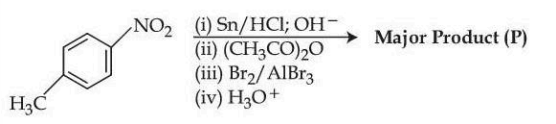
When the product (P) is subjected to Carius analysis using $\text{AgNO}_3$, $1.0\text{ g}$ of the product (P) will produce __________ g of the precipitate of AgBr. (Nearest Integer)
(Given : molar mass in $\text{g mol}^{-1}$ C : 12, H : 1, O : 16, N : 14, Br : 80, Ag : 108)


