
Observe the two polymerization reactions I and II given below I. \(\mathrm{A+B\rightarrow X}\) (polymer) II. \(\mathrm{C+D\rightarrow Y}\)(polymer) In reaction I, monomer (A) reacts with NaOH and in reaction II monomer (C) reacts with \(\mathrm{NaHCO_3}\). What are X and Y respectively?
Novolac; Terylene
Each polymer forms from two monomers, so both are copolymers (condensation polymers here).
A reacts with NaOH but the question singles out \(\mathrm{NaHCO_3}\) for C: a weak acid such as phenol dissolves in NaOH but does not react with \(\mathrm{NaHCO_3}\), whereas a carboxylic acid liberates \(\mathrm{CO_2}\) from \(\mathrm{NaHCO_3}\).
Reaction I: phenol (A) + formaldehyde (B) → novolac, the linear phenol–formaldehyde polymer (X).
Reaction II: terephthalic acid (C, a dicarboxylic acid that reacts with \(\mathrm{NaHCO_3}\)) + ethylene glycol (D) → terylene (Y), a polyester.
Neoprene comes from the single monomer chloroprene, Buna-S from butadiene and styrene (neither acidic), and melamine does not react with NaOH, so the other pairs fail.
Hence, Novolac; Terylene.
Similar Questions
Identify the compounds which can react with chloroform and alcoholic KOH and give substances with offensive odour, from the following
I. N, N - Dimethyl aniline
II. 2, 4 - Dimethyl aniline
III. N - Methyl - o - methyl aniline
IV. p - Methyl benzyl amine
The correct answer is
Which of the following has lowest \(pK_a\) value?
Identify the major product ‘P’ in the following sequence of reactions

What is the end product Z in the given reaction sequence?
\(\text{Phenol}\xrightarrow[\text{(ii) }\mathrm{Cl_2/FeCl_3},\,\Delta]{\text{(i) }\mathrm{Zn}/\Delta}X\xrightarrow[\text{Anh. }\mathrm{AlCl_3}]{\mathrm{CH_3COCl}}Y\xrightarrow[\text{Glycol},\,\Delta]{\mathrm{N_2H_4/OH^-}}Z\)
Identify the chiral molecules from the following
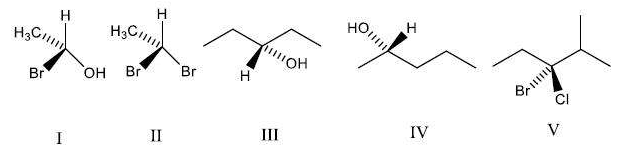
The correct answer is
The correct order of reactivity of the products A, B, C and D towards \(\mathrm{S_N1}\) reaction is
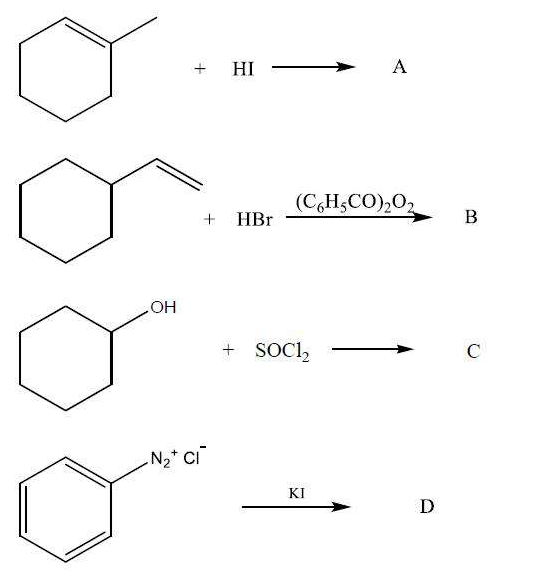
Which of the following is not an example of antibiotic?
Which of the following is/are present both in DNA and RNA?
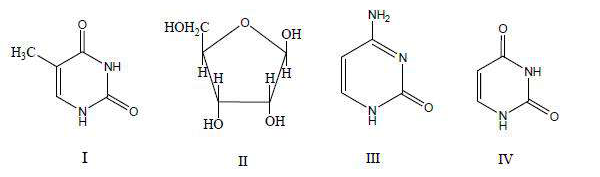
A and B are two position isomers of an alkene \(\mathrm{C_5H_{10}}\). Both A and B do not exhibit cis-trans isomerism. Addition of HBr with A forms X (major product) and B adds HBr to form Y (major product). What are X and Y respectively?
What are X and Y in the following reaction sequence?
\(\text{Ethanal}\ \xleftarrow[\mathrm{(ii)\ Zn\,+\,H_2O}]{\mathrm{(i)\ O_3}}\ \mathrm{C_4H_8}\ \xrightarrow[\mathrm{(ii)\ X}]{\mathrm{(i)\ Br_2/CCl_4}}\ \mathrm{Y}\)
Important Questions from Organic Chemistry
- In Dumas method for estimation of nitrogen, 0.50 g of an organic compound gave 70 mL of nitrogen collected at 300 K and 715 mm pressure. The percentage of nitrogen in the organic compound is ______ %.
(Aqueous tension at 300 K is 15 mm). - $0.25 \text{ g}$ of an organic compound "A" containing carbon, hydrogen and oxygen was analysed using the combustion method. There was an increase in mass of $\text{CaCl}_2$ tube and potash tube at the end of the experiment. The amount was found to be $0.15 \text{ g}$ and $0.1837 \text{ g}$, respectively. The percentage of oxygen in compound A is ______ %. (Nearest integer)
(Given: molar mass in $\text{g mol}^{-1}$ $\text{H} : 1, \text{C} : 12, \text{O} : 16$) - Grignard reagent $\text{RMgBr (P)}$ reacts with water and forms a gas $\text{(Q)}$. One gram of Q occupies $1.4 \text{ dm}^3$ at STP. (P) on reaction with dry ice in dry ether followed by $\text{H}_3\text{O}^+$ forms a compound $\text{(Z)}$. 0.1 mole of $\text{(Z)}$ will weigh _________ g. (Nearest integer)
- Consider all the structural isomers with molecular formula $\text{C}_5\text{H}_{11}\text{Br}$ are separately treated with $\text{KOH(aq)}$ to give respective substitution products, without any rearrangement. The number of products which can exhibit optical isomerism from these is ___________.
Consider the following reactions sequence
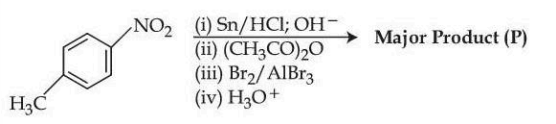
When the product (P) is subjected to Carius analysis using $\text{AgNO}_3$, $1.0\text{ g}$ of the product (P) will produce __________ g of the precipitate of AgBr. (Nearest Integer)
(Given : molar mass in $\text{g mol}^{-1}$ C : 12, H : 1, O : 16, N : 14, Br : 80, Ag : 108)


