
Which of the following is/are present both in DNA and RNA?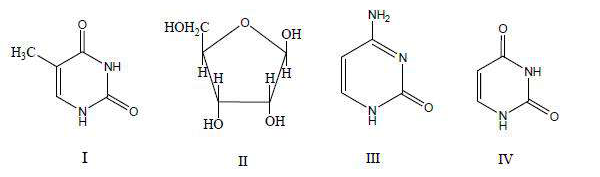
III only
DNA contains the sugar 2-deoxyribose and the bases A, G, C and T; RNA contains ribose and the bases A, G, C and U.
I is 5-methyluracil, i.e. thymine – found only in DNA.
II is ribose (it carries an \(\mathrm{-OH}\) on C-2) – the sugar of RNA only; DNA has 2-deoxyribose.
III is cytosine (4-amino pyrimidin-2-one) – present in both DNA and RNA.
IV is uracil – found only in RNA.
So only III is common to both nucleic acids.
Hence, III only.
Similar Questions
Identify the compounds which can react with chloroform and alcoholic KOH and give substances with offensive odour, from the following
I. N, N - Dimethyl aniline
II. 2, 4 - Dimethyl aniline
III. N - Methyl - o - methyl aniline
IV. p - Methyl benzyl amine
The correct answer is
Which of the following has lowest \(pK_a\) value?
Identify the major product ‘P’ in the following sequence of reactions

What is the end product Z in the given reaction sequence?
\(\text{Phenol}\xrightarrow[\text{(ii) }\mathrm{Cl_2/FeCl_3},\,\Delta]{\text{(i) }\mathrm{Zn}/\Delta}X\xrightarrow[\text{Anh. }\mathrm{AlCl_3}]{\mathrm{CH_3COCl}}Y\xrightarrow[\text{Glycol},\,\Delta]{\mathrm{N_2H_4/OH^-}}Z\)
Identify the chiral molecules from the following
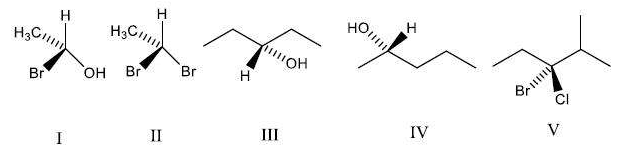
The correct answer is
The correct order of reactivity of the products A, B, C and D towards \(\mathrm{S_N1}\) reaction is
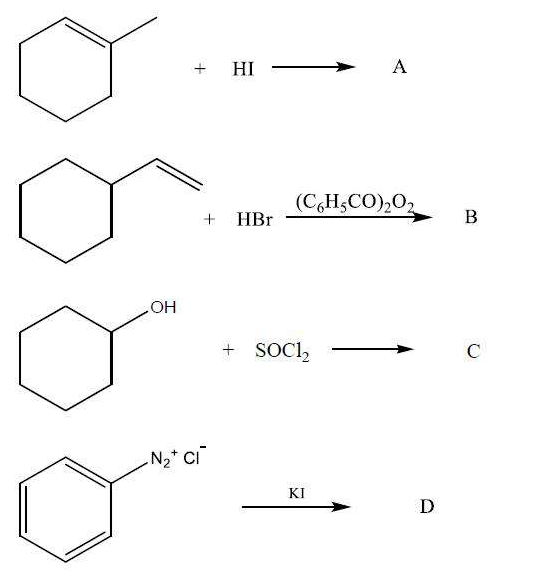
Which of the following is not an example of antibiotic?
Observe the two polymerization reactions I and II given below
I. \(\mathrm{A+B\rightarrow X}\) (polymer)
II. \(\mathrm{C+D\rightarrow Y}\)(polymer)
In reaction I, monomer (A) reacts with NaOH and in reaction II monomer (C) reacts with \(\mathrm{NaHCO_3}\). What are X and Y respectively?
A and B are two position isomers of an alkene \(\mathrm{C_5H_{10}}\). Both A and B do not exhibit cis-trans isomerism. Addition of HBr with A forms X (major product) and B adds HBr to form Y (major product). What are X and Y respectively?
What are X and Y in the following reaction sequence?
\(\text{Ethanal}\ \xleftarrow[\mathrm{(ii)\ Zn\,+\,H_2O}]{\mathrm{(i)\ O_3}}\ \mathrm{C_4H_8}\ \xrightarrow[\mathrm{(ii)\ X}]{\mathrm{(i)\ Br_2/CCl_4}}\ \mathrm{Y}\)
Important Questions from Organic Chemistry
- In Dumas method for estimation of nitrogen, 0.50 g of an organic compound gave 70 mL of nitrogen collected at 300 K and 715 mm pressure. The percentage of nitrogen in the organic compound is ______ %.
(Aqueous tension at 300 K is 15 mm). - $0.25 \text{ g}$ of an organic compound "A" containing carbon, hydrogen and oxygen was analysed using the combustion method. There was an increase in mass of $\text{CaCl}_2$ tube and potash tube at the end of the experiment. The amount was found to be $0.15 \text{ g}$ and $0.1837 \text{ g}$, respectively. The percentage of oxygen in compound A is ______ %. (Nearest integer)
(Given: molar mass in $\text{g mol}^{-1}$ $\text{H} : 1, \text{C} : 12, \text{O} : 16$) - Grignard reagent $\text{RMgBr (P)}$ reacts with water and forms a gas $\text{(Q)}$. One gram of Q occupies $1.4 \text{ dm}^3$ at STP. (P) on reaction with dry ice in dry ether followed by $\text{H}_3\text{O}^+$ forms a compound $\text{(Z)}$. 0.1 mole of $\text{(Z)}$ will weigh _________ g. (Nearest integer)
- Consider all the structural isomers with molecular formula $\text{C}_5\text{H}_{11}\text{Br}$ are separately treated with $\text{KOH(aq)}$ to give respective substitution products, without any rearrangement. The number of products which can exhibit optical isomerism from these is ___________.
Consider the following reactions sequence
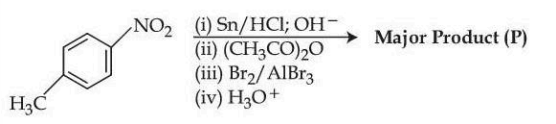
When the product (P) is subjected to Carius analysis using $\text{AgNO}_3$, $1.0\text{ g}$ of the product (P) will produce __________ g of the precipitate of AgBr. (Nearest Integer)
(Given : molar mass in $\text{g mol}^{-1}$ C : 12, H : 1, O : 16, N : 14, Br : 80, Ag : 108)


