
How many dots lie opposite to the face having five dots, when the given figure is folded to form a cube?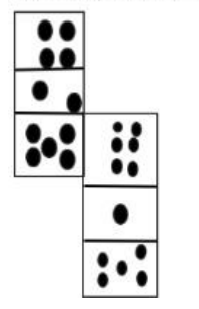
To solve the problem of determining which face is opposite the one with five dots when the given figure is folded into a cube, we need to examine the arrangement of the faces:
In the given net of a cube:
- The face with four dots is adjacent to the face with five dots.
- The face with three dots is also adjacent to the face with five dots.
- By observation, opposite faces in a cube layout are not adjacent.
From the above analysis, since adjacent faces cannot be opposite faces and only the face with four dots is not touching the face with five dots, the face with four dots lies opposite the face with five dots.
Thus, the number of dots opposite the face with five dots is 4.
Similar Questions
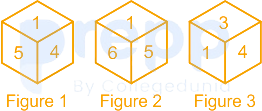
1, 2, 3, 4, 5 and 6 are written on different faces of a dice. Three different positions of the same dice are shown below. Find the number on the face opposite to the one showing ‘5’.
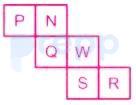
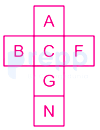
In the figure, what will come opposite to face containing ‘N’?
From the options, select the cube that can be formed by folding the given sheet.
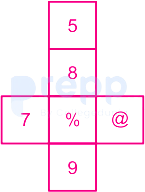
Choose the box that is similar to the box formed from the given sheet of paper.
Select the cube that can be formed by folding the given sheet.
From the given options, which answer figure can be formed by folding the figure given in the question?

Two position of a cube are shown below. What will come opposite to face containing ‘*’?

From the given options, which answer figure can be formed by folding the figure given in the question?

In the figure, what will come opposite to face containing ‘A’?
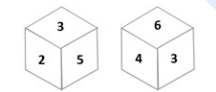
Two different positions of the same die are shown below. What is the number on the face opposite to the one having 1?
Important Questions from Cube and Dice
A cube of side 4 cm is painted green on all its faces and then divided into smaller cubes of side 2 cm each. How many small cubes have been obtained?
Two adjacent faces of a solid cube are painted with black colour. The faces opposite to the black faces is painted with blue colour while the remaining faces are painted with yellow colour. After painting, this cube has been divided into 125 equal cubes. How many cubes have no faces painted?
A cube, whose two adjacent faces are coloured, is cut into 64 identical small cubes. How many of these small cubes are not coloured at all?
Two different positions of the same dice are shown, the six faces of which are marked with the letters A to F. Select the letter that will be on the face opposite to the one having A.

A Cube is coloured blue on all the faces. It is then cut into 64 smaller cubes. These cubes are now separated. The number of smaller cubes with no surface coloured is:



