Given below are two statements: one is labelled as Assertion A and the other is labelled as Reason R
Statement I: Change in internal energy of a system containing $n$ mole of ideal gas can be written as $\Delta U = n C_v (T_f - T_i) = \frac{nR}{\gamma - 1}(T_f - T_i)$, where $\gamma = \frac{C_p}{C_v}$, $T_i = \text{initial temperature}$, $T_f = \text{final temperature}$.
Statement II: Relation between degree of freedom $f$ and $\gamma (= C_p / C_v)$ is $\left(\gamma = 1 + \frac{2}{f}\right)$
Choose the correct answer from the options given below
Analyzing Statement I: Internal Energy Change Formula
Statement I concerns the change in internal energy ($\Delta U$) for an ideal gas:
- The formula $\Delta U = nC_v(T_f - T_i)$ is correct, relating internal energy change to moles ($n$), specific heat at constant volume ($C_v$), and temperature change ($\Delta T = T_f - T_i$).
- Using Mayer's relation ($C_p - C_v = R$) and the definition of $\gamma = C_p/C_v$, we can express $C_v$ as $C_v = R/(\gamma - 1)$.
- Substituting this into the $\Delta U$ formula gives $\Delta U = n \frac{R}{\gamma - 1}(T_f - T_i)$.
Both expressions for $\Delta U$ are valid for an ideal gas. Therefore, Statement I is true.
Analyzing Statement II: Relation Between Gamma and Degrees of Freedom
Statement II provides a formula relating the adiabatic index ($\gamma$) to the degrees of freedom ($f$): $\gamma = 1 + \frac{2}{f}$.
- For an ideal gas, the specific heat at constant volume is given by $C_v = \frac{f}{2}R$.
- Using $C_p = C_v + R$, we find $C_p = (\frac{f}{2} + 1)R = \frac{f+2}{2}R$.
- Calculating $\gamma$: $\gamma = \frac{C_p}{C_v} = \frac{(f+2)/2 \cdot R}{f/2 \cdot R} = \frac{f+2}{f} = 1 + \frac{2}{f}$.
This formula is a standard result derived from the kinetic theory of gases. Therefore, Statement II is true.
Determining if Reason Correctly Explains Assertion
We need to check if Statement II (Reason R) correctly explains Statement I (Assertion A).
- Statement I provides a formula for $\Delta U$ based on $n, C_v, T$ or $n, R, \gamma, T$.
- Statement II provides a formula relating $\gamma$ to the molecular property of degrees of freedom ($f$).
- While both statements are true and involve $\gamma$, Statement II does not explain the derivation or validity of the internal energy formula in Statement I. The formula in Statement I arises from the First Law of Thermodynamics, while the formula in Statement II relates to the molecular structure of the gas.
Consequently, both statements are true, but Statement II is not the correct explanation for Statement I.
Final Answer Selection
The correct option is the one stating that both A and R are true, but R is not the correct explanation of A.
Correct option: Both A and R are true but R is NOT the correct explanation of A.
Similar Questions
- Consider two boxes containing ideal gases A and B such that their temperatures, pressures and number densities are same. The molecular size of A is half of that of B and mass of molecule A is four times that of B. If the collision frequency in gas B is $32 \times 10^{18}$ /s then collision frequency in gas A is _________ /s.
- An insulated cylinder of volume $60 \text{ cm}^3$ is filled with a gas at $27^\circ\text{C}$ and 2 atmospheric pressure. Then the gas is compressed making the final volume as $20 \text{ cm}^3$ while allowing the temperature to rise to $77^\circ\text{C}$. The final pressure is _________ atmospheric pressure.
- A brass wire of length 2 m and radius 1 mm at $27^\circ\text{C}$ is held taut between two rigid supports. Initially it was cooled to a temperature of $-43^\circ\text{C}$ creating a tension $T$ in the wire. The temperature to which the wire has to be cooled in order to increase the tension in it to $1.4T$, is ______ $^\circ\text{C}$.
- A gas of certain mass filled in a closed cylinder at a pressure of 3.23 kPa has temperature $50^\circ\text{C}$. The gas is now heated to double its temperature. The modified pressure is ______ Pa.
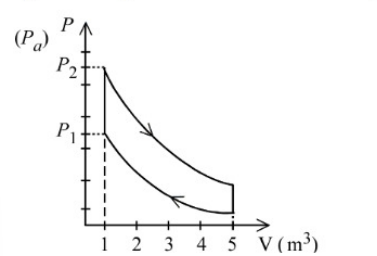
10 mole of an ideal gas is undergoing the process shown in the figure. The heat involved in the process from $P_1$ to $P_2$ is $\alpha \text{ Joule}$ ($P_1 = 21.7 \text{ Pa}$ and $P_2 = 30 \text{ Pa}, C_v = 21 \text{ J/K.mol}, R = 8.3 \text{ J/mol.K}$). The value of $\alpha$ is _______.
- When $300 \text{ J}$ of heat given to an ideal gas with $C_p = \frac{7}{2} R$ its temperature raises from $20^\circ\text{C}$ to $50^\circ\text{C}$ keeping its volume constant. The mass of the gas is (approximately) _______ g. ($R = 8.314 \text{ J/mol.K}$)
- The mean free path of a molecule of diameter $5 \times 10^{-10}\text{ m}$ at the temperature $41^{\circ}\text{C}$ and pressure $1.38 \times 10^{5}\text{ Pa}$, is given as _________ $\text{m}$. (Given $k_{\text{B}} = 1.38 \times 10^{-23}\text{ J/K}$).
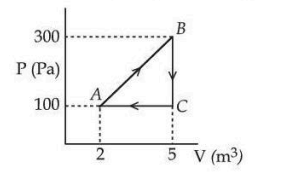
A thermodynamic system is taken through the cyclic process ABC as shown in the figure. The total work done by the system during the cycle $ABC$ is _________ $\text{J}$.
- A certain gas is isothermally compressed to $\left(\frac{1}{3}\right)^{\text{rd}}$ of its initial volume ($V_o = 3$ litre) by applying required pressure. If the bulk modulus of the gas is $3 \times 10^5 \text{ N/m}^2$, the magnitude of work done on the gas is _________ J.
- Consider the following statements:
A. Zeroth law of thermodynamics gives concept of temperature
B. First law of thermodynamics gives concept of internal energy
C. In isothermal expansion of ideal gas, $\Delta Q \neq \Delta W$
D. Product of intensive and extensive variables is extensive
E. The ratio of any extensive variable to mass will be an extensive variable
Choose the correct combination of statements from the options given below:
Important Questions from Heat and Thermodynamics
- Consider two boxes containing ideal gases A and B such that their temperatures, pressures and number densities are same. The molecular size of A is half of that of B and mass of molecule A is four times that of B. If the collision frequency in gas B is $32 \times 10^{18}$ /s then collision frequency in gas A is _________ /s.
- An insulated cylinder of volume $60 \text{ cm}^3$ is filled with a gas at $27^\circ\text{C}$ and 2 atmospheric pressure. Then the gas is compressed making the final volume as $20 \text{ cm}^3$ while allowing the temperature to rise to $77^\circ\text{C}$. The final pressure is _________ atmospheric pressure.
- A brass wire of length 2 m and radius 1 mm at $27^\circ\text{C}$ is held taut between two rigid supports. Initially it was cooled to a temperature of $-43^\circ\text{C}$ creating a tension $T$ in the wire. The temperature to which the wire has to be cooled in order to increase the tension in it to $1.4T$, is ______ $^\circ\text{C}$.
- A gas of certain mass filled in a closed cylinder at a pressure of 3.23 kPa has temperature $50^\circ\text{C}$. The gas is now heated to double its temperature. The modified pressure is ______ Pa.
10 mole of an ideal gas is undergoing the process shown in the figure. The heat involved in the process from $P_1$ to $P_2$ is $\alpha \text{ Joule}$ ($P_1 = 21.7 \text{ Pa}$ and $P_2 = 30 \text{ Pa}, C_v = 21 \text{ J/K.mol}, R = 8.3 \text{ J/mol.K}$). The value of $\alpha$ is _______.