
11, 13, 17, 19
Finding the Number Set That Doesn't Belong
This problem requires us to identify the set of numbers that is different from the others. We need to look for a common characteristic shared by most sets and find the one set that does not possess this characteristic. The key here is to analyze the properties of the numbers within each group.
Understanding Prime and Composite Numbers
The core concept needed to solve this problem is the difference between prime and composite numbers:
- Prime Number: A natural number greater than 1 that has only two divisors: 1 and itself. For example, 2, 3, 5, 7, 11 are all prime numbers. Mathematically, a number '$p$' is prime if it's greater than 1 and its only factors are 1 and '$p$'.
- Composite Number: A natural number greater than 1 that has more than two divisors. In other words, a composite number is any natural number greater than 1 that is not prime. For example, 4 (factors: 1, 2, 4), 6 (factors: 1, 2, 3, 6), and 9 (factors: 1, 3, 9) are composite. Mathematically, a number '$c$' is composite if it has factors other than 1 and '$c$'.
Analyzing Each Option
Let's examine the numbers in each provided option to determine if they are prime or composite:
Option 1: {11, 13, 17, 19}
- 11 is a prime number.
- 13 is a prime number.
- 17 is a prime number.
- 19 is a prime number.
This set consists entirely of prime numbers.
Option 2: {37, 41, 43, 47}
- 37 is a prime number.
- 41 is a prime number.
- 43 is a prime number.
- 47 is a prime number.
This set also consists entirely of prime numbers.
Option 3: {23, 29, 31, 33}
- 23 is a prime number.
- 29 is a prime number.
- 31 is a prime number.
- 33 is a composite number, as it is divisible by 3 and 11 ( $33 = 3 \times 11$ ).
This set contains three prime numbers and one composite number.
Option 4: {2, 3, 5, 7}
- 2 is a prime number (the only even prime).
- 3 is a prime number.
- 5 is a prime number.
- 7 is a prime number.
This set consists entirely of prime numbers.
Determining the Set That Doesn't Belong
By comparing the sets, we can see the pattern:
- Sets in Option 1, Option 2, and Option 4 are all composed exclusively of prime numbers.
- The set in Option 3 is the only one that includes a composite number (33).
The number set that doesn't belong is the one that deviates from the common characteristic of the other sets.
Conclusion
The set that doesn't belong is {23, 29, 31, 33}. This is because options 1, 2, and 4 exclusively contain prime numbers, while option 3 contains the composite number 33.
Similar Questions
- Four of the following five are alike in a certain way and hence form a group. Which is the one that does not belong to that group?
A. BRIGHT: DSJHF
B. CUSTOM: FVUUP
C. FLIGHT: HNIJI
D. CHANCE: EKBMF
E. STRONG: VUQPR - A coding rule is followed by Roll numbers ending with an even digit belong to Batch 1 and Roll numbers ending with an odd digit
belong to Batch 2.
Identify the roll number for Batch 1 and Batch 2. - Choose the number that is different from the others.
Which figure breaks the pattern?

- Guitar, Piano, Violin, Microphone - which is the odd one?
Which one of the following figures breaks the pattern followed by the others?
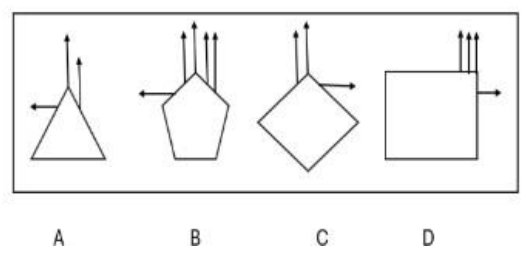
Choose the figure that is different from the rest in terms of the observed sequence or rule.
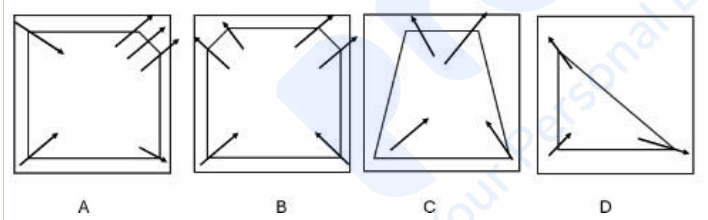
- Identify the odd pair:
- Apple, Banana, Carrot, Mango - which is the odd one?
Choose the figure which is different from the rest?
Important Questions from Classification
Three of the following four are alike in a certain way and thus form a group. Which is the one that does NOT belong to that group?
(Note: The odd one out is not based on the number of consonants/vowels or their position in the letter cluster.)Three of the following numbers are alike in a certain way and one is different. Pick the odd one out.
(NOTE: Operations should be performed on the whole numbers, without breaking down the numbers into their constituent digits. E.g. 13 – Operations on 13 such as adding/deleting/multiplying etc. to 13 can be performed. Breaking down 13 into 1 and 3 and then performing mathematical operations on 1 and 3 is not allowed.)
The following contains two pairs of words which are related to each other in a certain way. Three of the following four word-pairs are alike as these have the same relationship and thus form a group. Which word-pair does NOT belong to that group?
(The words must be considered as meaningful English words and must not be grouped based on the number of letters/number of consonants/vowels in the word)Three of the following four options are alike in a certain way and thus form a group. Which is the one that does NOT belong to that group?
(NOTE: Operations should be performed on the whole numbers, without breaking down the numbers into their constituent digits. E.g., 13 – Operations on 13 such as adding/subtracting/multiplying etc. to 13 can be performed. Breaking down 13 into 1 and 3 and then performing mathematical operations on 1 and 3 is not allowed.)
The following contains two pairs of words which are related to each other in a certain way. Three of the following four word-pairs are alike as these have the same relationship and thus form a group. Which word-pair does NOT belong to that group?
(The words must be considered as meaningful English words and must not be grouped based on the number of letters/number of consonants/vowels in the word)



