Choose the figure which is different from the rest?
Analysing the Figures to Find the Odd One Out
The question asks us to identify the figure that is different from the others among the four options provided. Each option shows a square divided into four equal quadrants by a horizontal and a vertical line. We need to find a characteristic that three of the figures share, which the fourth one lacks.
Step 1: Examine the Characteristics of Each Figure
Let's carefully observe the features of each figure:
- Figure 1: The top-left (TL) and bottom-right (BR) quadrants are shaded. A diagonal line runs from the top-left corner to the bottom-right corner.
- Figure 2: The top-right (TR) and bottom-left (BL) quadrants are shaded. A diagonal line runs from the top-right corner to the bottom-left corner.
- Figure 3: The top-left (TL) and bottom-right (BR) quadrants are shaded. There is no diagonal line present.
- Figure 4: The top-right (TR) and bottom-left (BL) quadrants are shaded. There is no diagonal line present.
Step 2: Identify Patterns and Common Features
We can observe two main types of features:
- Shading Pattern: Two diagonally opposite quadrants are shaded in all figures. There are two patterns: TL/BR shaded (Figures 1 & 3) or TR/BL shaded (Figures 2 & 4).
- Diagonal Line: Figures 1 and 2 contain a diagonal line, while Figures 3 and 4 do not.
Step 3: Determine the Differentiating Logic
We are looking for a single figure that is different. Let's consider the combination of features. Often, in such problems, three figures satisfy a specific condition or set of conditions, while one does not.
Let's test a rule that combines the presence of a diagonal line and a specific shading pattern. Consider the rule: "The figure has a diagonal line OR it has the Top-Right/Bottom-Left shading pattern."
Let's apply this rule to each figure:
- Figure 1: It has a diagonal line (TL-BR). The rule is satisfied.
- Figure 2: It has a diagonal line (TR-BL). The rule is satisfied.
- Figure 3: It does NOT have a diagonal line. It also does NOT have the TR/BL shading pattern (it has TL/BR shading instead). Since both conditions are false, the combined rule (False OR False) is False. This figure does not satisfy the rule.
- Figure 4: It does NOT have a diagonal line, BUT it has the TR/BL shading pattern. The rule (False OR True) is True. The rule is satisfied.
Based on this logic, Figures 1, 2, and 4 satisfy the condition, while Figure 3 does not.
Conclusion
Figure 3 is the only figure that lacks a diagonal line AND does not have the Top-Right/Bottom-Left shading pattern. Therefore, Figure 3 is the one that is different from the rest.
Similar Questions
- Apple, Banana, Carrot, Mango - which is the odd one?
Among the given figures, identify the one that does not belong to the group based on the pattern.
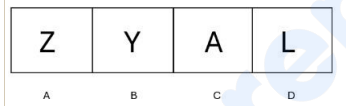
Three of the following four are alike in a certain way and thus form a group. Which is the one that does NOT belong to that group?
Three of the following four letter-clusters are alike in a certain way and one is different. Pick the odd one out.
(NOTE: The odd one out is not based on the number of vowels or consonants in the word)
Three of the following four letter-clusters are alike in a certain way and one is different. Pick the odd one out.
(NOTE: The odd one out is not based on the number of vowels or consonants in the word)
Three of the following four letter-clusters are alike in a certain way and one is different. Pick the odd one out.
(NOTE: The odd one out is not based on the number of vowels or consonants in the word)
- Four of the following five are alike in a certain way and hence form a group. Which is the one that does not belong to that group?
A. FHJL
B. KMOQ
C. PRTV
D. ACED
E. WYAC - Find the number that doesn't belong:
- Find the different term:
Three of the following four are alike in a certain way and thus form a group. Which is the one that does NOT belong to that group?
(NOTE: The odd one out is not based on the number of vowels or consonants in the word)
Important Questions from Classification
Directions for the following 3 (three) items : consider the given information and answer the three items that follow.
A, B, C, D, E, F and G are Lecturers from different cities—Hyderabad, Delhi, Shillong, Kanpur, Chennai, Mumbai and Srinagar (not necessarily in the same order) who participated in a conference. Each one of them is specialized in a different subject, viz., Economics, Commerce, History, Sociology, Geography, Mathematics and Statistics (not necessarily in the same order).
Further 1. Lecturer from Kanpur is specialized in Geography
2. Lecturer D is from Shillong
3. Lecturer C from Delhi is specialized in Sociology
4. Lecturer B is specialized in neither History nor Mathematics
5. Lecturer A who is specialized in Economics does not belong to Hyderabad
6. Lecturer F who is specialized in Commerce belongs to Srinagar
7. Lecturer G who is specialized in Statistics belongs to Chennai
Who is specialized in Geography?
A, B, C, D, E, F and G are Lecturers from different cities—Hyderabad, Delhi, Shillong, Kanpur, Chennai, Mumbai and Srinagar (not necessarily in the same order) who participated in a conference. Each one of them is specialized in a different subject, viz., Economics, Commerce, History, Sociology, Geography, Mathematics and Statistics (not necessarily in the same order).
Further 1. Lecturer from Kanpur is specialized in Geography
2. Lecturer D is from Shillong
3. Lecturer C from Delhi is specialized in Sociology
4. Lecturer B is specialized in neither History nor Mathematics
5. Lecturer A who is specialized in Economics does not belong to Hyderabad
6. Lecturer F who is specialized in Commerce belongs to Srinagar
7. Lecturer G who is specialized in Statistics belongs to Chennai
To which city does the Lecturer specialized in Economics belong?
A, B, C, D, E, F and G are Lecturers from different cities—Hyderabad, Delhi, Shillong, Kanpur, Chennai, Mumbai and Srinagar (not necessarily in the same order) who participated in a conference. Each one of them is specialized in a different subject, viz., Economics, Commerce, History, Sociology, Geography, Mathematics and Statistics (not necessarily in the same order).
Further 1. Lecturer from Kanpur is specialized in Geography
2. Lecturer D is from Shillong
3. Lecturer C from Delhi is specialized in Sociology
4. Lecturer B is specialized in neither History nor Mathematics
5. Lecturer A who is specialized in Economics does not belong to Hyderabad
6. Lecturer F who is specialized in Commerce belongs to Srinagar
7. Lecturer G who is specialized in Statistics belongs to Chennai
Who of the following belongs to Hyderabad?
In a school, there are five teachers A, B, C, D and E. A and B teach Hindi and English. C and B teach English and Geography. D and A teach Mathematics and Hindi. E and B teach History and French. Who teaches maximum numb, of subjects?
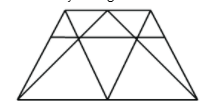
How many triangles are there in the given figure?