
Three of the following four letter-clusters are alike in a certain way and one is different. Pick the odd one out. (NOTE: The odd one out is not based on the number of vowels or consonants in the word)
The correct answer is NOPQ.
In the letter clusters GHDV, LMIQ, and STPJ, the alphabetical difference between consecutive letters is constant. Let's analyze:
- GHDV: G (+2) H (+3) D (+3) V
- LMIQ: L (+2) M (+3) I (+3) Q
- STPJ: S (+2) T (+3) P (+3) J
However, in NOPQ, the alphabetical difference between consecutive letters is not consistent. The sequence is:
- NOPQ: N (+1) O (+1) P (+1) Q
Therefore, NOPQ is the odd one out because it does not follow the pattern of a consistent difference of +2 and +3 between consecutive letters as seen in the other three letter clusters. This consistent pattern is the defining characteristic that links GHDV, LMIQ, and STPJ. The solution hinges on identifying and applying this rule to distinguish the outlier. Understanding this underlying pattern is crucial for solving similar analogy-based reasoning questions effectively. The unique pattern of the correct option establishes its deviation from the other three options, highlighting the principle of recognizing consistent relations in solving such word problems. This method emphasizes analytical thinking rather than relying on superficial observations like vowel or consonant counts, as explicitly prohibited in the question's instructions.
Similar Questions
Three of the following four letter-clusters are alike in a certain way and one is different. Pick the odd one out.
(NOTE: The odd one out is not based on the number of vowels or consonants in the word)
Three of the following four letter-clusters are alike in a certain way and one is different. Pick the odd one out.
(NOTE: The odd one out is not based on the number of vowels or consonants in the word)
Three of the following four are alike in a certain way and thus form a group. Which is the one that does NOT belong to that group?
(NOTE: The odd one out is not based on the number of vowels or consonants in the word)
Three of the following four letter-clusters are alike in a certain way and one is different.Pick the odd one out.
(NOTE: The odd one out is not based on the number of vowels or consonants in the word)
- Find the odd one out:
- Guitar, Piano, Violin, Microphone - which is the odd one?
Which one of the following figures breaks the pattern followed by the others?
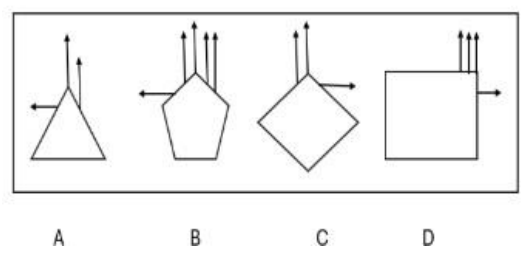
- Find the odd one out:
- Which figure breaks the 3D classification rule?
- Four of the following five are alike in a certain way and hence form a group. Which is the one that does not belong to that group?
1. SMILE: T NKLI
2. BRING: CSHMH
3. FLOUR: GMNVQ
4. HOUSE: IPVTF
5. TRUTH: USVUI
Important Questions from Classification
- Based on the English alphabetical order, three of the following four letter-cluster pairs are alike in a certain way and thus form a group. Which letter-cluster pair DOES NOT belong to that group?
(Note: The odd one out is not based on the number of consonants/vowels or their position in the letter-cluster pair.) - Based on the English alphabetical order, three of the following four letter-cluster pairs are alike in a certain way and thus form a group. Which letter-cluster pair DOES NOT belong to that group?
(Note: The odd one out is not based on the number of consonants/vowels or their position in the letter-cluster.) - Based on the English alphabetical order, three of the following four letter-cluster pairs are alike in a certain way and thus form a group. Which letter-cluster pair DOES NOT belong to that group?
(Note: The odd one out is not based on the number of consonants/vowels or their position in the letter-cluster.) Based on the English alphabetical order, three of the following four letter-clusters are alike in a certain way and thus form a group. Which letter-cluster DOES NOT belong to that group?
(Note: The odd one out is not based on the number of consonants/vowels or their position in the letter-cluster.)Based on the English alphabetical order, three of the following four letter-cluster pairs are alike in a certain way and thus form a group. Which letter-cluster pair DOES NOT belong to that group?
(Note: The odd one out is not based on the number of consonants/vowels or their position in the letter-cluster.)



