\(\bigcirc\)
Understanding 3D Classification Rules and Geometric Shapes
The question asks to identify which figure breaks a "3D classification rule". While the rule isn't explicitly stated, in the context of geometry and classifying shapes, particularly those related to three-dimensional (3D) objects, we often consider properties like faces, edges, and vertices. Many 3D shapes, especially polyhedra, are constructed from flat faces that are polygons. Polygons are 2D shapes characterized by straight sides and vertices (corners). Figures that deviate from this polygonal nature are often considered distinct within classification systems related to polyhedral structures.
Analyzing the Geometric Figures
Let's examine the properties of the figures provided in the options, focusing on those typically used in 3D classifications:
- Triangle (\(\bigtriangleup\)): This figure represents a triangle. A triangle is a fundamental polygon with three straight sides and three vertices. Triangles are crucial components in constructing many 3D objects, serving as the faces of shapes like pyramids and prisms.
- Square (□): This figure represents a square. A square is also a polygon, defined by four equal straight sides and four vertices, each forming a right angle. Squares are common faces for 3D shapes such as cubes.
- Circle (\(\bigcirc\)): This figure represents a circle. A circle is defined as the set of all points in a plane that are at a fixed distance (the radius) from a central point. It is characterized by a continuous curve and lacks straight sides or vertices in the way polygons do. While circles are related to 3D objects (like spheres, cylinders, and cones), they are not polygons themselves.
- Symbol '⬠': This Unicode character (U+2B14) typically represents a square with rounded corners. While it has some characteristics of a square (a closed four-sided figure), the rounded corners introduce curvature, making it different from a standard polygon with sharp vertices. However, its classification is less standard compared to the other figures.
Comparison of Figures
To clarify the differences, here's a comparison based on properties relevant to 3D polyhedral classification:
| Figure Symbol | Geometric Name | Type of Boundary | Presence of Vertices | Relevance to Polyhedra |
|---|---|---|---|---|
\(\bigtriangleup \) |
Triangle | Straight Sides | Yes (3) | Forms faces of polyhedra. |
| □ | Square | Straight Sides | Yes (4) | Forms faces of polyhedra. |
| \(\bigcirc\) | Circle | Continuous Curve | No | Not a face of a polyhedron; related to curved 3D shapes. |
Identifying the Figure That Breaks the Rule
Based on the analysis, the most likely "3D classification rule" being referred to involves the classification of shapes that can form the faces of polyhedra. Polyhedra are defined by their polygonal faces.
- The triangle and the square are polygons. They possess straight sides and vertices, which are essential attributes for constructing the surfaces of polyhedra.
- The circle, however, is defined by a curve and lacks straight sides and vertices. Therefore, it does not fit the classification of shapes that typically form the faces of polyhedra.
Consequently, the circle (\(\bigcirc\)) is the figure that breaks the classification rule associated with the polygonal components of 3D polyhedral structures.
Similar Questions
Three of the following four are alike in a certain way and thus form a group. Which is the one that does NOT belong to that group?
Three of the following four letter-clusters are alike in a certain way and one is different. Pick the odd one out.
(NOTE: The odd one out is not based on the number of vowels or consonants in the word)
Three of the following four letter-clusters are alike in a certain way and one is different. Pick the odd one out.
(NOTE: The odd one out is not based on the number of vowels or consonants in the word)
Three of the following four letter-clusters are alike in a certain way and one is different. Pick the odd one out.
(NOTE: The odd one out is not based on the number of vowels or consonants in the word)
Three of the following four are alike in a certain way and thus form a group. Which is the one that does NOT belong to that group?
(NOTE: The odd one out is not based on the number of vowels or consonants in the word)
Three of the following four letter-clusters are alike in a certain way and one is different.Pick the odd one out.
(NOTE: The odd one out is not based on the number of vowels or consonants in the word)
- Find the odd one out:
- Guitar, Piano, Violin, Microphone - which is the odd one?
Which one of the following figures breaks the pattern followed by the others?
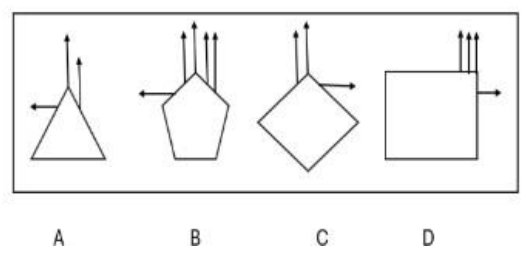
- Find the odd one out:
Important Questions from Classification
Directions for the following 3 (three) items : consider the given information and answer the three items that follow.
A, B, C, D, E, F and G are Lecturers from different cities—Hyderabad, Delhi, Shillong, Kanpur, Chennai, Mumbai and Srinagar (not necessarily in the same order) who participated in a conference. Each one of them is specialized in a different subject, viz., Economics, Commerce, History, Sociology, Geography, Mathematics and Statistics (not necessarily in the same order).
Further 1. Lecturer from Kanpur is specialized in Geography
2. Lecturer D is from Shillong
3. Lecturer C from Delhi is specialized in Sociology
4. Lecturer B is specialized in neither History nor Mathematics
5. Lecturer A who is specialized in Economics does not belong to Hyderabad
6. Lecturer F who is specialized in Commerce belongs to Srinagar
7. Lecturer G who is specialized in Statistics belongs to Chennai
Who is specialized in Geography?
A, B, C, D, E, F and G are Lecturers from different cities—Hyderabad, Delhi, Shillong, Kanpur, Chennai, Mumbai and Srinagar (not necessarily in the same order) who participated in a conference. Each one of them is specialized in a different subject, viz., Economics, Commerce, History, Sociology, Geography, Mathematics and Statistics (not necessarily in the same order).
Further 1. Lecturer from Kanpur is specialized in Geography
2. Lecturer D is from Shillong
3. Lecturer C from Delhi is specialized in Sociology
4. Lecturer B is specialized in neither History nor Mathematics
5. Lecturer A who is specialized in Economics does not belong to Hyderabad
6. Lecturer F who is specialized in Commerce belongs to Srinagar
7. Lecturer G who is specialized in Statistics belongs to Chennai
To which city does the Lecturer specialized in Economics belong?
A, B, C, D, E, F and G are Lecturers from different cities—Hyderabad, Delhi, Shillong, Kanpur, Chennai, Mumbai and Srinagar (not necessarily in the same order) who participated in a conference. Each one of them is specialized in a different subject, viz., Economics, Commerce, History, Sociology, Geography, Mathematics and Statistics (not necessarily in the same order).
Further 1. Lecturer from Kanpur is specialized in Geography
2. Lecturer D is from Shillong
3. Lecturer C from Delhi is specialized in Sociology
4. Lecturer B is specialized in neither History nor Mathematics
5. Lecturer A who is specialized in Economics does not belong to Hyderabad
6. Lecturer F who is specialized in Commerce belongs to Srinagar
7. Lecturer G who is specialized in Statistics belongs to Chennai
Who of the following belongs to Hyderabad?
In a school, there are five teachers A, B, C, D and E. A and B teach Hindi and English. C and B teach English and Geography. D and A teach Mathematics and Hindi. E and B teach History and French. Who teaches maximum numb, of subjects?
How many triangles are there in the given figure?