1. SMILE: T NKLI
2. BRING: CSHMH
3. FLOUR: GMNVQ
4. HOUSE: IPVTF
5. TRUTH: USVUI
Logical Reasoning: Analyzing Alphabet Coding Patterns
This question asks us to identify which word pair among the five options does not follow the same logical pattern as the others. We need to find a common characteristic shared by four pairs and identify the one pair that deviates from this characteristic. The typical method involves analyzing the shift in alphabetical positions between the letters of the original word and its coded counterpart.
Alphabetical Shifts Analysis: SMILE
First, let's determine the alphabetical shifts for the word SMILE and its corresponding code T NKLI. We calculate the difference in position for each letter in the alphabet (A=1, B=2, ..., Z=26).
| Original Letter | Alphabet Position | Coded Letter | Coded Position | Shift Value |
|---|---|---|---|---|
| S | 19 | T | 20 | \(+1\) |
| M | 13 | N | 14 | \(+1\) |
| I | 9 | K | 11 | \(+2\) |
| L | 12 | L | 12 | \(0\) |
| E | 5 | I | 9 | \(+4\) |
The shifts observed are \(+1\), \(+1\), \(+2\), \(0\), and \(+4\). The set of distinct shift values used here is {\(+1\), \(+2\), \(0\), \(+4\)}. This involves four unique shift values.
Letter Pattern Breakdown: BRING
Next, we analyze the shifts for the word BRING and its code CSHMH.
| Original Letter | Alphabet Position | Coded Letter | Coded Position | Shift Value |
|---|---|---|---|---|
| B | 2 | C | 3 | \(+1\) |
| R | 18 | S | 19 | \(+1\) |
| I | 9 | H | 8 | \(-1\) |
| N | 14 | M | 13 | \(-1\) |
| G | 7 | H | 8 | \(+1\) |
The shifts observed are \(+1\), \(+1\), \(-1\), \(-1\), and \(+1\). The set of distinct shift values used here is {\(+1\), \(-1\)}. This involves two unique shift values.
Coding Logic Comparison: FLOUR
Now, let's examine the shifts for the word FLOUR and its code GMNVQ.
| Original Letter | Alphabet Position | Coded Letter | Coded Position | Shift Value |
|---|---|---|---|---|
| F | 6 | G | 7 | \(+1\) |
| L | 12 | M | 13 | \(+1\) |
| O | 15 | N | 14 | \(-1\) |
| U | 21 | V | 22 | \(+1\) |
| R | 18 | Q | 17 | \(-1\) |
The shifts observed are \(+1\), \(+1\), \(-1\), \(+1\), and \(-1\). The set of distinct shift values used here is {\(+1\), \(-1\)}. This involves two unique shift values.
Identifying Pattern Group: HOUSE
Let's analyze the shifts for the word HOUSE and its code IPVTF.
| Original Letter | Alphabet Position | Coded Letter | Coded Position | Shift Value |
|---|---|---|---|---|
| H | 8 | I | 9 | \(+1\) |
| O | 15 | P | 16 | \(+1\) |
| U | 21 | V | 22 | \(+1\) |
| S | 19 | T | 20 | \(+1\) |
| E | 5 | F | 6 | \(+1\) |
The shifts observed are \(+1\), \(+1\), \(+1\), \(+1\), and \(+1\). The set of distinct shift values used here is {\(+1\)}. This involves only one unique shift value.
Commonality Check: TRUTH
Finally, we analyze the shifts for the word TRUTH and its code USVUI.
| Original Letter | Alphabet Position | Coded Letter | Coded Position | Shift Value |
|---|---|---|---|---|
| T | 20 | U | 21 | \(+1\) |
| R | 18 | S | 19 | \(+1\) |
| U | 21 | V | 22 | \(+1\) |
| T | 20 | U | 21 | \(+1\) |
| H | 8 | I | 9 | \(+1\) |
The shifts observed are \(+1\), \(+1\), \(+1\), \(+1\), and \(+1\). The set of distinct shift values used here is {\(+1\)}. This involves only one unique shift value.
Determining the Outlier Word
Let's summarize the number of distinct shift values identified for each word pair:
- SMILE: 4 distinct values ({\(+1\), \(+2\), \(0\), \(+4\)})
- BRING: 2 distinct values ({\(+1\), \(-1\)})
- FLOUR: 2 distinct values ({\(+1\), \(-1\)})
- HOUSE: 1 distinct value ({\(+1\)})
- TRUTH: 1 distinct value ({\(+1\)})
We observe that the pairs BRING, FLOUR, HOUSE, and TRUTH all utilize a limited set of shift values (either one or two distinct values). This consistency forms the basis of the group.
The pair SMILE, however, uses four distinct shift values. This significantly differs from the pattern observed in the other four pairs, making it the one that does not belong to the group.
Conclusion: Outlier Identification
Therefore, based on the analysis of the number of unique shift values applied in the coding process, SMILE: T NKLI is the pair that does not fit the pattern established by the other four.
Similar Questions
- Apple, Banana, Carrot, Mango - which is the odd one?
Choose the figure which is different from the rest?
Among the given figures, identify the one that does not belong to the group based on the pattern.
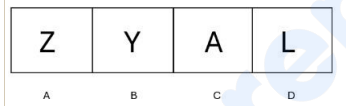
Three of the following four are alike in a certain way and thus form a group. Which is the one that does NOT belong to that group?
Three of the following four letter-clusters are alike in a certain way and one is different. Pick the odd one out.
(NOTE: The odd one out is not based on the number of vowels or consonants in the word)
Three of the following four letter-clusters are alike in a certain way and one is different. Pick the odd one out.
(NOTE: The odd one out is not based on the number of vowels or consonants in the word)
Three of the following four letter-clusters are alike in a certain way and one is different. Pick the odd one out.
(NOTE: The odd one out is not based on the number of vowels or consonants in the word)
- Four of the following five are alike in a certain way and hence form a group. Which is the one that does not belong to that group?
A. FHJL
B. KMOQ
C. PRTV
D. ACED
E. WYAC - Which one is different from the others?
- Find the number that doesn't belong:
Important Questions from Classification
Directions for the following 3 (three) items : consider the given information and answer the three items that follow.
A, B, C, D, E, F and G are Lecturers from different cities—Hyderabad, Delhi, Shillong, Kanpur, Chennai, Mumbai and Srinagar (not necessarily in the same order) who participated in a conference. Each one of them is specialized in a different subject, viz., Economics, Commerce, History, Sociology, Geography, Mathematics and Statistics (not necessarily in the same order).
Further 1. Lecturer from Kanpur is specialized in Geography
2. Lecturer D is from Shillong
3. Lecturer C from Delhi is specialized in Sociology
4. Lecturer B is specialized in neither History nor Mathematics
5. Lecturer A who is specialized in Economics does not belong to Hyderabad
6. Lecturer F who is specialized in Commerce belongs to Srinagar
7. Lecturer G who is specialized in Statistics belongs to Chennai
Who is specialized in Geography?
A, B, C, D, E, F and G are Lecturers from different cities—Hyderabad, Delhi, Shillong, Kanpur, Chennai, Mumbai and Srinagar (not necessarily in the same order) who participated in a conference. Each one of them is specialized in a different subject, viz., Economics, Commerce, History, Sociology, Geography, Mathematics and Statistics (not necessarily in the same order).
Further 1. Lecturer from Kanpur is specialized in Geography
2. Lecturer D is from Shillong
3. Lecturer C from Delhi is specialized in Sociology
4. Lecturer B is specialized in neither History nor Mathematics
5. Lecturer A who is specialized in Economics does not belong to Hyderabad
6. Lecturer F who is specialized in Commerce belongs to Srinagar
7. Lecturer G who is specialized in Statistics belongs to Chennai
To which city does the Lecturer specialized in Economics belong?
A, B, C, D, E, F and G are Lecturers from different cities—Hyderabad, Delhi, Shillong, Kanpur, Chennai, Mumbai and Srinagar (not necessarily in the same order) who participated in a conference. Each one of them is specialized in a different subject, viz., Economics, Commerce, History, Sociology, Geography, Mathematics and Statistics (not necessarily in the same order).
Further 1. Lecturer from Kanpur is specialized in Geography
2. Lecturer D is from Shillong
3. Lecturer C from Delhi is specialized in Sociology
4. Lecturer B is specialized in neither History nor Mathematics
5. Lecturer A who is specialized in Economics does not belong to Hyderabad
6. Lecturer F who is specialized in Commerce belongs to Srinagar
7. Lecturer G who is specialized in Statistics belongs to Chennai
Who of the following belongs to Hyderabad?
In a school, there are five teachers A, B, C, D and E. A and B teach Hindi and English. C and B teach English and Geography. D and A teach Mathematics and Hindi. E and B teach History and French. Who teaches maximum numb, of subjects?
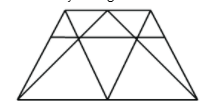
How many triangles are there in the given figure?