
Series Analysis: Identifying the Pattern
To find the next term in the series $5C$, $6D$, $10F$, $19I$, we need to analyze the pattern for both the numbers and the letters separately.
Number Pattern Progression
Let's examine the sequence of numbers: 5, 6, 10, 19.
- The difference between the first two numbers is $6 - 5 = 1$.
- The difference between the second and third numbers is $10 - 6 = 4$.
- The difference between the third and fourth numbers is $19 - 10 = 9$.
Observe the differences: 1, 4, 9. These are the squares of consecutive integers: $1^2, 2^2, 3^2$.
Following this pattern, the next difference should be the square of the next integer, which is $4^2 = 16$.
Therefore, the next number in the series is $19 + 16 = 35$.
Letter Pattern Progression
Now let's look at the sequence of letters: C, D, F, I.
We can determine the pattern by looking at the position of each letter in the English alphabet:
- C is the 3rd letter.
- D is the 4th letter.
- F is the 6th letter.
- I is the 9th letter.
Let's find the difference in positions between consecutive letters:
- From C to D: $4 - 3 = 1$ position.
- From D to F: $6 - 4 = 2$ positions.
- From F to I: $9 - 6 = 3$ positions.
The pattern of differences in alphabetical positions is 1, 2, 3.
Following this pattern, the next difference should be 4 positions.
The position of the current letter (I) is 9. So, the position of the next letter is $9 + 4 = 13$.
The 13th letter of the English alphabet is M.
Combining Number and Letter
We found the next number to be 35 and the next letter to be M.
Combining these, the next term in the series is 35M.
Similar Questions
Which figure should replace the question mark (?) if the following series were to be continued?
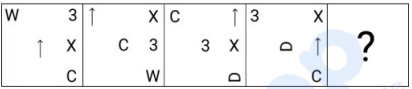
Which figure should replace the question mark (?) if the following series were to be continued?
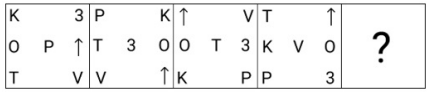
If x means ÷, ÷ means -, - means +, and + means x, what will be the value of the given expression?
7 + 5 ÷ 3 − 12 × 4- How many meaningful English words can be formed with the letters 'EGMA' using each letter exactly only once in each word?
- A man walks 12 km north, then turns right and walks 8 km, then again turns right and walks 12 km.
How far is he from the starting point? - Complete the series: \(3, \ 6, \ 12, \ 24, \ ?, \ 96\)
- Find the missing number in the series:\(2, \ 4, \ 8, \ 16, \ ?, \ 64\)
What will be the next figure?
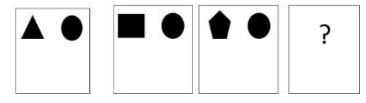
- Choose the next figure.
\(\square \ \square \ \square \ \square \ \square \ ?\) Which of the following figures will complete the figural series given below?
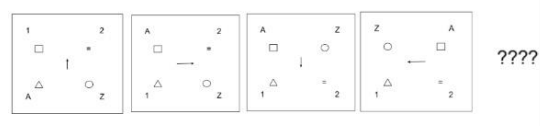
Important Questions from Series
Choose the option which completes the given figure series.

Select the correct option that will fill in the blank and complete the series.
18, 36, 108, 432, 2160, .............Select the correct option that will fill in the blank and complete the series.
52, 56, 65, 81, 106, ?Select the correct option that will fill in the blank and complete the series. 21, 43, 85, 171, 341, .......
Select the correct option that will fill in the blank and complete the series.
3, 5, 7, 9, 11, ?
2, 2, 2, 2, 2, ?



