
correctly fills the blanks in the given sequence. \(A, \ O, \ D, \ 8, \ G, \ \_\_, \ J, \ 42, \ M, \ \_\_, \ P, \ 100, \ S, \ 138, \ V, \ 182\)
Number Pattern Analysis
The given sequence combines letters and numbers: $A, \ O, \ D, \ 8, \ G, \ \_\_, \ J, \ 42, \ M, \ \_\_, \ P, \ 100, \ S, \ 138, \ V, \ 182$
First, let's isolate the number sequence and identify its pattern. The numbers appear at specific positions:
- Position 4: 8
- Position 6: (First Blank)
- Position 8: 42
- Position 10: (Second Blank)
- Position 12: 100
- Position 14: 138
- Position 16: 182
Let's denote the number sequence as $N_k$, where $k$ is the index within this number sequence (1st number, 2nd number, etc.). So, we have: $N_1 = 8$ $N_2 = ?$ $N_3 = 42$ $N_4 = ?$ $N_5 = 100$ $N_6 = 138$ $N_7 = 182$
To find the pattern, we calculate the differences between consecutive known terms:
- Difference between $N_3$ and $N_1$: $42 - 8 = 34$
- Difference between $N_5$ and $N_3$: $100 - 42 = 58$
- Difference between $N_6$ and $N_5$: $138 - 100 = 38$
- Difference between $N_7$ and $N_6$: $182 - 138 = 44$
The differences are not constant. Let's examine the second differences (differences between the differences):
- $58 - 34 = 24$
- $38 - 58 = -20$
- $44 - 38 = 6$
Since the second differences are not constant with the current known numbers, let's assume a consistent pattern. If the second difference is constant, it indicates a quadratic sequence ($N_k = Ak^2 + Bk + C$). Let's calculate the first differences involving the blanks:
- $d_1 = N_2 - 8$
- $d_2 = 42 - N_2$
- $d_3 = N_4 - 42$
- $d_4 = 100 - N_4$
- $d_5 = 38$
- $d_6 = 44$
Now, let's calculate the second differences:
- $SD_1 = d_2 - d_1 = (42 - N_2) - (N_2 - 8) = 50 - 2N_2$
- $SD_2 = d_3 - d_2 = (N_4 - 42) - (42 - N_2) = N_4 + N_2 - 84$
- $SD_3 = d_4 - d_3 = (100 - N_4) - (N_4 - 42) = 142 - 2N_4$
- $SD_4 = d_5 - d_4 = 38 - (100 - N_4) = N_4 - 62$
- $SD_5 = d_6 - d_5 = 44 - 38 = 6$
Assuming the second difference is constant and equal to 6 (based on $SD_5$), we can solve for $N_2$ and $N_4$.
- Set $SD_4 = 6$: $N_4 - 62 = 6 \implies N_4 = 68$.
- Set $SD_1 = 6$: $50 - 2N_2 = 6 \implies 2N_2 = 44 \implies N_2 = 22$.
We can verify these values using the other second differences:
- Check $SD_3$: $142 - 2N_4 = 142 - 2(68) = 142 - 136 = 6$.
- Check $SD_2$: $N_4 + N_2 - 84 = 68 + 22 - 84 = 90 - 84 = 6$.
The calculations confirm that the missing numbers are 22 and 68. The complete number sequence is $8, 22, 42, 68, 100, 138, 182$.
The formula for the $k$-th term of this number sequence is $N_k = 3k^2 + 5k$. Let's verify the blanks:
- For the first blank (which is $N_2$): $N_2 = 3(2)^2 + 5(2) = 3(4) + 10 = 12 + 10 = 22$.
- For the second blank (which is $N_4$): $N_4 = 3(4)^2 + 5(4) = 3(16) + 20 = 48 + 20 = 68$.
Letter Pattern Analysis
The sequence also includes letters: $A, O, D, G, J, M, P, S, V$. Let's examine their positions in the alphabet:
- A = 1
- O = 15
- D = 4
- G = 7
- J = 10
- M = 13
- P = 16
- S = 19
- V = 22
Calculating the difference in alphabetical positions between consecutive letters:
- $15 - 1 = 14$ (A to O)
- $4 - 15 = -11$ (O to D)
- $7 - 4 = 3$ (D to G)
- $10 - 7 = 3$ (G to J)
- $13 - 10 = 3$ (J to M)
- $16 - 13 = 3$ (M to P)
- $19 - 16 = 3$ (P to S)
- $22 - 19 = 3$ (S to V)
A pattern emerges where the alphabetical position increases by 3, starting from 'D'. The letters forming this arithmetic progression are D, G, J, M, P, S, V.
The problem statement mentions patterns for both letters and numbers. The numbers ($N_k$) are associated with a specific subsequence of letters ($l_k$, starting from D). The alphabetical position $P_k$ of the $k$-th letter in this subsequence (D, G, J, ...) follows $P_k = 3k + 1$. The number sequence formula $N_k = 3k^2 + 5k$ can be expressed in terms of $P_k$ as $N_k = \frac{P_k^2 + 3P_k - 4}{3}$, linking the letter and number patterns.
The blanks in the sequence are filled by the numbers 22 and 68.
Similar Questions
- Find the next term in the given letter series:
YZYWYZYZ, YZYZWYZY, YZYZYWYZ, YZYZYZWY, YZYZYZWW, ? - Complete the following series: M, O, R, V, ?
- A man walks 12 km north, then turns right and walks 8 km, then again turns right and walks 12 km.
How far is he from the starting point? Identify the figure that best fits in place of the question mark.
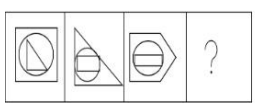
Which of the following figures will complete the figural series given below?
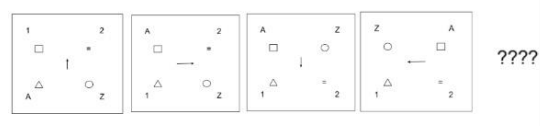
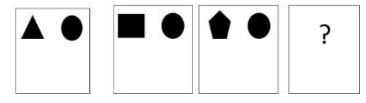
What will be the next figure?
Important Questions from Series
In the following question, select the missing number from the given series.
5, 10, 17, 26, 37, ?, 65
In the following question, select the missing number from the given series.
5, 10, 17, 26, 37, ?, 65
- What should come in place of the question mark (?) in the given series?
5 4 2 -2 -10 ? - What should come in place of the question mark (?) in the given series?
31 11 20 30 41 ? - What should come in place of the question mark (?) in the given series?
31 20 7 -8 -25 ?



