Select the correct option that will fill in the blank and complete the series. 21, 43, 85, 171, 341, .......
683
Pattern Identification in Number Series
The question requires finding the next number in the sequence: 21, 43, 85, 171, 341, ... To solve this, we need to identify the pattern governing the series.
Step-by-Step Series Solution
Step 1: Analyze Term Relationships
Let's examine the relationship between consecutive terms:
- $43 = 21 \times 2 + 1$
- $85 = 43 \times 2 - 1$
- $171 = 85 \times 2 + 1$
- $341 = 171 \times 2 - 1$
The pattern observed is to multiply the current term by 2 and then alternately add 1 and subtract 1.
The general formula can be represented as:
$Term_{n+1} = (Term_n \times 2) + (-1)^{n+1}$
Where $n$ represents the position of the term starting from $n=1$ for the operation applied to get the second term.
Step 2: Calculate the Next Term
Following the identified pattern, the next operation involves multiplying the last term (341) by 2 and adding 1 (since the last operation was subtraction):
- Next Term $= (341 \times 2) + 1$
- Next Term $= 682 + 1$
- Next Term $= 683$
Conclusion: Next Term Calculation
The next term in the series 21, 43, 85, 171, 341 is 683.
Similar Questions
Choose the option which completes the given figure series.

Select the correct option that will fill in the blank and complete the series.
18, 36, 108, 432, 2160, .............Select the correct option that will fill in the blank and complete the series.
52, 56, 65, 81, 106, ?Select the correct option that will fill in the blank and complete the series.
3, 5, 7, 9, 11, ?
2, 2, 2, 2, 2, ?
Select the correct option that will fill in the blank and complete the series. FKP, GMQ, HOR, ?
Choose the option which comes next in the given figure series.
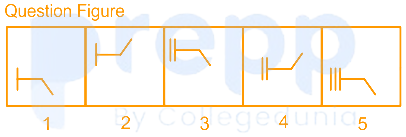
Choose the option which completes the given figure series

Select the option that completes the given figure series.
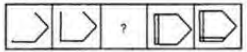
Select the option that completes the given figure series.
Question figure:
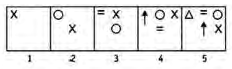
Select the next combination in the following series.
X X0 XX XX0 ?
Important Questions from Series
Choose the option which completes the given figure series.
Select the correct option that will fill in the blank and complete the series.
18, 36, 108, 432, 2160, .............Select the correct option that will fill in the blank and complete the series.
52, 56, 65, 81, 106, ?Select the correct option that will fill in the blank and complete the series.
3, 5, 7, 9, 11, ?
2, 2, 2, 2, 2, ?
Select the correct option that will fill in the blank and complete the series. FKP, GMQ, HOR, ?