
Consider the given statement/s to be true and decide which of the given conclusions/assumptions can definitely be drawn from the given statement. Statement I: All astronomers are scientists.
Statement II: Some scientists are shopkeepers.
Conclusion I: All astronomers are shopkeepers.
Conclusion II: All astronomers are scientists.
Conclusion III: Some shopkeepers are astronomers.
Conclusion IV: All scientists are astronomers.
Only Conclusion III follows
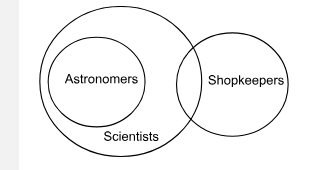
Conclusion I: All astronomers are shopkeepers – From the Venn diagram, it is evident that there is no direct relation between astronomers and shopkeepers. So, no definite relation can be drawn. Therefore, this conclusion does not follow.
Conclusion II: Some shopkeepers are astronomers – From the Venn diagram, it is evident that there is no direct relation between astronomers and shopkeepers. So, no definite relation can be drawn. Therefore, this conclusion does not follow.
Conclusion III: Some shopkeepers are scientists – From the Venn diagram, it is evident that the circles representing shopkeepers and scientists overlap each other and have a part of their areas in common. So, from this, it can be concluded that some shopkeepers are scientists. Therefore, this conclusion follows.
Conclusion IV: All scientists are astronomers – From the Venn diagram, it is evident that some parts of the circle representing scientists lie outside the circle representing astronomers while some lie inside. So, from this, it can be concluded that some scientists are astronomers. Therefore, this conclusion does not follow.
Therefore, only conclusion III follows. Hence, the third option is correct.
Similar Questions
Read the given statements and conclusions carefully. Assuming that the information given in the statements is true, even if it appears to be at variance with commonly known facts, decide which of the given conclusions logically follow(s) from the statements.
Statements:
Some cards are postcards.
Some cards are envelopes.
All envelopes are copies.
Conclusions:
I. Some copies are envelopes.
II. Some postcards are copies.
III. Some cards are copies.
In the following question below are given some statements followed by some conclusions based on those statements. Taking the given statements to be true even if they seem to be at variance from commonly known facts. Read all the conclusions and then decide which of the given conclusion logically follows the given statements.
Statements:
I. Some Z are X.
II. Some W are Z.
Conclusions:
I. Some X are not W.
II. Some X are not Z.
Three Statements are given followed by Three conclusions numbered I, II and III. Assuming the statements to be true, even if they seem to be at variance with commonly known facts, decide which of the conclusions logically follow(s) from the statements.
Statements:
Some mobiles are flat.
All flats are TVs.
Some TVs are plastic.
Conclusions:
I. Some mobiles are TVs.
II. Some flats are plastic.
III. All plastic are TVs.
Three statements are given, followed by three conclusions numbered I, II and III.Assuming the statements to be true, even if they seem to be at variance with commonly known facts, decide which of the conclusions logically follow(s) from the statements.
Statements:
No cup is a plate.
All cups are utensils.
Some bottles are cups.
Conclusions:
I. Some utensils are not plates.
II. Some bottles are not plates.
III. No bottle is a plate.
Consider the given statement(s) to be true and decide which of the given conclusions/assumptions can definitely be drawn from the given statement.
Statement 1: All elephants are men.
Statement 2: All men are socks.
Conclusion I: Some socks are elephants.
Conclusion II: All elephants are socks.In the question, a word is represented by only one set of numbers as given in any one of the alternatives. The sets of numbers given in the question are represented by two classes of alphabets in two matrices given below. The columns and rows of Matrix 1 are numbered from 0 to 4 and that of Matrix II are numbered from 5 to 9. A letter from these matrices can be represented first by its row and next by its column, e.g., 'A' can be represented by 04, 12, etc., and 'U' can be represented by 59, 66, etc. Similarly, you have to identify the set for the word 'ROOT'.
MATRIX I
0 1 2 3 4 0 B C D E A 1 D E A B C 2 C D E A B 3 A B C D E 4 E A B C D MATRIX II
5 6 7 8 9 5 R O N T U 6 T U R O N 7 O N T U R 8 U R O N T 9 N T U R O Consider the given statement/s to be true and decide which of the given conclusions/assumptions can definitely be drawn from the given statement.
Statements: 1. All fish are tortoise.
2. No tortoise is a crocodile.
Conclusion: 1. No crocodile is a fish.
II. No fish is a crocodile.
Consider the given statements to be true and decide which of the given conclusions/assumptions can definitely be drawn from the given statement.
Statements: 1. All books are novels.
2. Some novels are poems.
Conclusions: I. Some books are poems.
II. Some poems are novels.Consider the statement to be true and decide which of the conclusions logically follow:
Statement:
All dogs are animals.
All animals are living beings.
Conclusion
I:Dog is not an animal.
II. Dog is an animal.In the question, a word is represented by only one set of numbers as given in any one of the alternatives. The sets of numbers given in the matrices are represented by two classes of alphabets as in two matrices given below. The columns and rows of Matrix I are numbered from 0 to 4 and that of Matrix II are numbered from 5 to 9. A letter from these matrices can be represented first by its row and next by its column, e.g., 'A' can be represented by 01, 13, etc., and 'S' can be represented by 55, 66, etc. Similarly, you have to identify the set for the word 'BOTH'.
MATRIX I
0 1 2 3 4 0 F A N O I 1 I O F A N 2 A N O I F 3 O F I N A 4 N I A F O MATRIX II
5 6 7 8 9 5 S E H B T 6 H S E T B 7 B T S E H 8 E H T B S 9 T S E H B
Important Questions from Syllogism
The statements below are followed by conclusions labeled I, II and III. Assuming that the information in the statements is true, even if it appears to be at variance with generally established facts, decide which conclusion(s) logically and definitely follow(s) from the information given in the statements.
Statements:
All twenty are thirty.
All thirty are forty.
All forty are sixty.
All sixty are seventy.
Conclusions:
I. Some forty are thirty.
II. Some seventy are sixty.
III. No thirty is twenty.The statements below are followed by two conclusions labelled I and II. Assuming that the information in the statements is true, even if it appears to be at variance with generally established facts, decide which conclusion(s) logically and definitely follow(s) from the information given in the statements.
Statements:
All Strong are animals.
Some animals are Tigers.
All Tigers are Sharp.
Conclusions:
I. Some Strong are Sharp.
II. No Strong is Sharp.The statements below are followed by conclusions labelled I, II and III. Assuming that the information in the statements is true, even if it appears to be at variance with generally established facts, decide which conclusion(s) logically and definitely follow(s) from the information given in the statements.Statements:
Some women are weak.
Some weaks are female.
All female are iron.
All iron are gold.Conclusions:
I. Some weaks are iron.
II. Some gold are weaks.
III. Some women are female.
The statements below are followed by two conclusions labeled I and II. Assuming that the information in the statements is true, even if it appears to be at variance with generally established facts, decide which conclusion(s) logically and definitely follow(s) from the information given in the statements.Statements:
Some teaspoons are glasses.
All teddies are teaspoons.
Conclusions:
I. Some teddies are glasses.
II. Some glasses are teddies.
The statements below are followed by two conclusions labeled I and II. Assuming that the information in the statements is true, even if it appears to be at variance with generally Established facts, decide which conclusion(s) logically and definitely follow(s) from the Information, Given in the Statements.
Statements:
All bangles are rings.
Some rings are toys.
Some toys are dolls.
Conclusions:
I. Some rings are bangles.
II. Some dolls are rings.



