
Consider the following ICs : 1. LM 78 05 The correct sequence of the output noise voltage (at 25 °C and for an operating frequency range of 10 Hz ≤ f ≤ 100 KHz) in decreasing order is given by
2. LM 78 15
3. LM 78 12
2, 3, 1
The last two digits of a 78xx part number give its output voltage, and the output noise scales with that voltage, so the decreasing order is 15 V, 12 V, 5 V — that is 2, 3, 1, option 2.
| Device | Output | Typical output noise, 10 Hz – 100 kHz |
|---|---|---|
| LM7815 | 15 V | ≈ 90 µV |
| LM7812 | 12 V | ≈ 75 µV |
| LM7805 | 5 V | ≈ 40 µV |
Why noise tracks the output voltage. All three parts share one die and one internal architecture: a bandgap reference of about 1.25 V, an error amplifier, and a series pass transistor. The reference generates a fixed noise voltage, and the error amplifier scales the reference up to the wanted output through a resistive divider. That same gain is applied to the reference noise:
\(V_{n,out}=V_{n,ref}\times\dfrac{V_{out}}{V_{ref}}\)
A 15 V part uses three times the gain of a 5 V part, so it delivers roughly three times the noise. The measured figures follow this ratio closely, confirming that the reference dominates.
How to read the part number — the point the question is really testing: in 78xx, "78" marks a positive fixed regulator (79 marks a negative one) and xx is the output in volts. So 7805, 7812 and 7815 give +5 V, +12 V and +15 V. The question deliberately lists them out of order to see whether the convention is known.
The specification's fine print matters too. Noise is quoted over a stated band, here 10 Hz to 100 kHz, because the wideband thermal contribution grows with bandwidth as \(\sqrt{\Delta f}\), and the low-frequency end is set by \(1/f\) flicker noise. Quoting 25 °C fixes the thermal noise, which rises as \(\sqrt{T}\).
A practical corollary : where a low-noise supply is needed, one does not simply pick a lower-voltage regulator — the ratio of noise to output is much the same across the family. An RC or LC filter after the regulator, or a low-noise LDO with a bypassed reference pin, is the usual remedy.
Hence, the decreasing order of output noise is 2, 3, 1.
Similar Questions
Assertion (A) : The series pass transistor in a regulator is in class A mode.
Reason (R) : Class A is a switching mode and yields high efficiency.
IC LM 380 is a
Important Questions from Power Amplifiers and 555 Timer and Voltage Regulators
Assertion (A) : The series pass transistor in a regulator is in class A mode.
Reason (R) : Class A is a switching mode and yields high efficiency.
IC LM 380 is a
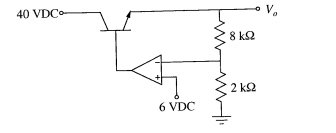
The value of $V_o$ of the series regulator shown below is
In VCO IC 566, the value of charging & discharging is dependent on the voltage applied at ________.
Which among the following are the features of push-pull amplifier?
(i) Noise rejection
(ii) Can give efficiency of more than 50
(iii) Output may have cross over distortion
(iv) Output may have harmonic distortion



