
The value of $V_o$ of the series regulator shown below is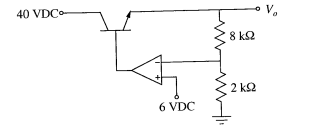
To find the output voltage \( V_o \) of the series regulator circuit, we need to analyze the voltage divider formed by the resistors and the operational amplifier settings.
The key to solving this problem is understanding how the feedback loop controls the output voltage. The operational amplifier (op-amp) is configured to maintain its inverting input at the same voltage as its non-inverting input.
Given that the non-inverting input is connected to a 6 V DC source, the inverting input of the op-amp will also try to maintain 6 V.
Using the voltage divider rule:
\(V_-=V_o\left(\frac{2 \, \text{k}\Omega}{2 \, \text{k}\Omega + 8 \, \text{k}\Omega}\right)\)
The inverting input voltage \( V_- \) can be set equal to the non-inverting input voltage of 6 V:
\(6=\frac{V_o \times 2 \, \text{k}\Omega}{10 \, \text{k}\Omega}\)
Solving for \( V_o \):
\(6=\frac{V_o}{5}\) \(V_o=30 \, \text{V}\)
Therefore, the value of \( V_o \) is 30 V.
Conclusion: The correct answer is 30 V.
Important Questions from Power Amplifiers and 555 Timer and Voltage Regulators
In VCO IC 566, the value of charging & discharging is dependent on the voltage applied at ________.
Which among the following are the features of push-pull amplifier?
(i) Noise rejection
(ii) Can give efficiency of more than 50
(iii) Output may have cross over distortion
(iv) Output may have harmonic distortion
Power amplifiers generally use transformer coupling because transformer permits
In a single tuned capacitance coupled amplifier, the frequency response depends on
If a high degree of selectivity is desired, then double tuned circuit should have


