ABCD is a cyclic quadrilateral in which sides AD and BC are produced to meet at P, and sides DC and AB meet at Q when produced. If ∠A = 60° and ∠ABC = 72°, then ∠DPC –∠BQC = ?
36°
Cyclic Quadrilateral Problem Analysis
The question asks us to find the difference between two specific angles, $\angle DPC$ and $\angle BQC$, formed by producing the sides of a given cyclic quadrilateral ABCD. We are provided with two angles of the quadrilateral: $\angle A = 60^\circ$ and $\angle ABC = 72^\circ$.
Key Properties Used:
- A cyclic quadrilateral is a quadrilateral whose vertices all lie on a single circle.
- A fundamental property of cyclic quadrilaterals is that the sum of opposite angles is $180^\circ$.
- When finding angles in triangles formed by extending sides, we often use the property that angles on a straight line sum to $180^\circ$.
We need to determine the measures of $\angle C$ and $\angle D$ first, and then use the properties of triangles formed by the intersecting lines.
Calculating Unknown Angles of the Quadrilateral
Since ABCD is a cyclic quadrilateral:
- Opposite angles sum to $180^\circ$.
- Therefore, $\angle BCD = \angle C = 180^\circ - \angle A$.
- Substituting the given value of $\angle A$: $$ \angle C = 180^\circ - 60^\circ = 120^\circ $$
- Similarly, $\angle ADC = \angle D = 180^\circ - \angle ABC$.
- Substituting the given value of $\angle ABC$: $$ \angle D = 180^\circ - 72^\circ = 108^\circ $$
So, the angles of the cyclic quadrilateral are $\angle A = 60^\circ$, $\angle ABC = 72^\circ$, $\angle C = 120^\circ$, and $\angle D = 108^\circ$.
Finding the Measure of Angle DPC
Angles $\angle DPC$ is formed at point P, where the extensions of sides AD and BC meet.
Consider the triangle $\triangle PDC$. The sum of angles in a triangle is $180^\circ$. The angles in $\triangle PDC$ are $\angle DPC$, $\angle PDC$, and $\angle PCD$.
- The angle $\angle PDC$ is formed by the line segment PD (extension of AD) and the side DC. Since A, D, P are collinear, $\angle PDC = 180^\circ - \angle ADC$. $$ \angle PDC = 180^\circ - 108^\circ = 72^\circ $$
- The angle $\angle PCD$ is formed by the line segment PC (extension of BC) and the side CD. Since B, C, P are collinear, $\angle PCD = 180^\circ - \angle BCD$. $$ \angle PCD = 180^\circ - 120^\circ = 60^\circ $$
- Now, apply the angle sum property in $\triangle PDC$: $$ \angle DPC + \angle PDC + \angle PCD = 180^\circ $$ $$ \angle DPC + 72^\circ + 60^\circ = 180^\circ $$ $$ \angle DPC + 132^\circ = 180^\circ $$ $$ \angle DPC = 180^\circ - 132^\circ = 48^\circ $$
Finding the Measure of Angle BQC
Angle $\angle BQC$ is formed at point Q, where the extensions of sides DC and AB meet.
Consider the triangle $\triangle QBC$. The sum of angles in this triangle is $180^\circ$. The angles in $\triangle QBC$ are $\angle BQC$, $\angle QBC$, and $\angle BCQ$.
- The angle $\angle QBC$ is formed by the line segment QB (extension of AB) and the side BC. Since A, B, Q are collinear, $\angle QBC = 180^\circ - \angle ABC$. $$ \angle QBC = 180^\circ - 72^\circ = 108^\circ $$
- The angle $\angle BCQ$ is formed by the line segment QC (extension of DC) and the side CB. Since D, C, Q are collinear, $\angle BCQ = 180^\circ - \angle BCD$. $$ \angle BCQ = 180^\circ - 120^\circ = 60^\circ $$
- Now, apply the angle sum property in $\triangle QBC$: $$ \angle BQC + \angle QBC + \angle BCQ = 180^\circ $$ $$ \angle BQC + 108^\circ + 60^\circ = 180^\circ $$ $$ \angle BQC + 168^\circ = 180^\circ $$ $$ \angle BQC = 180^\circ - 168^\circ = 12^\circ $$
Final Calculation: The Difference Between Angles
The question asks for the value of $\angle DPC - \angle BQC$.
- Using the calculated values: $$ \angle DPC - \angle BQC = 48^\circ - 12^\circ $$
- $$ \angle DPC - \angle BQC = 36^\circ $$
Therefore, the difference between the angles $\angle DPC$ and $\angle BQC$ is $36^\circ$. This corresponds to Option 2.
Similar Questions
ABCD is an isoceles trapezium such that AD||BC, AB = 5 cm, AD = 8 cm and BC = 14 cm. What is the area (in cm 2) of trapezium?
In a trapezium ABCD, DC ∥ AB, AB = 12 cm and DC = 7.2cm. What is the length of the line segment joining the mid-points of its diagonals?
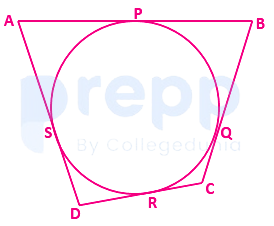
In the given figure, a circle touches quadrilateral ABCD. If AB = 2x + 3, BC = 3x – 1, CD = x + 6 and DA = x + 4, then what is the value of x?
PQRS is a cyclic quadrilateral and PQ is the diameter of the circle. If ∠RPQ = 38°, then what is the value (in degrees) of ∠PSR?
PQRS is a parallelogram and its area is 300 cm 2. Side PQ is extended to X such that PQ = QX. If XS intersects QR at Y, then what is the area (in cm 2) of triangle SYR?
ABCD is a cyclic quadrilateral whose diagonals intersect at P. If AB = BC, ∠DBC = 70° and ∠BAC = 30°, then the measure of ∠PCD is:
ABDC is a parallelogram in which diagonals AD and BC intersect at O. AE and DF are perpendicular on BC at E and F, respectively. Which of the following is not true?
The sides BA and DE of a regular pentagon are produced to meet at F. What is a measure of ∠EFA?
ABCD is a cyclic quadrilateral. Diagonals BD and AC intersect each other at E. If ∠BEC = 128° and ∠ECD = 25°, then what is the measure of ∠BAC?
In E is a point inside the quadrilateral ABCD where DE and CE is the angle bisector of ∠D and ∠C respectively. If ∠B is 82° and ∠DEC is 80°, then find the ∠A.
Important Questions from Quadrilaterals
ABCD is a quadrilateral such that $\angle A = 47^\circ$, $\angle B = 66^\circ$, $\angle C = 133^\circ$ and $\angle D = 114^\circ$. What type of a quadrilateral is ABCD?
- What is the main purpose of cell division in multicellular organisms?
- Which of the following organelles is the first to divide during binary fission in Amoeba?
- The sum of all internal angles of a quadrilateral is:
- If ABCD is a cyclic quadrilateral and ABC is an equilateral triangle find the angle of CDA.