
AB is parallel to CD. A transversal PQ intersects AB and CD at E and F, respectively, and ∠PEB = 69°. G is a point between AB and CD such that ∠BEG = 33° and ∠GFE = 17°. What is the measure of ∠EGF?
85°
Angles on a straight line add to 180 degrees, and the angles of a triangle add to 180 degrees. Use these on the transversal PQ and triangle EGF.
Since P, E, F, Q lie on one straight line, \(\angle BEF = 180^\circ - \angle PEB = 180^\circ - 69^\circ = 111^\circ\). The point G lies between the parallel lines on the side of B, so \(\angle GEF = 111^\circ - 33^\circ = 78^\circ\).
In triangle EGF: \(\angle EGF = 180^\circ - 78^\circ - 17^\circ = 85^\circ\).
Check: \(78^\circ + 17^\circ + 85^\circ = 180^\circ\).
Hence, 85°.
Similar Questions
- In Δ ABC, AB = 10 cm. ∠ A is bisected internally to intersect BC at D. BD = 6 cm and DC = 7.5 cm. What is the length of CA?
How many triangles are present in the below figure?
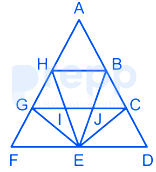
AB and CD are two parallel lines. Another line EF cuts these parallel lines at M and N, respectively. The bisectors of angles BMN and MND meet at the point P. Which of the following statements is true?
Let AB and CD be two parallel lines, with AB above CD. Let EF and GH be two parallel transversals intersecting AB at P and R, respectively, and CD at Q and S, respectively. Assume that E and G lie above AB, while F and H lie below CD. If ∠EPB = 2a°, ∠DSG = b° and ∠FQD = 80°, then find the values for a and b, respectively.
PQ ∥ RS and AB is the transversal that touches PQ at X and RS at Y. If ∠PXA = 120°, then find ∠PXY.
AB is parallel to CD. A transversal PQ intersects AB and CD at E and F, respectively, and ∠PEB = 25°. G is a point between AB and CD such that ∠BEG = 43° and ∠GFE = 10°. What is the measure of ∠EGF?
In angular measurement, one radian is equivalent to ________ degree (approximately).
Important Questions from Lines and Angles
- Two parallel lines L1 and L2 are cut by a transversal. If one of the alternate interior angles is $65^\circ$, what is the measure of the corresponding alternate interior angle?
- The measure of an angle is one half of its supplementary angle. Find its measure.
- The sum of two angles is $155^\circ$ and their difference is $\frac{\pi}{2}$. The value of the greater angle (in radians) is:
- The measure of an angle is three times the measure of its complement. The angles are respectively:
- The supplement of $70^\circ$ is:



