
AB and CD are two parallel lines. Another line EF cuts these parallel lines at M and N, respectively. The bisectors of angles BMN and MND meet at the point P. Which of the following statements is true?
MNP is a right-angled triangle with right angle at P.
When a transversal cuts two parallel lines, the interior angles on the same side of the transversal are supplementary (co-interior angles).
Angles BMN and MND lie between the parallel lines on the same side of EF, so \(\angle BMN + \angle MND = 180^\circ\).
Their bisectors give \(\angle PMN = \tfrac{1}{2}\angle BMN\) and \(\angle PNM = \tfrac{1}{2}\angle MND\), so \(\angle PMN + \angle PNM = \tfrac{1}{2}(180^\circ) = 90^\circ\).
In triangle MNP the angle sum is \(180^\circ\), so \(\angle MPN = 180^\circ - 90^\circ = 90^\circ\). Check: the other two angles of the triangle add to a right angle, so the right angle lies at P only.
Hence, MNP is a right-angled triangle with right angle at P.
Similar Questions
- In Δ ABC, AB = 10 cm. ∠ A is bisected internally to intersect BC at D. BD = 6 cm and DC = 7.5 cm. What is the length of CA?
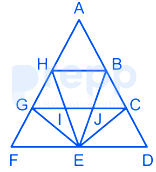
How many triangles are present in the below figure?
Let AB and CD be two parallel lines, with AB above CD. Let EF and GH be two parallel transversals intersecting AB at P and R, respectively, and CD at Q and S, respectively. Assume that E and G lie above AB, while F and H lie below CD. If ∠EPB = 2a°, ∠DSG = b° and ∠FQD = 80°, then find the values for a and b, respectively.
AB is parallel to CD. A transversal PQ intersects AB and CD at E and F, respectively, and ∠PEB = 69°. G is a point between AB and CD such that ∠BEG = 33° and ∠GFE = 17°.
What is the measure of ∠EGF?
PQ ∥ RS and AB is the transversal that touches PQ at X and RS at Y. If ∠PXA = 120°, then find ∠PXY.
AB is parallel to CD. A transversal PQ intersects AB and CD at E and F, respectively, and ∠PEB = 25°. G is a point between AB and CD such that ∠BEG = 43° and ∠GFE = 10°. What is the measure of ∠EGF?
In angular measurement, one radian is equivalent to ________ degree (approximately).
Important Questions from Lines and Angles
- Two parallel lines L1 and L2 are cut by a transversal. If one of the alternate interior angles is $65^\circ$, what is the measure of the corresponding alternate interior angle?
- The measure of an angle is one half of its supplementary angle. Find its measure.
- The sum of two angles is $155^\circ$ and their difference is $\frac{\pi}{2}$. The value of the greater angle (in radians) is:
- The measure of an angle is three times the measure of its complement. The angles are respectively:
- The supplement of $70^\circ$ is:



