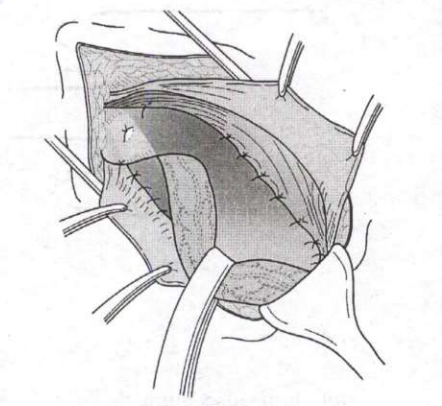
A patient of blunt trauma to the abdomen is being explored in the emergency. Intraoperatively a non-expanding haematoma is seen lifting the descending colon. What is the appropriate management of this patient?
Haematoma not to be explored, nothing to be done to the colon
The correct management is that the haematoma should not be explored and nothing need be done to the colon. The descending colon is a retroperitoneal zone 2 (lateral perirenal) structure. In blunt trauma a non-expanding, non-pulsatile retroperitoneal haematoma is tamponaded by the intact retroperitoneum; opening it releases that tamponade, converting a self-limiting venous bleed into torrential haemorrhage and risking devascularisation of the colon. A haematoma merely lifting the colon is not evidence of full-thickness bowel injury, so resection is unjustified.
Explore, do nothing to the colon and explore and resect both open a contained zone 2 haematoma, indicated only if it is expanding, pulsatile or actively bleeding, or in penetrating trauma. Do not explore but resect the colon is illogical, since resection demands exposure of the mesocolon and retroperitoneum, and there is no demonstrated bowel injury.
Key point: Zone 1 (central) haematomas are always explored; zone 2 (perirenal) and zone 3 (pelvic) only in penetrating trauma or if expanding, pulsatile or ruptured.
Important Questions from Abdominal Injuries
- Diaphragmatic injury is suspected in a 50 year gentleman with history of blunt abdominal trauma, having a normal chest X-ray. He is best managed by:
- Which of the following statements regarding a patient of liver trauma are correct?
1. Liver is the most common organ injured following abdominal trauma.
2. Surgical exploration (laparotomy) is required in haemodynamically unstable patients and patients with free intraperitoneal fluid on FAST.
3. Contrast enhanced CT abdomen should be done in haemodynamically stable patients.
4. Blunt injuries have a higher mortality as compared to penetrating injuries.
Select the correct answer using the code given below. - Mainstay of an accurate diagnosis of pancreatic injury following blunt abdominal trauma is:
- What is the investigation of choice in a patient with blunt abdominal trauma with hematuria?
- A 30-year-old patient developed haematuria following a blunt injury to the abdomen. The patient is haemodynamically stable. However, the ultrasonographic examination reveals a perirenal collection which measures 4 x 4 cm. The patient is best managed by