A cube of side 125 cm is painted red on all the faces and then cut into smaller cubes of sides 25 cm each. Find the number of smaller cubes having at least two faces painted.
44
Understanding the Cube Cutting Problem
This problem involves a larger cube being cut into smaller, equally sized cubes after being painted on all its faces. We need to find the number of these smaller cubes that have at least two faces painted red. 'At least two faces painted' means either exactly two faces painted or exactly three faces painted.
Step 1: Determine the number of divisions along each edge
The large cube has a side length of 125 cm, and the smaller cubes have a side length of 25 cm. To find out how many smaller cubes fit along one edge of the larger cube, we divide the side length of the larger cube by the side length of the smaller cube.
Number of smaller cubes along one edge, denoted by \(n\), is:
\(n = \frac{\text{Side of large cube}}{\text{Side of small cube}}\)
\(n = \frac{125 \text{ cm}}{25 \text{ cm}}\)
\(n = 5\)
So, the large cube is divided into 5 sections along each of its edges.
Step 2: Identify types of smaller cubes based on painted faces
When a cube is cut into smaller cubes, the smaller cubes can be categorized based on how many of their faces were originally on the surface of the large painted cube:
- Cubes with 3 faces painted: These are the corner cubes of the large cube. A cube has 8 corners.
- Cubes with 2 faces painted: These cubes are located along the edges of the large cube, but not at the corners.
- Cubes with 1 face painted: These cubes are located on the faces of the large cube, but not along the edges.
- Cubes with 0 faces painted: These cubes are located entirely inside the large cube.
Step 3: Calculate the number of smaller cubes with exactly three faces painted
Cubes with exactly three faces painted are the corner cubes. A cube always has 8 corners. Since all faces of the large cube were painted, all 8 corner cubes will have exactly three faces painted.
Number of cubes with 3 faces painted = 8
Step 4: Calculate the number of smaller cubes with exactly two faces painted
Cubes with exactly two faces painted are located along the edges, excluding the corner cubes at the ends of each edge. There are 12 edges in a cube.
Along each edge, there are \(n\) small cubes. The two cubes at the ends are corner cubes (3 faces painted). So, the number of cubes with exactly 2 faces painted along one edge is \(n-2\).
Total number of cubes with 2 faces painted = (Number of edges) \(\times\) (\(n-2\))
Total number of cubes with 2 faces painted = \(12 \times (5-2)\)
Total number of cubes with 2 faces painted = \(12 \times 3\)
Total number of cubes with 2 faces painted = 36
Step 5: Calculate the number of smaller cubes with at least two faces painted
The question asks for the number of cubes with at least two faces painted. This includes cubes with exactly two faces painted and cubes with exactly three faces painted.
Number of cubes with at least two faces painted = (Number of cubes with 2 faces painted) + (Number of cubes with 3 faces painted)
Number of cubes with at least two faces painted = 36 + 8
Number of cubes with at least two faces painted = 44
Summary of Smaller Cube Types (for \(n=5\))
| Type of Cube | Number of Faces Painted | Formula | Calculation (for n=5) | Number of Cubes |
|---|---|---|---|---|
| Corner Cubes | 3 | 8 | 8 | 8 |
| Edge Cubes | 2 | \(12(n-2)\) | \(12(5-2) = 12 \times 3\) | 36 |
| Face Cubes | 1 | \(6(n-2)^2\) | \(6(5-2)^2 = 6 \times 3^2 = 6 \times 9\) | 54 |
| Inner Cubes | 0 | \((n-2)^3\) | \((5-2)^3 = 3^3\) | 27 |
Total number of smaller cubes = \(8 + 36 + 54 + 27 = 125\). This matches \(n^3 = 5^3 = 125\), confirming our calculations.
The number of cubes with at least two faces painted is the sum of cubes with 2 faces painted and cubes with 3 faces painted, which is \(36 + 8 = 44\).
Revision Table: Cube Cutting Concepts
| Concept | Description | Formula (where n = side of large cube / side of small cube) |
|---|---|---|
| Total smaller cubes | Total number of small cubes formed. | \(n^3\) |
| Cubes with 3 faces painted | Cubes at the corners of the large cube. | 8 (always for a single large cube) |
| Cubes with 2 faces painted | Cubes along the edges, excluding corners. | \(12(n-2)\) |
| Cubes with 1 face painted | Cubes on the faces, excluding edges and corners. | \(6(n-2)^2\) |
| Cubes with 0 faces painted | Cubes completely inside the large cube. | \((n-2)^3\) |
| Cubes with at least 2 faces painted | Sum of cubes with 2 and 3 faces painted. | \(12(n-2) + 8\) |
| Cubes with at least 1 face painted | Total cubes minus cubes with 0 faces painted. | \(n^3 - (n-2)^3\) or \(8 + 12(n-2) + 6(n-2)^2\) |
Additional Information: Cube Painting and Cutting
Cube cutting problems are common in spatial reasoning and quantitative aptitude tests. The key is to visualize the cube and how cuts affect the smaller cubes formed. Each cut parallel to a face increases the number of sections along that dimension by one. If you make \(x\) cuts parallel to one face, \(y\) cuts parallel to another, and \(z\) cuts parallel to the third, the total number of smaller cubes will be \((x+1)(y+1)(z+1)\). In standard problems like this one, the cuts are made uniformly, resulting in small cubes of equal size, meaning \(x=y=z=n-1\), where \(n\) is the number of smaller cubes along each edge. This results in a total of \((n-1+1)^3 = n^3\) smaller cubes.
The painting on the surface of the large cube determines which smaller cubes will have painted faces. Corner cubes are part of three faces, edge cubes are part of two faces, and face cubes are part of one face of the original large cube. Inner cubes were not part of the original surface.
Similar Questions
Six letters T, P, K, G, R, and U are written on different faces of a dice. Two positions of this dice are shown in the figure. Find the letter on the face opposite to K.

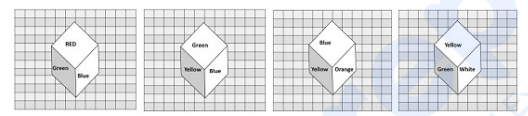
Four positions of a cube are shown below. Which color is opposite to white color in the given cubes?
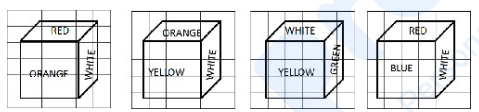
Four positions of a cube are shown in the diagram. Which color is opposite to Green color in the given cubes?
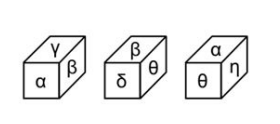
Three positions of a cube are shown below. What will come opposite to face containing 'a'?
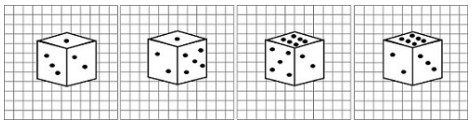
Four different views of a cube/dice are given as viewed from different angles. Find out the number of dots on the face opposite to the face with one dot.
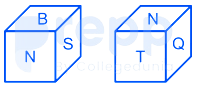
Two positions of a cube are shown below. What will come opposite to face containing ‘B’?
Three different positions of the same dice are shown. Select the symbol that will be on the face opposite to the one showing ‘+’.

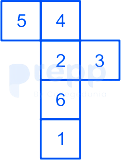
A cube is made by folding the given sheet. In the cube so formed, what would be the number on the opposite side of the number ‘1'?
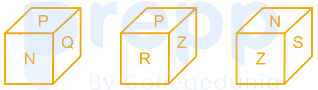
Three positions of a cube are shown below. What will come opposite to face containing ‘N’?
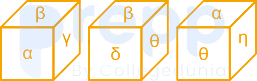
Three positions of a cube are shown below, what will come opposite to face containing ‘α’?
Important Questions from Cube and Dice
A cube of side 4 cm is painted green on all its faces and then divided into smaller cubes of side 2 cm each. How many small cubes have been obtained?
Two adjacent faces of a solid cube are painted with black colour. The faces opposite to the black faces is painted with blue colour while the remaining faces are painted with yellow colour. After painting, this cube has been divided into 125 equal cubes. How many cubes have no faces painted?
A cube, whose two adjacent faces are coloured, is cut into 64 identical small cubes. How many of these small cubes are not coloured at all?
Select the dice that can be formed by folding the given sheet along the lines.
Two different positions of the same dice are shown, the six faces of which are marked with the letters A to F. Select the letter that will be on the face opposite to the one having A.