
Understanding Average Speed Calculation
This problem asks us to find the average speed of a car over a specific journey. The core concept here is average speed, which is defined as the total distance traveled divided by the total time it took to travel that distance.
Defining the Average Speed Formula
The fundamental formula for calculating average speed is:
\(\text{Average Speed} = \frac{\text{Total Distance}}{\text{Total Time}}\)
Analyzing the Car's Journey Details
Let's break down the information given in the question:
- The total distance covered by the car is represented by \(L\).
- The journey is split into two equal parts concerning distance.
- The distance covered in the first part is \(\frac{L}{2}\).
- The speed maintained during this first part is \(v_1\).
- The distance covered in the second part is also \(\frac{L}{2}\).
- The speed maintained during this second part is \(v_2\).
Calculating Time for Each Segment
To find the average speed, we need the total time. We can find the time taken for each part of the journey using the formula:
\(\text{Time} = \frac{\text{Distance}}{\text{Speed}}\)
Let's calculate the time for each half of the journey:
- Time for the first half (\(t_1\)):
The distance is \(\frac{L}{2}\) and the speed is \(v_1\). So, the time taken is:
\(t_1 = \frac{L/2}{v_1} = \frac{L}{2v_1}\)
- Time for the second half (\(t_2\)):
Similarly, the distance is \(\frac{L}{2}\) and the speed is \(v_2\). So, the time taken is:
\(t_2 = \frac{L/2}{v_2} = \frac{L}{2v_2}\)
Determining Total Time and Calculating Average Speed
Next, we find the total time spent traveling by adding the times for both halves:
\(\text{Total Time} = t_1 + t_2\)
\(\text{Total Time} = \frac{L}{2v_1} + \frac{L}{2v_2}\)
To add these fractions, we find a common denominator, which is \(2v_1v_2\):
\(\text{Total Time} = \frac{L \cdot v_2}{2v_1v_2} + \frac{L \cdot v_1}{2v_1v_2}\)
\(\text{Total Time} = \frac{L v_2 + L v_1}{2v_1v_2} = \frac{L(v_1 + v_2)}{2v_1v_2}\)
Now, we can calculate the average speed using the total distance (\(L\)) and the total time we just found:
\(\text{Average Speed} = \frac{\text{Total Distance}}{\text{Total Time}} = \frac{L}{\frac{L(v_1 + v_2)}{2v_1v_2}}\)
To simplify this expression, we multiply the total distance (\(L\)) by the reciprocal of the total time:
\(\text{Average Speed} = L \times \frac{2v_1v_2}{L(v_1 + v_2)}\)
The distance \(L\) cancels out from the numerator and the denominator:
\(\text{Average Speed} = \frac{2v_1v_2}{v_1 + v_2}\)
Final Result for Average Speed
The average speed of the car over the entire distance \(L\), when traveling half the distance at speed \(v_1\) and the other half at speed \(v_2\), is given by the formula \(\frac{2v_1v_2}{v_1 + v_2}\). This result represents the harmonic mean of the two speeds, applicable when the distances traveled are equal.
Important Questions from Speed Time & Distance (Notes)
- Ajay walks at a speed of 4 km/hr. He doubles his speed after reaching exactly half way. He walks for 12 hours in all. What is the total distance travelled by him ?
With a certain set of diameters, a tractor's front wheels make 2 revolutions (revs) for every 1 revolution of the rear wheels. The effect of changing wheel diameter(s) is shown in the following plot.
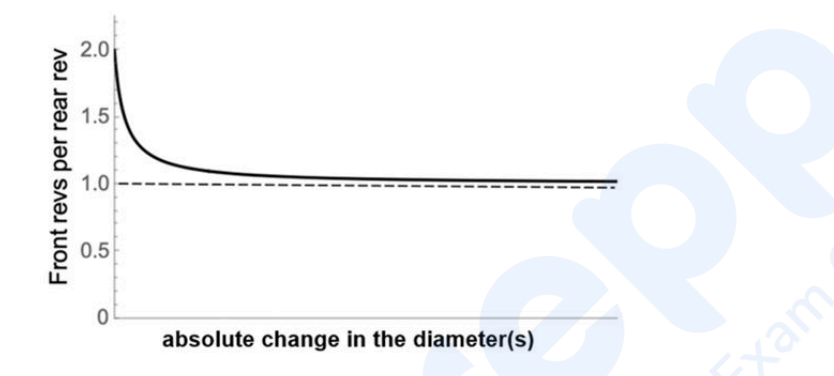
In this context, which of the following statements is CORRECT?- A train travels from Karnal to Kurukshetra at a speed of $90$ km/hr and returns at a speed of $92$ km/hr. If it takes $182$ hours for total travel, then find the distance between Karnal to Kurukshetra. (In Km)
A car covers 4 successive stretches of 3 km each at speed of 10 kmph, 20 kmph, 30 kmph and 60 kmph respectively. The average speed of the car for the entire journey is:
- A cyclist travels at 18 km/hr for 2.5 hours. What distance does he cover?



