
Calculating Distance Covered by a Cyclist
This problem asks us to find the total distance a cyclist travels given their speed and the duration of their travel.
Understanding the Concepts
To solve this, we need the fundamental relationship between distance, speed, and time. The formula is:
Distance = Speed × Time
In mathematical notation, this is represented as:
\( d = v \times t \)
Where:
- \( d \) represents the distance traveled.
- \( v \) represents the speed of the object.
- \( t \) represents the time taken.
Applying the Formula
We are given the following information:
- Speed (\( v \)) = 18 km/hr
- Time (\( t \)) = 2.5 hours
Now, we substitute these values into the formula:
\( d = 18 \text{ km/hr} \times 2.5 \text{ hours} \)
Step-by-Step Calculation
- Identify the given values:
- Speed = 18 km/hr
- Time = 2.5 hours
- Recall the formula: Distance = Speed × Time.
- Substitute the values into the formula:
Distance = \( 18 \times 2.5 \) km
- Perform the multiplication:
\( 18 \times 2.5 = 45 \)
You can calculate this as \( 18 \times \frac{5}{2} \), which simplifies to \( 9 \times 5 \), resulting in 45.
- State the final answer with units: The distance covered is 45 km.
Conclusion
By applying the distance formula using the provided speed and time, the cyclist covers a distance of 45 km.
Important Questions from Speed Time & Distance (Notes)
- Ajay walks at a speed of 4 km/hr. He doubles his speed after reaching exactly half way. He walks for 12 hours in all. What is the total distance travelled by him ?
With a certain set of diameters, a tractor's front wheels make 2 revolutions (revs) for every 1 revolution of the rear wheels. The effect of changing wheel diameter(s) is shown in the following plot.
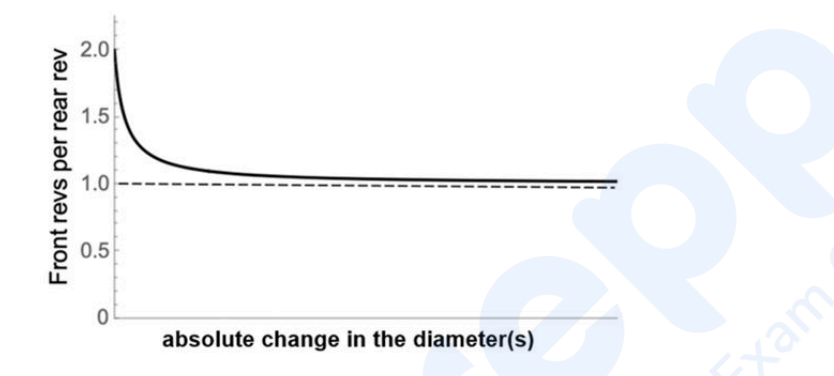
In this context, which of the following statements is CORRECT?- A train travels from Karnal to Kurukshetra at a speed of $90$ km/hr and returns at a speed of $92$ km/hr. If it takes $182$ hours for total travel, then find the distance between Karnal to Kurukshetra. (In Km)
- A car covers a distance from Hayathnagar to LB nagar at the speed of 64 km/hr and covers the distance from LB nagar to Hayathnagar at the speed of 56 km/hr. What is the average speed (rounded off to nearest integer) of the car?
- If Amit walks at a speed of 20 km/hr instead of 15 km/hr, he would have walked 25 km more. The actual distance travelled by him is:


