
With a certain set of diameters, a tractor's front wheels make 2 revolutions (revs) for every 1 revolution of the rear wheels. The effect of changing wheel diameter(s) is shown in the following plot. 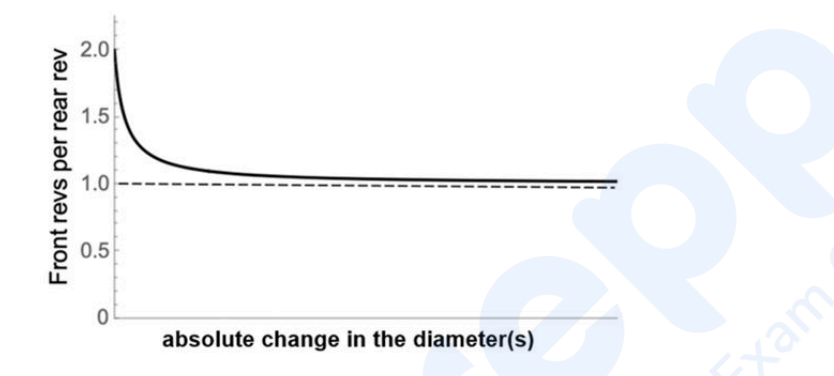
In this context, which of the following statements is CORRECT?
The problem involves understanding the effect of changing wheel diameters on the number of revolutions made by the front wheels compared to the rear wheels of a tractor.
Initially, the front wheels make 2 revolutions for every 1 revolution of the rear wheels. This is reflected on the graph where the initial ratio is 2:1. The goal is to identify what change in wheel diameters brings the ratio towards 1:1, as shown on the graph.
From the graph provided, we see that as the diameters change, the ratio of front wheel revolutions per rear wheel revolution approaches 1.0. This indicates that at this point, both the wheels make the same number of total revolutions over a given distance.
Let's analyze the options:
- Only the rear wheel diameter is decreased: If only the rear wheel diameter is decreased, each rear wheel revolution will cover less distance, increasing the ratio of front to rear revolutions beyond 1:1. This is incorrect.
- Both the rear and front wheel diameters are decreased equally: Reducing both equally keeps the original ratio unchanged (2:1). This is incorrect.
- Both the rear and front wheel diameters are increased equally: If both diameters are increased equally, the revolution ratio would become closer to 1:1 as both wheels would cover more distance per revolution without changing the relative number of revolutions between them. This aligns with the observed shift in the graph towards 1:1, making it the correct option.
- The rear wheel diameter decreased, and the front wheel diameter increased equally: This would increase the ratio, causing more front wheel revolutions for each rear wheel revolution. This is incorrect.
Therefore, the correct answer is: Both the rear and front wheel diameters are increased equally.
Important Questions from Speed Time & Distance (Notes)
- Ajay walks at a speed of 4 km/hr. He doubles his speed after reaching exactly half way. He walks for 12 hours in all. What is the total distance travelled by him ?
- A train travels from Karnal to Kurukshetra at a speed of $90$ km/hr and returns at a speed of $92$ km/hr. If it takes $182$ hours for total travel, then find the distance between Karnal to Kurukshetra. (In Km)
- A cyclist travels at 18 km/hr for 2.5 hours. What distance does he cover?
- A car covers a distance from Hayathnagar to LB nagar at the speed of 64 km/hr and covers the distance from LB nagar to Hayathnagar at the speed of 56 km/hr. What is the average speed (rounded off to nearest integer) of the car?
- If Amit walks at a speed of 20 km/hr instead of 15 km/hr, he would have walked 25 km more. The actual distance travelled by him is:


