
Understanding Amit's Distance Problem
This problem involves calculating the actual distance Amit traveled based on a hypothetical change in his walking speed. We need to use the relationship between distance, speed, and time to solve it.
Key Information Provided:
- Original Speed: 15 km/hr
- Hypothetical Speed: 20 km/hr
- Difference in Distance Covered: 25 km more (if speed was 20 km/hr)
- Goal: Find the actual distance traveled.
Step-by-Step Solution
1. Define Variables
Let's define the variables we'll use:
- Let $D$ be the actual distance Amit traveled (in km).
- Let $T$ be the actual time Amit took to travel the distance $D$ (in hours).
- Let $S_1$ be the original speed = 15 km/hr.
- Let $S_2$ be the hypothetical speed = 20 km/hr.
2. Formulate Equations based on Speed, Distance, Time
We know the fundamental formula: Distance = Speed × Time.
Using this, we can write the equations for the two scenarios:
- Actual Scenario: The actual distance $D$ is covered at speed $S_1$ in time $T$.
$D = S_1 \times T$
$D = 15 \times T$ ... (Equation 1)
- Hypothetical Scenario: If Amit walked at speed $S_2$ for the *same time* $T$, the distance covered would be $D_{new}$.
$D_{new} = S_2 \times T$
$D_{new} = 20 \times T$ ... (Equation 2)
3. Relate the Distances
The problem states that if Amit walked at 20 km/hr (instead of 15 km/hr) for the same duration, he would have walked 25 km more. This means:
$D_{new} = D + 25$
4. Solve for Time (T)
Now, substitute the expressions for $D_{new}$ and $D$ from Equations 1 and 2 into the relationship above:
$20 \times T = (15 \times T) + 25$
To find $T$, we need to isolate it:
$20T - 15T = 25$
$5T = 25$
Divide both sides by 5:
$T = \frac{25}{5}$
$T = 5$ hours
So, Amit actually took 5 hours to travel.
5. Calculate the Actual Distance (D)
Now that we know the time $T$, we can find the actual distance $D$ using Equation 1:
$D = 15 \times T$
$D = 15 \times 5$
$D = 75$ km
Verification
Let's check if this distance fits the problem statement:
- Actual distance (15 km/hr): 75 km. Time taken = $75 \div 15 = 5$ hours.
- Hypothetical distance (20 km/hr for 5 hours): $20 \times 5 = 100$ km.
- Difference: $100 \text{ km} - 75 \text{ km} = 25 \text{ km}$.
This matches the information given in the question, confirming our calculation.
Final Answer
The actual distance travelled by Amit is 75 km.
Important Questions from Speed Time & Distance (Notes)
- Ajay walks at a speed of 4 km/hr. He doubles his speed after reaching exactly half way. He walks for 12 hours in all. What is the total distance travelled by him ?
With a certain set of diameters, a tractor's front wheels make 2 revolutions (revs) for every 1 revolution of the rear wheels. The effect of changing wheel diameter(s) is shown in the following plot.
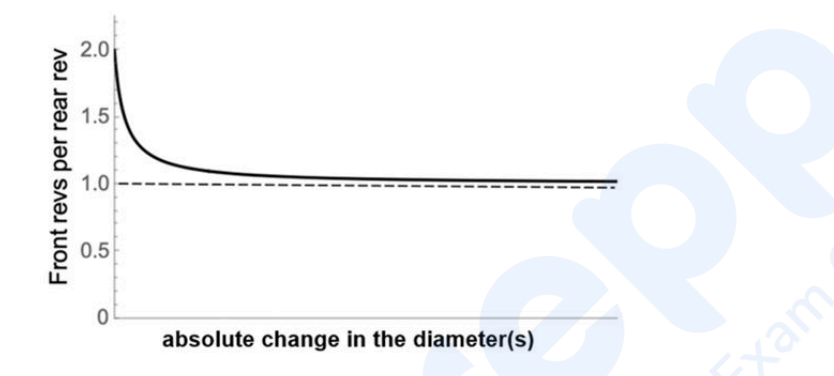
In this context, which of the following statements is CORRECT?- A train travels from Karnal to Kurukshetra at a speed of $90$ km/hr and returns at a speed of $92$ km/hr. If it takes $182$ hours for total travel, then find the distance between Karnal to Kurukshetra. (In Km)
- A cyclist travels at 18 km/hr for 2.5 hours. What distance does he cover?
- A car covers a distance from Hayathnagar to LB nagar at the speed of 64 km/hr and covers the distance from LB nagar to Hayathnagar at the speed of 56 km/hr. What is the average speed (rounded off to nearest integer) of the car?


