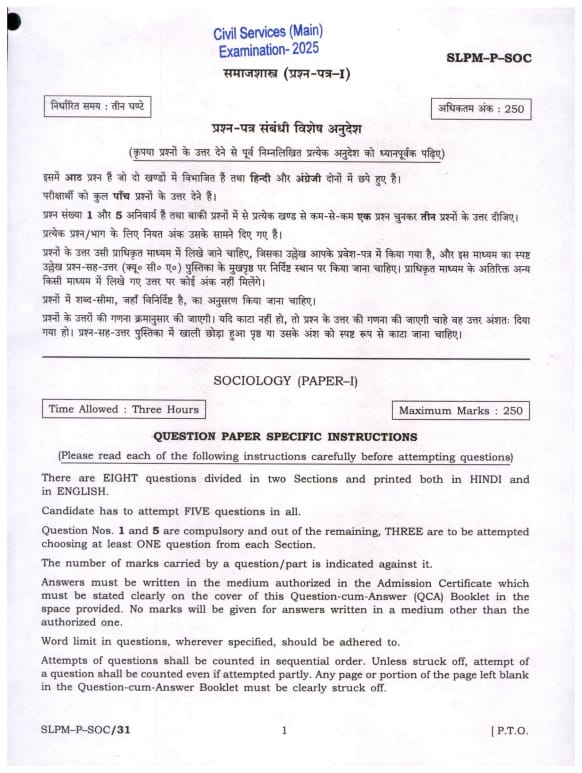
Sociology Optional Paper 1 Question Paper 2025 with Detailed Solution; Download PDF
UPSC Mains 2025 Question Paper for Sociology Optional Paper-I is available here to download in PDF Format. The exam has been conducted on August 31, 2025, in Forenoon Session (09:00 AM to 12 Noon). Check UPSC IAS 2025 Question Papers. This Paper comprises 8 questions which are of 250 marks. The duration of the exam is 3 hours.
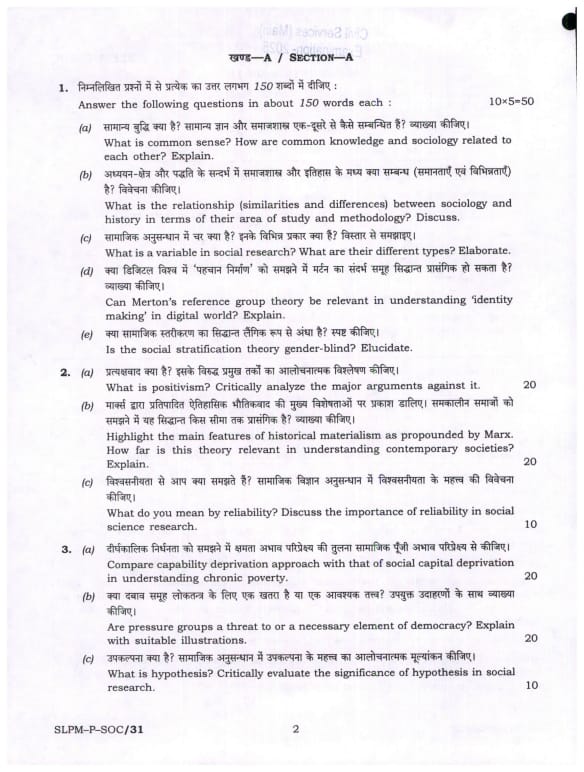
SECTION-A /खण्ड-A
1.Answer the following questions in about 150 words each:
निम्नलिखित प्रश्नों में से प्रत्येक का उत्तर लगभग 150 शब्दों में दीजिए: (Marks 10 * 5 = 50)
(a) What is common sense? How are common knowledge and sociology related to each other? Explain.
सामान्य बुद्धि क्या है? सामान्य ज्ञान और समाजशास्त्र एक-दूसरे से कैसे सम्बन्धित है? व्याख्या कीजिए।
(b) What is the relationship (similarities and differences) between sociology and history in terms of their area of study and methodology? Discuss.
अध्ययन-क्षेत्र और पद्धति के सन्दर्भ में समाजशास्त्र और इतिहास के मध्य क्या सम्बन्ध (समानताएँ एवं विभिन्नताएँ) है? विवेचना कीजिए।
(c) What is a variable in social research? What are their different types? Elaborate.
सामाजिक अनुसन्धान में चर क्या है? इनके विभिन्न प्रकार क्या है? विस्तार से समझाइए।
(d) Can Merton's reference group theory be relevant in understanding identity making in digital world? Explain.
क्या डिजिटल विश्व में 'पहचान निर्माण' को समझने में मर्टन का संदर्भ समूह सिद्धान्त प्रासंगिक हो सकता है? व्याख्या कीजिए।
(e) Is the social stratification theory gender-blind? Elucidate. क्या सामाजिक स्तरीकरण का सिद्धान्त लैंगिक रूप से अंधा है? स्पष्ट कीजिए।
क्या सामाजिक स्तरीकरण का सिद्धान्त लैंगिक रूप से अंधा है? स्पष्ट कीजिए।
2.(a) What is positivism? Critically analyze the major arguments against it.
प्रत्यक्षवाद क्या है? इसके विरुद्ध प्रमुख तकों का आलोचनात्मक विश्लेषण कीजिए। (Marks 20)
(b) Highlight the main features of historical materialism as propounded by Marx. How far is this theory relevant in understanding contemporary societies? Explain.
मार्क्स द्वारा प्रतिपादित ऐतिहासिक भौतिकवाद की मुख्य विशेषताओं पर प्रकाश डालिए। समकालीन समाजों को समझने में यह सिद्धान्त किस सीमा तक प्रासंगिक है? व्याख्या कीजिए। (Marks 20)
(c) What do you mean by reliability? Discuss the importance of reliability in social science research.
विश्वसनीयता से आप क्या समझते हैं? सामाजिक विज्ञान अनुसन्धान में विश्वसनीयता के महत्त्व की विवेचना कीजिए। (Marks 10)
3. (a) Compare capability deprivation approach with that of social capital deprivation in understanding chronic poverty.
दीर्घकालिक निर्धनता को समझने में क्षमता अभाव परिप्रेक्ष्य की तुलना सामाजिक पूँजी अभाव परिप्रेक्ष्य से कीजिए। (Marks 20)
(b) Are pressure groups a threat to or a necessary element of democracy? Explain with suitable illustrations.
क्या दबाव समूह लोकतन्त्र के लिए एक खतरा है या एक आवश्यक तत्त्व? उपयुक्त उदाहरणों के साथ व्याख्या कीजिए। (Marks 20)
(c) What is hypothesis? Critically evaluate the significance of hypothesis in social research.उपकल्पना क्या है?
सामाजिक अनुसन्धान में उपकल्पना के महत्त्व का आलोचनात्मक मूल्यांकन कीजिए। (Marks 10)
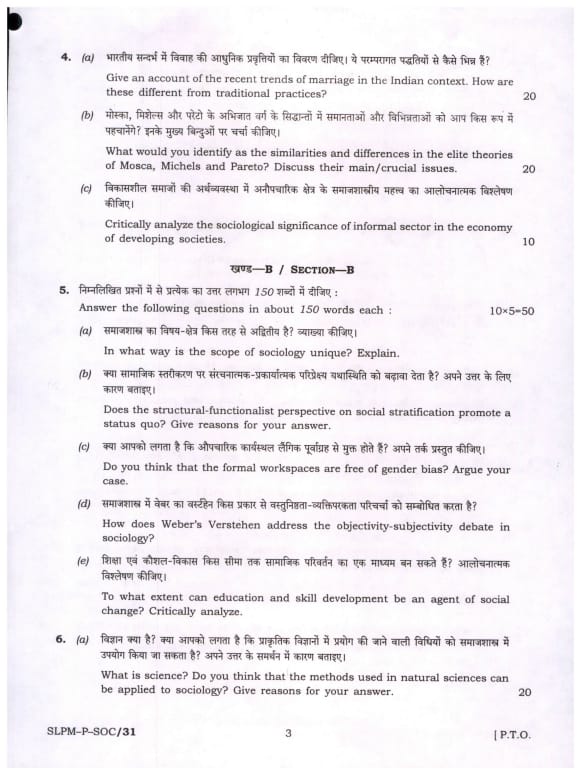
4. (a) Give an account of the recent trends of marriage in the Indian context. How are these different from traditional practices?
भारतीय सन्दर्भ में विवाह की आधुनिक प्रवृत्तियों का विवरण दीजिए। ये परम्परागत पद्धतियों से कैसे भिन्न हैं? (Marks 20)
(b) What would you identify as the similarities and differences in the elite theories of Mosca, Michels and Pareto? Discuss their main/crucial issues.
मोस्का, मिशेल्स और परेटों के अभिजात वर्ग के सिद्धान्तों में समानताओं और विभिन्नताओं को आप किस रूप में पहचानेंगे? इनके मुख्य बिन्दुओं पर चर्चा कीजिए। (Marks 20)
(c) Critically analyze the sociological significance of informal sector in the economy of developing societies.
विकासशील समाजों की अर्थव्यवस्था में अनौपचारिक क्षेत्र के समाजशास्त्रीय महत्त्व का आलोचनात्मक विश्लेषण कीजिए। (Marks 10)
SECTION-B / खण्ड-B
5. Answer the following questions in about 150 words each:
निम्नलिखित प्रश्नों में से प्रत्येक का उत्तर लगभग 150 शब्दों में दीजिए: (Marks 10 * 5 = 50)
(a) In what way is the scope of sociology unique? Explain.
समाजशास्त्र का विषय क्षेत्र किस तरह से अद्वितीय है? व्याख्या कीजिए।
(b) Does the structural-functionalist perspective on social stratification promote a status quo? Give reasons for your answer.
क्या सामाजिक स्तरीकरण पर संरचनात्मक प्रकार्यात्मक परिप्रेक्ष्य यथास्थिति को बढ़ावा देता है? अपने उत्तर के लिए कारण बताइए।
(c) Do you think that the formal workspaces are free of gender bias? Argue your case.
क्या आपको लगता है कि औपचारिक कार्यस्थल लैंगिक पूर्वाग्रह से मुक्त होते हैं? अपने तर्क प्रस्तुत कीजिए।
(d) How does Weber's Verstehen address the objectivity-subjectivity debate in sociology?
समाजशास्त्र में वेबर का वस्टहन किस प्रकार से वस्तुनिष्ठता व्यक्तिपरकता परिचर्चा को सम्बोधित करता है?
(e) To what extent can education and skill development be an agent of social change? Critically analyze.
शिक्षा एवं कौशल विकास किस सीमा तक सामाजिक परिवर्तन का एक माध्यम बन सकते हैं? आलोचनात्मक विश्लेषण कीजिए।
6. (a) What is science? Do you think that the methods used in natural sciences can be applied to sociology? Give reasons for your answer.
विज्ञान क्या है? क्या आपको लगता है कि प्राकृतिक विज्ञानों में प्रयोग की जाने वाली विधियों को समाजशास्त्र में उपयोग किया जा सकता है? अपने उत्तर के समर्थन में कारण बताइए। (Marks 20)
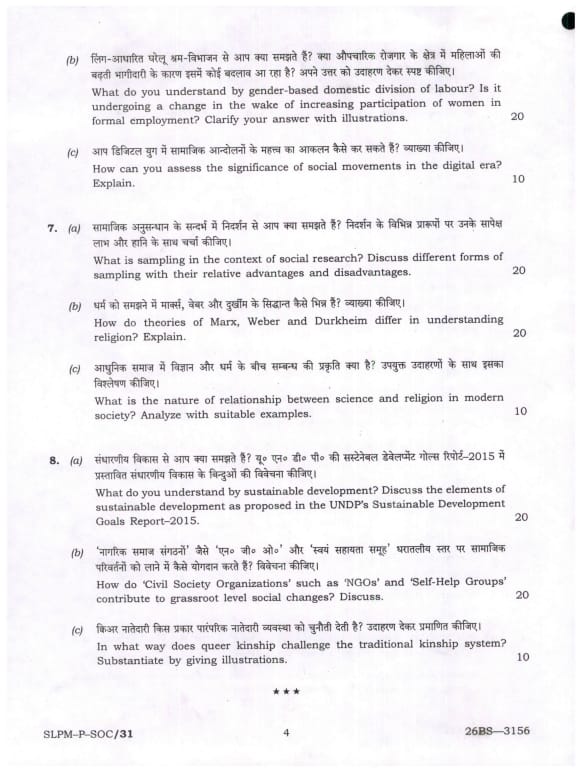
(b) What do you understand by gender-based domestic division of labour? Is it undergoing a change in the wake of increasing participation of women in formal employment? Clarify your answer with illustrations.
लिंग-आधारित घरेलू श्रम-विभाजन से आप क्या समझते हैं? क्या औपचारिक रोजगार के क्षेत्र में महिलाओं की बढ़ती भागीदारी के कारण इसमें कोई बदलाव आ रहा है? अपने उत्तर को उदाहरण देकर स्पष्ट कीजिए (Marks 20)
(c) How can you assess the significance of social movements in the digital era? Explain.
आप डिजिटल युग में सामाजिक आन्दोलनों के महत्त्व का आकलन कैसे कर सकते हैं? व्याख्या कीजिए। (Marks 10)
7. (a) What is sampling in the context of social research? Discuss different forms of sampling with their relative advantages and disadvantages.
सामाजिक अनुसन्धान के सन्दर्भ में निदर्शन से आप क्या समझते हैं? निदर्शन के विभिन्न प्रारूपों पर उनके सापेक्ष लाभ और हानि के साथ चर्चा कीजिए। (Marks 20)
(b) How do theories of Marx, Weber and Durkheim differ in understanding religion? Explain. (Marks 20)
धर्म को समझने में मार्क्स, वेबर और दुर्खीम के सिद्धान्त कैसे भिन्न हैं? व्याख्या कीजिए।
(c) What is the nature of relationship between science and religion in modern society? Analyze with suitable examples.
आधुनिक समाज में विज्ञान और धर्म के बीच सम्बन्ध की प्रकृति क्या है? उपयुक्त उदाहरणों के साथ इसका विश्लेषण कीजिए। (Marks 10)
8. (a) What do you understand by sustainable development? Discuss the elements of sustainable development as proposed in the UNDP's Sustainable Development Goals Report-2015.
संधारणीय विकास से आप क्या समझते हैं? यू० एन० डी० पी० की सस्टेनेबल डेवेलप्मेंट गोल्स रिपोर्ट-2015 में प्रस्तावित संधारणीय विकास के बिन्दुओं की विवेचना कीजिए। (Marks 20)
(b) How do 'Civil Society Organizations' such as 'NGOs' and 'Self-Help Groups' contribute to grassroot level social changes? Discuss.
'नागरिक समाज संगठनों' जैसे 'एन० जी० ओ०' और 'स्वयं सहायता समूह' घरातलीय स्तर पर सामाजिक परिवर्तनों को लाने में कैसे योगदान करते हैं? विवेचना कीजिए। (Marks 20)
(c) In what way does queer kinship challenge the traditional kinship system? Substantiate by giving illustrations.
किअर नातेदारी किस प्रकार पारंपरिक नातेदारी व्यवस्था को चुनौती देती है? उदाहरण देकर प्रमाणित कीजिए। (Marks 10)
UPSC Mains Sociology Optional Paper 1 Question Paper 2025 with Detailed Solution; Download PDF (August 31, 2025)
UPSC Previous Year Question Papers
Other Relevant Articles
| UPSC IAS Exam Syllabus | UPSC IAS Exam Pattern | UPSC IAS Exam Current Affairs |
| UPSC IAS Exam Study Materials | UPSC IAS Mock Test Series | UPSC IAS Salary |
Check the latest Government Recruitment News here.
Join Prepp Telegram Channel today for further updates.
Download the PREPP App and attempt FREE IAS Exam Mock Tests and get complete study material!

Full Test - 04: UPSC CSE Prelims CSAT (Paper-II)
Full Test - 03: UPSC CSE Prelims CSAT (Paper-II)
UPSC CSE Prelims 2026 GS Paper 1 Question Paper (24-May-2026)
UPSC CSE Prelims 2026 CSAT Paper 2 Question Paper (24-May-2026)

17 February 2025 | The Hindu Must Read Articles | Current Affairs

16 February 2026 | The Hindu Must Read Articles | Current Affairs

13 February 2026 | The Hindu Must Read Articles | Current Affairs









Comments