CTET Paper 1 Syllabus 2026, Download Syllabus PDF
Central Teacher Eligibility Test (CTET) is a national-level exam conducted by the CBSE to assess the teaching eligibility of aspiring teachers. CTET Paper 1 is specifically designed for candidates who aim to become primary teachers for Classes I to V. The exam evaluates essential teaching skills in child development and pedagogy, language proficiency, mathematics, and environmental studies.
What is CTET?
Central Teacher Eligibility Test (CTET) is a national-level exam conducted by the CBSE to assess the teaching eligibility of aspiring teachers. As per the CBSE CTET syllabus and structure, CTET evaluates candidates' subject knowledge, pedagogy, and teaching aptitude. Qualifying CTET is crucial for teaching positions in Classes I to VIII, ensuring that candidates are well-prepared and eligible for classroom responsibilities.
CTET Paper 1 Exam Structure
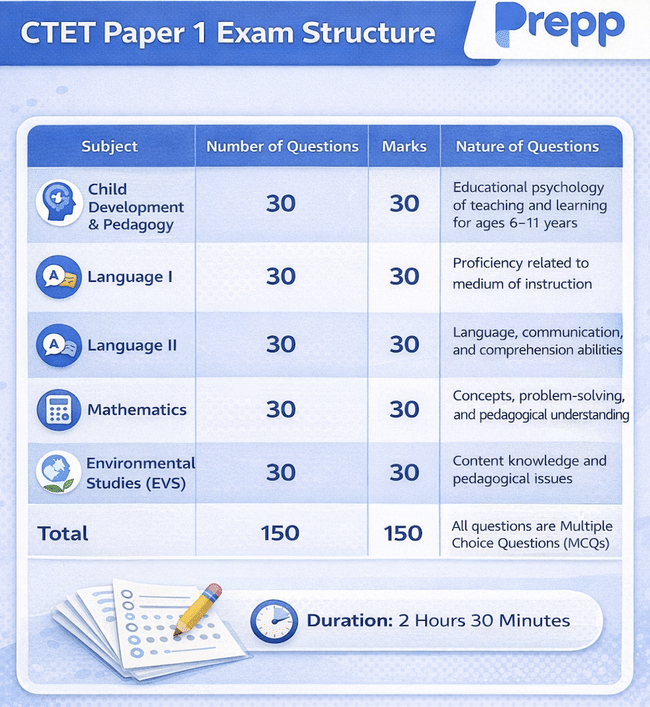
CTET Paper 1 exam is divided into five compulsory sections, each carrying 30 questions for 30 marks. The total paper consists of 150 multiple-choice questions (MCQs), and candidates are given 2 hours 30 minutes to complete the exam. Every correct answer is awarded one mark, and there is no negative marking for incorrect responses.
CTET Paper 1 Syllabus 2026
CTET Paper 1 Syllabus 2026 is designed as per the latest CBSE CTET syllabus and exam pattern for primary teachers (Classes I–V). The syllabus is divided into five sections with equal weightage, focusing on child development, pedagogy, and core subjects. Understanding CTET 2026 Syllabus is essential for targeted preparation and scoring well in the exam.
| Subject | Section | Key Topics Covered |
|---|---|---|
| Child Development & Pedagogy (30 Qs) | Child Development | Concept of development & learning, principles of child development, heredity & environment, socialization (teacher, parents, peers), Piaget–Kohlberg–Vygotsky theories, child-centered & progressive education, intelligence & multi-dimensional intelligence, language & thought, gender as social construct, individual differences, assessment for learning vs assessment of learning, CCE, school-based assessment, framing questions for readiness & critical thinking |
| Inclusive Education | Learners from diverse & disadvantaged backgrounds, children with learning difficulties & impairments, gifted, creative & specially-abled learners | |
| Learning & Pedagogy | How children learn & think, causes of poor performance, teaching-learning process, learning as social activity, social context, problem solving, errors as learning steps, cognition & emotions, motivation, personal & environmental factors | |
| Mathematics (30 Qs) | Content | Geometry, shapes & spatial understanding, solids, numbers, addition, subtraction, multiplication, division, measurement (length, weight, time), volume, data handling, patterns, money |
| Pedagogy | Nature of mathematics, logical thinking, children’s reasoning & strategies, curriculum, language of mathematics, community mathematics, evaluation methods, teaching difficulties, error analysis, diagnostic & remedial teaching | |
| Environmental Studies (EVS) (30 Qs) | Content | Family & friends (relationships, work & play), animals, plants, food, shelter, water, travel, things we make and do |
| Pedagogy | Concept & scope of EVS, integrated EVS, environmental education, learning principles, relation with science & social science, teaching approaches, activities & experiments, discussion method, CCE, teaching aids, common teaching problems | |
| Language I (30 Qs) | Comprehension | Unseen prose/drama & poem, comprehension, inference, grammar, verbal ability, literary, scientific, narrative & discursive texts |
| Pedagogy | Language acquisition, principles of language teaching, listening & speaking, language as communication, grammar role, diverse classroom challenges, errors & language disorders, LSRW skills, evaluation, textbooks & multimedia, remedial teaching | |
| Language II (30 Qs) | Comprehension | Two unseen prose passages, comprehension, grammar, verbal ability |
| Pedagogy | Second language acquisition, teaching principles, listening & speaking, grammar role, multilingual classroom challenges, errors & disorders, LSRW skills, evaluation, textbooks & multimedia resources, remedial teaching |
Languages Offered in CTET Paper 1
In CTET Paper 1, candidates are required to choose two different languages in CTET 2026- Language I and Language II—both of which are compulsory as per CTET Syllabus 2026.
- Language I: Focuses on proficiency related to the medium of instruction chosen by the candidate.
- Language II: Tests comprehension, communication, and teaching methodology in another language.
Candidates must select their language options during the application process, and the same will be reflected on CTET 2026 admit card.
Below is the list of languages available for CTET 2026:
| Code | Language | Code | Language |
|---|---|---|---|
| 01 | English | 15 | Punjabi |
| 02 | Hindi | 16 | Sanskrit |
| 03 | Assamese | 17 | Tamil |
| 04 | Bengali | 18 | Telugu |
| 05 | Garo | 19 | Tibetan |
| 06 | Gujarati | 20 | Urdu |
| 07 | Kannada | 21 | Bodo |
| 08 | Khasi | 22 | Dogri |
| 09 | Malayalam | 23 | Kashmiri |
| 10 | Manipuri | 24 | Konkani |
| 11 | Marathi | 25 | Maithili |
| 12 | Mizo | 26 | Santhali |
| 13 | Nepali | 27 | Sindhi |
| 14 | Odia |
Note:
- Candidates must attempt questions only in the languages they have chosen.
- If attempted in any other language, the candidature will be cancelled.
- Language I and II cannot be the same
Download CTET Paper 1 Syllabus PDF
CTET Paper 1 Syllabus 2026 has been officially released by the Central Board of Secondary Education (CBSE) on the official website ctet.nic.in. Candidates can download CTET syllabus PDF from the notification to check the complete list of topics, exam structure, and subject-wise details. Referring to the official syllabus PDF ensures accuracy and helps aspirants align their preparation with the NCERT curriculum for Classes I to V.
Download CTET 2026 Paper 1 Syllabus PDFCTET Paper 1 Syllabus 2026 FAQs
Ques: What are the main subjects in CTET Paper 1 syllabus 2026 exam?
Ans: CTET Paper 1 syllabus 2026 exam includes Child Development and Pedagogy, Language I, Language II, Mathematics, and Environmental Studies.
Ques: How many questions are asked from each subject in CTET Paper 1 syllabus 2026 exam?
Ans: Each subject in CTET Paper 1 syllabus 2026 exam has 30 questions, making a total of 150 questions for 150 marks.
Ques: What topics are covered in Child Development and Pedagogy in CTET Paper 1 syllabus 2026 exam?
Ans: The Child Development and Pedagogy section in CTET Paper 1 syllabus 2026 exam covers child development theories, learning and pedagogy, inclusive education, intelligence, socialization, motivation, and assessment methods.
Ques: What is included in the Mathematics section of CTET Paper 1 syllabus 2026 exam?
Ans: The Mathematics section of CTET Paper 1 syllabus 2026 exam covers numbers, geometry, patterns, measurement, time, money, data handling, and related pedagogical issues.
Ques: What topics are part of Environmental Studies in CTET Paper 1 syllabus 2026 exam?
Ans: Environmental Studies in CTET Paper 1 syllabus 2026 exam includes Family and Friends, Food, Shelter, Water, Travel, and Things We Make and Do, along with pedagogy of EVS.
Ques: What is the difference between Language I and Language II in CTET Paper 1 syllabus 2026 exam?
Ans: In CTET Paper 1 syllabus 2026 exam, Language I tests proficiency in the medium of instruction chosen by the candidate, while Language II checks comprehension, communication, and teaching abilities in another language.
Ques: How many languages are offered in CTET Paper 1 syllabus 2026 exam?
Ans: CTET Paper 1 syllabus 2026 exam offers 20 languages including Hindi, English, Sanskrit, Urdu, Tamil, Telugu, Bengali, Gujarati, and others.
Ques: What is the difficulty level of CTET Paper 1 syllabus 2026 exam?
Ans: CTET Paper 1 syllabus 2026 exam is based on NCERT syllabus of Classes I–V, but the difficulty level of questions may go up to the secondary stage.
Download the PREPP App and attempt FREE CTET Mock Tests and get complete study material!

Full Test 10: CTET Paper II Social Science (L - I-II: Hindi-English)
Full Test 09: CTET Paper II Social Science (L - I-II: Hindi-English)
CTET 2026 Paper 1 Question Paper (07-Feb-2026)
CTET 2026 Paper 2 Social Science Question Paper (07-Feb-2026)

17 February 2025 | The Hindu Must Read Articles | Current Affairs

16 February 2026 | The Hindu Must Read Articles | Current Affairs

13 February 2026 | The Hindu Must Read Articles | Current Affairs









Comments