
Y in the above reaction is
Aspirin
Phenol reacts with sodium hydroxide to give sodium phenoxide, so \(\mathrm{A = C_6H_5ONa}\).
Sodium phenoxide heated with \(\mathrm{CO_2}\) under pressure and then acidified introduces a carboxyl group at the ortho position, giving salicylic acid, \(\mathrm{B = o\text{-}HOC_6H_4COOH}\) (Kolbe reaction).
The phenolic \(\mathrm{-OH}\) of salicylic acid is acetylated by acetic anhydride \(\mathrm{(CH_3CO)_2O}\) in acid, giving acetylsalicylic acid, \(\mathrm{o\text{-}CH_3COOC_6H_4COOH}\).
Salicylaldehyde would need the Reimer-Tiemann reaction, cumene is an arene used to make phenol, and picric acid comes from nitration of phenol, so none of these is formed.
Hence, Aspirin.
Similar Questions
The intermediates in heteropolar reactions are
Match the List-I with List-II in the following :
List-I List-II 1. Caprolactum (a) $-\!\Big(\mathrm{CH_2}-\underset{\underset{\textstyle \mathrm{CH_3}}{|}}{\mathrm{CH}}\Big)_{n}\!-$ 2. Vinyl chloride (b) $-\!\Big(\mathrm{CH_2}-\underset{\underset{\textstyle \mathrm{C_6H_5}}{|}}{\mathrm{CH}}\Big)_{n}\!-$ 3. Styrene (c) $-\!\Big(\mathrm{CH_2}-\underset{\underset{\textstyle \mathrm{Cl}}{|}}{\mathrm{CH}}\Big)_{n}\!-$ 4. Propene (d) $-\!\Big(\overset{\overset{\textstyle \mathrm{O}}{\|}}{\mathrm{C}}-\left(\mathrm{CH_2}\right)_{5}-\underset{\underset{\textstyle \mathrm{H}}{|}}{\mathrm{N}}\Big)_{n}\!-$ Among the following :
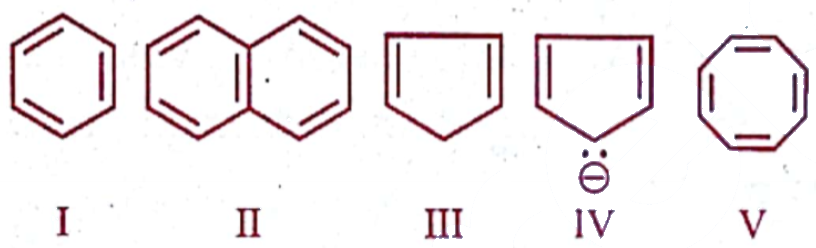
The set which represents aromatic species is
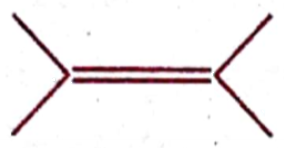
IUPAC name of the compound is
In the reaction :

P, Q and R respectively are :
IUPAC name of the compound \(\mathrm{CH_3{-}CH{=}CH{-}CH_2Br}\) is,
Replacement of Cl of Chlorobenzene to give phenol requires drastic conditions, but Cl of 2, 4 – dinitro chlorobenzene is readily replaced. This is because,
In the reaction :
Ethanol \(\xrightarrow{\mathrm{PCl_5}}\) X \(\xrightarrow{\mathrm{alc\,KOH}}\) Y \(\xrightarrow[\mathrm{H_2O,\Delta}]{\mathrm{H_2SO_4,\ Room\ temp.}}\) Z, the product Z is,
Which of the following compound is most acidic ?
Benzene carbaldehyde is reacted with concentrated NaOH solution to give the products A and B. The product A can be used food preservative and the product B is an aromatic hydroxy compound where OH gorup is linked to \(sp^{3}\) hybridised carbon atom next to Benzene ring. The products A and B are respectively,
Important Questions from Organic Chemistry
- $0.25 \text{ g}$ of an organic compound "A" containing carbon, hydrogen and oxygen was analysed using the combustion method. There was an increase in mass of $\text{CaCl}_2$ tube and potash tube at the end of the experiment. The amount was found to be $0.15 \text{ g}$ and $0.1837 \text{ g}$, respectively. The percentage of oxygen in compound A is ______ %. (Nearest integer)
(Given: molar mass in $\text{g mol}^{-1}$ $\text{H} : 1, \text{C} : 12, \text{O} : 16$) - Grignard reagent $\text{RMgBr (P)}$ reacts with water and forms a gas $\text{(Q)}$. One gram of Q occupies $1.4 \text{ dm}^3$ at STP. (P) on reaction with dry ice in dry ether followed by $\text{H}_3\text{O}^+$ forms a compound $\text{(Z)}$. 0.1 mole of $\text{(Z)}$ will weigh _________ g. (Nearest integer)
- Consider all the structural isomers with molecular formula $\text{C}_5\text{H}_{11}\text{Br}$ are separately treated with $\text{KOH(aq)}$ to give respective substitution products, without any rearrangement. The number of products which can exhibit optical isomerism from these is ___________.
Consider the following reactions sequence
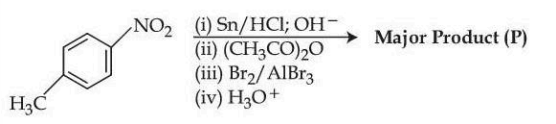
When the product (P) is subjected to Carius analysis using $\text{AgNO}_3$, $1.0\text{ g}$ of the product (P) will produce __________ g of the precipitate of AgBr. (Nearest Integer)
(Given : molar mass in $\text{g mol}^{-1}$ C : 12, H : 1, O : 16, N : 14, Br : 80, Ag : 108)- The number of isomeric compounds (structural isomers only) possible with the molecular formula $C_5H_{10}O_2$, which do not react with metallic sodium is ________


