
In the reaction : Ethanol \(\xrightarrow{\mathrm{PCl_5}}\) X \(\xrightarrow{\mathrm{alc\,KOH}}\) Y \(\xrightarrow[\mathrm{H_2O,\Delta}]{\mathrm{H_2SO_4,\ Room\ temp.}}\) Z, the product Z is,
\(\mathrm{CH_3CH_2OH}\)
Step 1: \(\mathrm{CH_3CH_2OH + PCl_5 \rightarrow CH_3CH_2Cl + POCl_3 + HCl}\), so X is chloroethane.
Step 2: alcoholic KOH brings about dehydrohalogenation: \(\mathrm{CH_3CH_2Cl + KOH(alc) \rightarrow CH_2{=}CH_2 + KCl + H_2O}\), so Y is ethene.
Step 3: ethene adds cold concentrated \(\mathrm{H_2SO_4}\) at room temperature to give ethyl hydrogen sulphate, \(\mathrm{CH_2{=}CH_2 + H_2SO_4 \rightarrow CH_3CH_2OSO_3H}\).
Boiling this with water hydrolyses it: \(\mathrm{CH_3CH_2OSO_3H + H_2O \xrightarrow{\Delta} CH_3CH_2OH + H_2SO_4}\). The net change is hydration of ethene, so Z is ethanol; ethyl hydrogen sulphate is only the intermediate, and ethene and diethyl ether are not formed in this last step.
Hence, the answer is \(\mathrm{CH_3CH_2OH}\).
Similar Questions
The intermediates in heteropolar reactions are
Match the List-I with List-II in the following :
List-I List-II 1. Caprolactum (a) $-\!\Big(\mathrm{CH_2}-\underset{\underset{\textstyle \mathrm{CH_3}}{|}}{\mathrm{CH}}\Big)_{n}\!-$ 2. Vinyl chloride (b) $-\!\Big(\mathrm{CH_2}-\underset{\underset{\textstyle \mathrm{C_6H_5}}{|}}{\mathrm{CH}}\Big)_{n}\!-$ 3. Styrene (c) $-\!\Big(\mathrm{CH_2}-\underset{\underset{\textstyle \mathrm{Cl}}{|}}{\mathrm{CH}}\Big)_{n}\!-$ 4. Propene (d) $-\!\Big(\overset{\overset{\textstyle \mathrm{O}}{\|}}{\mathrm{C}}-\left(\mathrm{CH_2}\right)_{5}-\underset{\underset{\textstyle \mathrm{H}}{|}}{\mathrm{N}}\Big)_{n}\!-$ Among the following :
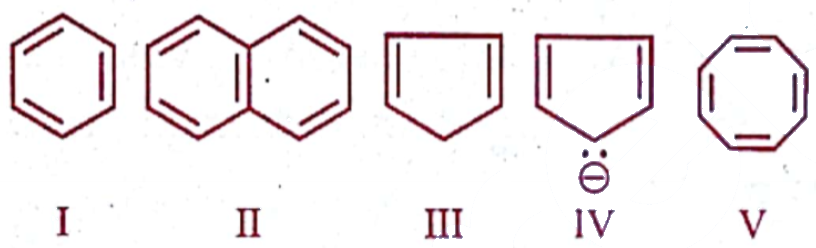
The set which represents aromatic species is
IUPAC name of the compound is
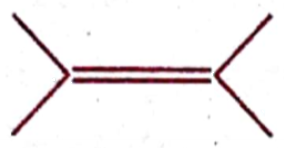
In the reaction :

P, Q and R respectively are :

Y in the above reaction is
IUPAC name of the compound \(\mathrm{CH_3{-}CH{=}CH{-}CH_2Br}\) is,
Replacement of Cl of Chlorobenzene to give phenol requires drastic conditions, but Cl of 2, 4 – dinitro chlorobenzene is readily replaced. This is because,
Which of the following compound is most acidic ?
Benzene carbaldehyde is reacted with concentrated NaOH solution to give the products A and B. The product A can be used food preservative and the product B is an aromatic hydroxy compound where OH gorup is linked to \(sp^{3}\) hybridised carbon atom next to Benzene ring. The products A and B are respectively,
Important Questions from Organic Chemistry
- $0.25 \text{ g}$ of an organic compound "A" containing carbon, hydrogen and oxygen was analysed using the combustion method. There was an increase in mass of $\text{CaCl}_2$ tube and potash tube at the end of the experiment. The amount was found to be $0.15 \text{ g}$ and $0.1837 \text{ g}$, respectively. The percentage of oxygen in compound A is ______ %. (Nearest integer)
(Given: molar mass in $\text{g mol}^{-1}$ $\text{H} : 1, \text{C} : 12, \text{O} : 16$) - Grignard reagent $\text{RMgBr (P)}$ reacts with water and forms a gas $\text{(Q)}$. One gram of Q occupies $1.4 \text{ dm}^3$ at STP. (P) on reaction with dry ice in dry ether followed by $\text{H}_3\text{O}^+$ forms a compound $\text{(Z)}$. 0.1 mole of $\text{(Z)}$ will weigh _________ g. (Nearest integer)
- Consider all the structural isomers with molecular formula $\text{C}_5\text{H}_{11}\text{Br}$ are separately treated with $\text{KOH(aq)}$ to give respective substitution products, without any rearrangement. The number of products which can exhibit optical isomerism from these is ___________.
Consider the following reactions sequence
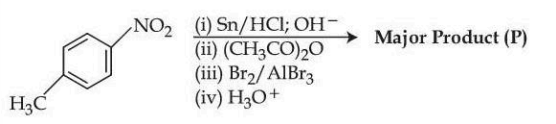
When the product (P) is subjected to Carius analysis using $\text{AgNO}_3$, $1.0\text{ g}$ of the product (P) will produce __________ g of the precipitate of AgBr. (Nearest Integer)
(Given : molar mass in $\text{g mol}^{-1}$ C : 12, H : 1, O : 16, N : 14, Br : 80, Ag : 108)- The number of isomeric compounds (structural isomers only) possible with the molecular formula $C_5H_{10}O_2$, which do not react with metallic sodium is ________


