
The intermediates in heteropolar reactions are
Both anions and cations
A heteropolar (heterolytic) reaction is one in which a covalent bond breaks unequally: the shared electron pair goes entirely to the more electronegative atom, so the two fragments carry opposite charges.
Step 1 — In heterolytic cleavage \(\mathrm{A{:}B \rightarrow A^{+} + {:}B^{-}}\), one fragment loses its share of the bonding pair and becomes positively charged, while the other keeps both electrons and becomes negatively charged.
Step 2 — When the carbon fragment is the electron-poor one, a carbocation (for example (CH3)3C+) forms; when carbon keeps the pair, a carbanion (for example CH3−) forms. Heteropolar reactions therefore proceed through charged intermediates of both signs.
Step 3 — Free radicals carry an unpaired electron and no charge; they arise only from homolytic (homopolar) cleavage, where each atom keeps one electron of the bond.
Free radicals only belong to homolytic reactions, so they are excluded. Cations only or anions only describe just one half of the heterolytic split and ignore the oppositely charged partner that forms at the same time.
Both anions and cations option is correct.
Similar Questions
Match the List-I with List-II in the following :
List-I List-II 1. Caprolactum (a) $-\!\Big(\mathrm{CH_2}-\underset{\underset{\textstyle \mathrm{CH_3}}{|}}{\mathrm{CH}}\Big)_{n}\!-$ 2. Vinyl chloride (b) $-\!\Big(\mathrm{CH_2}-\underset{\underset{\textstyle \mathrm{C_6H_5}}{|}}{\mathrm{CH}}\Big)_{n}\!-$ 3. Styrene (c) $-\!\Big(\mathrm{CH_2}-\underset{\underset{\textstyle \mathrm{Cl}}{|}}{\mathrm{CH}}\Big)_{n}\!-$ 4. Propene (d) $-\!\Big(\overset{\overset{\textstyle \mathrm{O}}{\|}}{\mathrm{C}}-\left(\mathrm{CH_2}\right)_{5}-\underset{\underset{\textstyle \mathrm{H}}{|}}{\mathrm{N}}\Big)_{n}\!-$ Among the following :
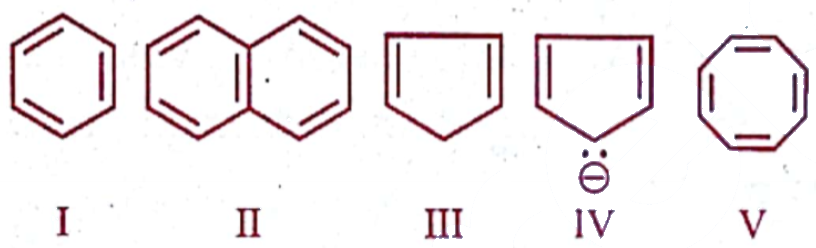
The set which represents aromatic species is
IUPAC name of the compound is
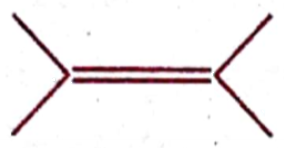
In the reaction :

P, Q and R respectively are :

Y in the above reaction is
IUPAC name of the compound \(\mathrm{CH_3{-}CH{=}CH{-}CH_2Br}\) is,
Replacement of Cl of Chlorobenzene to give phenol requires drastic conditions, but Cl of 2, 4 – dinitro chlorobenzene is readily replaced. This is because,
In the reaction :
Ethanol \(\xrightarrow{\mathrm{PCl_5}}\) X \(\xrightarrow{\mathrm{alc\,KOH}}\) Y \(\xrightarrow[\mathrm{H_2O,\Delta}]{\mathrm{H_2SO_4,\ Room\ temp.}}\) Z, the product Z is,
Which of the following compound is most acidic ?
Benzene carbaldehyde is reacted with concentrated NaOH solution to give the products A and B. The product A can be used food preservative and the product B is an aromatic hydroxy compound where OH gorup is linked to \(sp^{3}\) hybridised carbon atom next to Benzene ring. The products A and B are respectively,
Important Questions from Organic Chemistry
- $0.25 \text{ g}$ of an organic compound "A" containing carbon, hydrogen and oxygen was analysed using the combustion method. There was an increase in mass of $\text{CaCl}_2$ tube and potash tube at the end of the experiment. The amount was found to be $0.15 \text{ g}$ and $0.1837 \text{ g}$, respectively. The percentage of oxygen in compound A is ______ %. (Nearest integer)
(Given: molar mass in $\text{g mol}^{-1}$ $\text{H} : 1, \text{C} : 12, \text{O} : 16$) - Grignard reagent $\text{RMgBr (P)}$ reacts with water and forms a gas $\text{(Q)}$. One gram of Q occupies $1.4 \text{ dm}^3$ at STP. (P) on reaction with dry ice in dry ether followed by $\text{H}_3\text{O}^+$ forms a compound $\text{(Z)}$. 0.1 mole of $\text{(Z)}$ will weigh _________ g. (Nearest integer)
- Consider all the structural isomers with molecular formula $\text{C}_5\text{H}_{11}\text{Br}$ are separately treated with $\text{KOH(aq)}$ to give respective substitution products, without any rearrangement. The number of products which can exhibit optical isomerism from these is ___________.
Consider the following reactions sequence
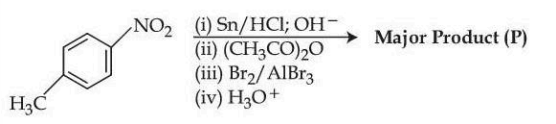
When the product (P) is subjected to Carius analysis using $\text{AgNO}_3$, $1.0\text{ g}$ of the product (P) will produce __________ g of the precipitate of AgBr. (Nearest Integer)
(Given : molar mass in $\text{g mol}^{-1}$ C : 12, H : 1, O : 16, N : 14, Br : 80, Ag : 108)- The number of isomeric compounds (structural isomers only) possible with the molecular formula $C_5H_{10}O_2$, which do not react with metallic sodium is ________


