
Why does Fluorine exhibit only –1 oxidation state?
It has no d orbitals.
Understanding Fluorine's Unique Oxidation State
Fluorine ($\text{F}$) is the first element in the halogen group (Group 17) of the periodic table. It is known for its extremely high electronegativity. Oxidation state is a number assigned to an element in a chemical compound or ion that indicates how many electrons it has gained or lost compared to the neutral atom.
Why Fluorine Favours a -1 Oxidation State
Fluorine's atomic number is 9, and its electronic configuration is $1\text{s}^2 2\text{s}^2 2\text{p}^5$. To achieve a stable electron configuration like the nearest noble gas, Neon ($\text{Ne}$, $1\text{s}^2 2\text{s}^2 2\text{p}^6$), Fluorine needs to gain just one electron. When it gains one electron, it forms the fluoride ion, $\text{F}^-$, which has an oxidation state of -1. Due to its small size, high effective nuclear charge, and high electronegativity, Fluorine has a very strong tendency to attract an electron and complete its valence shell.
Why Only -1 Oxidation State? Analyzing the Options
While Fluorine strongly favours gaining an electron for a -1 state, the question asks why it exhibits *only* -1 and no positive oxidation states or even other negative oxidation states. Let's look at the given options:
- Option 1: It has no d orbitals. The valence shell of Fluorine is the second shell ($n=2$). The second shell contains only s and p subshells (2s and 2p). It does not have any d orbitals ($n=2$ only has $l=0, 1$, corresponding to s and p). For an element to show positive oxidation states higher than +1 (or participate in multiple bonds and expanded octets seen in higher oxidation states), it often needs to involve vacant d orbitals in bonding to accommodate more than eight valence electrons or promote electrons to higher energy levels. Since Fluorine lacks vacant d orbitals in its valence shell, it cannot expand its octet beyond 8 electrons. This prevents it from forming compounds where it shares or loses electrons in a way that would result in a positive oxidation state. Fluorine is also the most electronegative element, meaning it will always pull electrons towards itself when bonded to any other element, reinforcing the tendency towards a negative oxidation state.
- Option 2: It is a non-metal. While non-metals typically exhibit negative oxidation states, many non-metals (like Chlorine, Bromine, Iodine, Oxygen, Nitrogen, Sulfur) can exhibit positive oxidation states when bonded to more electronegative elements (Fluorine and Oxygen being common examples). For instance, in $\text{Cl}_2\text{O}_7$, Chlorine has a +7 oxidation state. Therefore, being a non-metal alone doesn't explain why Fluorine is restricted to *only* -1.
- Option 3: It is small in size. Fluorine is indeed small. Small size and high nuclear charge contribute to its very high electronegativity, which is why it tends to gain an electron. However, size itself doesn't directly prevent it from having positive oxidation states if other factors (like available d orbitals) were present. For example, Oxygen is also small and electronegative but can exhibit positive oxidation states when bonded to Fluorine (e.g., +2 in $\text{OF}_2$).
- Option 4: It is a halogen. Fluorine is the first member of the halogen family. While halogens commonly exhibit a -1 oxidation state, all other halogens (Chlorine, Bromine, Iodine, Astatine) can exhibit positive oxidation states like +1, +3, +5, and +7, especially when bonded to Oxygen or Fluorine. This is because they have vacant d orbitals in their valence shells (or higher shells) that can be used for expanding their octets and forming multiple bonds, allowing for higher positive oxidation states. Being a halogen does not restrict an element to *only* -1, as seen with Cl, Br, and I.
Based on this analysis, the most accurate reason for Fluorine exhibiting *only* a -1 oxidation state is the absence of vacant d orbitals in its valence shell. This, combined with its extreme electronegativity, prevents it from attaining any positive oxidation states.
| Element | Valence Shell | Presence of d-orbitals in Valence Shell | Typical Oxidation State(s) |
|---|---|---|---|
| Fluorine (F) | $n=2$ (2s, 2p) | No (d-orbitals start from $n=3$) | -1 (Only) |
| Chlorine (Cl) | $n=3$ (3s, 3p, 3d) | Yes (Vacant 3d) | -1, +1, +3, +5, +7 |
| Bromine (Br) | $n=4$ (4s, 4p, 4d) | Yes (Vacant 4d) | -1, +1, +3, +5, +7 |
| Iodine (I) | $n=5$ (5s, 5p, 5d) | Yes (Vacant 5d) | -1, +1, +3, +5, +7 |
Step-by-Step Reasoning:
- Identify the question: Why Fluorine shows *only* -1 oxidation state.
- Recall Fluorine's electronic configuration: $1\text{s}^2 2\text{s}^2 2\text{p}^5$.
- Understand oxidation state: Represents electron gain/loss/sharing tendency.
- Consider why Fluorine tends to gain 1 electron (forms $\text{F}^-$): High electronegativity, small size, achieving stable octet. This explains -1.
- Address the 'only' part: Why no positive states or other negative states?
- Evaluate Option 1 (No d orbitals): Lack of d orbitals means it cannot expand its octet or easily promote electrons, limiting bonding possibilities that lead to positive states. This aligns with the observation of only -1.
- Evaluate Option 2 (Non-metal): Many non-metals show positive states. This doesn't explain 'only' -1.
- Evaluate Option 3 (Small size): Contributes to -1 tendency but doesn't prohibit positive states if d orbitals were available. Oxygen is small but shows positive states.
- Evaluate Option 4 (Halogen): Other halogens show positive states. This doesn't explain 'only' -1 for Fluorine.
- Conclusion: The absence of d orbitals is the defining factor restricting Fluorine to only a -1 oxidation state.
Thus, the primary reason Fluorine exhibits only a -1 oxidation state is that it lacks vacant d orbitals to accommodate additional electron density or participate in bonding arrangements that would result in positive oxidation states. Its extreme electronegativity further ensures it always attracts electrons in any bond.
Revision Table: Key Concepts about Fluorine Oxidation State
| Concept | Explanation for Fluorine |
|---|---|
| Valence Shell Electrons | 7 ($2\text{s}^2 2\text{p}^5$) |
| Electron Affinity | Very High (Tendency to gain electron) |
| Electronegativity | Highest (Always pulls electrons) |
| Vacant d Orbitals | None in valence shell ($n=2$) |
| Octet Rule | Acheives stable octet by gaining 1 electron ($\text{F}^-$) |
| Possible Oxidation States | Only -1 |
Additional Information: Fluorine Chemistry Insights
Fluorine's unique properties stem from its electronic configuration and position. While other halogens can be oxidized by strong oxidizing agents or form compounds with more electronegative elements like Oxygen (e.g., $\text{Cl}_2\text{O}_7$), Fluorine is the most electronegative element and cannot be oxidized by any other element. It only forms compounds where it is assigned a -1 oxidation state (like $\text{HF}$, $\text{NaF}$, $\text{CF}_4$, $\text{OF}_2$, etc.). Even in $\text{OF}_2$, Oxygen has a +2 oxidation state, and Fluorine is -1, as Fluorine is more electronegative than Oxygen. The absence of vacant d orbitals is crucial because it limits Fluorine's ability to expand its valence shell beyond 8 electrons, which is necessary for higher positive oxidation states seen in the compounds of other halogens.
Important Questions from Alcohols, Phenols and Ethers
Which among the following is a trihydric alcohol?
Which isomerism is shown by the following pairs?
CH₃CH₂CH₂OH and CH₃CH₂OCH₃
Correct order of boiling points in the following is:
(A) CH3CHO
(B) CH3COOH
(C) CH3CH2OH
(D) CH3CH3
(E) CH3CH2Cl
Choose the correct answer from the options given below:
Identify allylic alcohol:
(A) CH2= CH–CH2OH
(B) CH3= CH–CH2OH
(C)

(D)
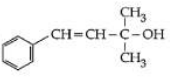
Choose the correct answer from the options given below:
In Kolbe's reaction, phenol undergoes:


