
Identify allylic alcohol: (A) CH2= CH–CH2OH (B) CH3= CH–CH2OH (C) (D) Choose the correct answer from the options given below:
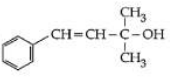
(A), (C), (D)
An **allylic alcohol** is an alcohol where the hydroxyl group (-OH) is attached to a carbon atom that is adjacent to a double bond (C=C). The alcohols in **Option 1 (CH2 = CH–CH2OH)** and **Option 4 (CH3CH=CH–CH2OH)** have the hydroxyl group adjacent to a C=C bond, making them **allylic alcohols**. On the other hand, **Option 2 (CH3CH2CH2OH)** is a primary alcohol with no adjacent C=C bond, and **Option 3 (Cyclohexanol)** is a cyclic alcohol with no adjacent C=C bond, so neither is an allylic alcohol.
Thus, the correct answer is **(a)** (A), (C), (D).
Important Questions from Alcohols, Phenols and Ethers
Which among the following is a trihydric alcohol?
Why does Fluorine exhibit only –1 oxidation state?
Which isomerism is shown by the following pairs?
CH₃CH₂CH₂OH and CH₃CH₂OCH₃
Correct order of boiling points in the following is:
(A) CH3CHO
(B) CH3COOH
(C) CH3CH2OH
(D) CH3CH3
(E) CH3CH2Cl
Choose the correct answer from the options given below:
In Kolbe's reaction, phenol undergoes:


