
Understanding the Distinction Between Benzophenone and Acetone
The question asks to identify a reagent capable of distinguishing between Benzophenone and Acetone. Both Benzophenone and Acetone are organic compounds containing a carbonyl group (C=O), classifying them as ketones. However, their structural differences are key to finding a specific reagent that reacts differently with each.
Analyzing the Chemical Structures
Acetone, with the chemical formula $CH_3COCH_3$, is the simplest aliphatic ketone. Crucially, it possesses a methyl group ($CH_3-$) directly attached to the carbonyl carbon ($C=O$). This specific structural feature, known as a methyl ketone, is important for certain chemical tests.
Benzophenone, with the chemical formula $(C_6H_5)_2CO$, is an aromatic ketone. In Benzophenone, the carbonyl carbon is bonded to two phenyl groups ($C_6H_5-$). It lacks the methyl group adjacent to the carbonyl group.
Evaluating Potential Reagents
Let's examine why the other reagents listed are not suitable for distinguishing between Benzophenone and Acetone:
- Fehling's reagent: This reagent is used to test for aldehydes. It does not react with ketones.
- Tollen's reagent: Similar to Fehling's reagent, Tollen's reagent specifically tests for aldehydes and does not react with ketones.
- 2,4-DNP reagent (2,4-Dinitrophenylhydrazine): This reagent reacts with both aldehydes and ketones to form characteristic coloured precipitates (2,4-dinitrophenylhydrazones). While it confirms the presence of a carbonyl group, it doesn't differentiate between different types of ketones like Acetone and Benzophenone.
The Iodoform Test: The Correct Distinguishing Reagent
The reagent $I_2/NaOH$, commonly known as the Iodoform test reagent, is specifically used to identify compounds containing a methyl ketone group ($CH_3CO-R$) or alcohols that can be oxidized to methyl ketones (like secondary alcohols with the structure $CH_3CH(OH)-R$).
Reaction with Acetone:
Acetone ($CH_3COCH_3$) contains the $CH_3CO-$ group. When treated with $I_2/NaOH$, it undergoes a reaction known as haloform reaction.
The reaction proceeds as follows:
$$CH_3COCH_3 + 4I_2 + 6NaOH \rightarrow CHI_3 \downarrow + CH_3COONa + 5NaI + 5H_2O$$This reaction produces iodoform ($CHI_3$), which appears as a characteristic yellow precipitate and has a distinct medicinal odour. A positive result (yellow precipitate) indicates the presence of the methyl ketone group.
Reaction with Benzophenone:
Benzophenone ($(C_6H_5)_2CO$) does not have the required methyl group attached to the carbonyl carbon. Therefore, it cannot undergo the haloform reaction with $I_2/NaOH$. Benzophenone gives a negative result in the Iodoform test.
Conclusion
Since Acetone gives a positive Iodoform test (forming a yellow precipitate) and Benzophenone gives a negative test, the reagent $I_2/NaOH$ can effectively distinguish between these two ketones.
Important Questions from Aldehydes, Ketones and Carboxylic Acids
Phenol is brominated in solvent CS₂ at low temperature. The product formed are:
What is not true regarding compound [B]?
(A) They are higher boiling liquids than aldehydes and ketones due to extensive H bonding
(B) They are soluble in Benzene
(C) They produce alkane when heated with soda lime
(D) Produces CO₂ when treated with NaHCO₃
Choose the correct answer from the options given below:
Which of the following is the correct statement for hybridization of C-atom and number of π bonds in the Carbonyl group?
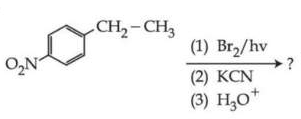
What is the product formed in the following reaction sequence?
What will be the product formed when cyclohexanone undergoes Aldol condensation?


