
Question is based on the following passage: Methyl nitrile is hydrolysed to carboxylic acid in the presence of H+ or OH- as catalyst. An intermediate compound [A] is formed during this reaction.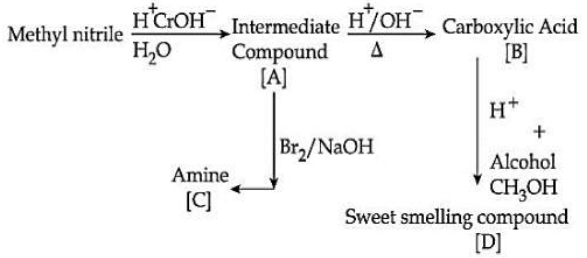
What is not true regarding compound [B]? (A) They are higher boiling liquids than aldehydes and ketones due to extensive H bonding (B) They are soluble in Benzene (C) They produce alkane when heated with soda lime (D) Produces CO₂ when treated with NaHCO₃ Choose the correct answer from the options given below:
(B) only
- (A): Compounds with hydrogen bonding (such as alcohols or carboxylic acids) generally have higher boiling points than aldehydes and ketones due to the strong intermolecular hydrogen bonds. So, statement (A) is true.
- (B): Compounds with hydrogen bonding (such as alcohols or acids) are typically not soluble in benzene, which is a non-polar solvent. So, statement (B) is false.
- (C): Compounds like carboxylic acids or alcohols can produce an alkane when heated with soda lime. This is a typical decarboxylation reaction. Therefore, statement (C) is true.
- (D): Compounds like carboxylic acids will produce CO₂ when treated with NaHCO₃, which is characteristic of acids reacting with bicarbonates. So, statement (D) is true.
- Thus, the correct answer is (c) (B) only.
Important Questions from Aldehydes, Ketones and Carboxylic Acids
Phenol is brominated in solvent CS₂ at low temperature. The product formed are:
Which of the following is the correct statement for hybridization of C-atom and number of π bonds in the Carbonyl group?
What is the product formed in the following reaction sequence?
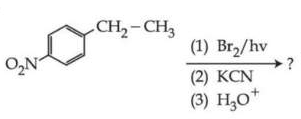
What will be the product formed when cyclohexanone undergoes Aldol condensation?
Match the chemical conversion in List-I to the appropriate reagent in List-II:
List-I List-II (A) 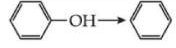
(I) Na2Cr2O7 in presence of H2SO4 (B) CH3CH2OH → C2H5OC2H5 (II) H2SO4 at 443 K (C) 
(III) Zn (D) CH3CH2OH → CH2 = CH2 (IV) H2SO4 at 413 K Choose the correct answer from the options given below:


