
What is the product formed in the following reaction sequence?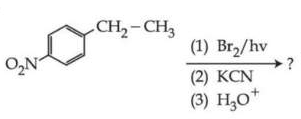
(c)
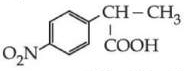
Step 1: Free radical bromination (Br2/hv)
- The benzyl position (-CH2CH3) is highly reactive towards radical bromination. - The bromine (Br) replaces one hydrogen from the benzyl carbon, forming **CBr-CH3**. Step 2: Nucleophilic substitution with KCN
- The bromine atom is replaced by a **-CN** (cyanide) group, forming a **benzyl cyanide** intermediate. Step 3: Hydrolysis of -CN with H3O+
- The **-CN** group undergoes hydrolysis in acidic conditions to form a **carboxyl (-COOH) group**. - The final product is **p-nitrophenyl acetic acid (option c)**. Thus, the correct answer is **(c)**.
Important Questions from Aldehydes, Ketones and Carboxylic Acids
Phenol is brominated in solvent CS₂ at low temperature. The product formed are:
What is not true regarding compound [B]?
(A) They are higher boiling liquids than aldehydes and ketones due to extensive H bonding
(B) They are soluble in Benzene
(C) They produce alkane when heated with soda lime
(D) Produces CO₂ when treated with NaHCO₃
Choose the correct answer from the options given below:
Which of the following is the correct statement for hybridization of C-atom and number of π bonds in the Carbonyl group?
What will be the product formed when cyclohexanone undergoes Aldol condensation?
Match the chemical conversion in List-I to the appropriate reagent in List-II:
List-I List-II (A) 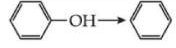
(I) Na2Cr2O7 in presence of H2SO4 (B) CH3CH2OH → C2H5OC2H5 (II) H2SO4 at 443 K (C) 
(III) Zn (D) CH3CH2OH → CH2 = CH2 (IV) H2SO4 at 413 K Choose the correct answer from the options given below:


