
Phenol is brominated in solvent CS₂ at low temperature. The product formed are:
Dibromophenols
Understanding Phenol Bromination Reactions
The question asks about the product formed when phenol undergoes bromination in carbon disulfide (CS₂) solvent at low temperature. This is an important electrophilic substitution reaction in organic chemistry. Understanding the properties of phenol, the electrophile, the solvent, and the reaction conditions is key to determining the product.
Phenol Reactivity and Directing Effects
Phenol consists of a benzene ring attached to a hydroxyl (-OH) group. The -OH group is strongly activating towards electrophilic substitution on the benzene ring. This means it makes the benzene ring much more reactive than benzene itself. The -OH group is also an ortho, para-director. This means incoming electrophiles, like the bromine cation ({}Br^+}), will preferentially attack the positions ortho (adjacent) and para (opposite) to the -OH group.
The canonical resonance structures of phenol show increased electron density at the ortho and para positions:
- Oxygen atom of -OH group donates electron density into the ring via resonance.
- Negative charge accumulates at the ortho and para positions, making them susceptible to electrophilic attack.
Effect of Solvent and Temperature on Phenol Bromination
The choice of solvent and temperature significantly influences the extent of bromination of phenol.
- Polar solvents (e.g., water): In a highly polar solvent like water, phenol is significantly activated due to ionization of the -OH group to {}O^-} (phenoxide ion), which is even more activating than the -OH group. Bromination in water is very rapid and typically leads to polysubstitution, forming 2,4,6-tribromophenol even without a catalyst.
- Non-polar or weakly polar solvents (e.g., CS₂, CHCl₃): In a non-polar solvent like carbon disulfide (CS₂), the activation by the -OH group is moderated. The reaction is less vigorous, and it is possible to control the substitution.
- Low temperature: Low temperature further helps in controlling the reaction rate and preventing excessive substitution (polysubstitution).
Bromination of Phenol in CS₂ at Low Temperature
Under the conditions specified (CS₂ solvent, low temperature), the bromination of phenol is controlled. While the ortho and para positions are still the primary sites for substitution, the reaction is less facile than in water. The electrophile, bromine ({}Br_2}) polarized by the Lewis acid catalyst (often generated in situ or implicitly present by interaction with the substrate/product), attacks the activated ring.
Initially, monobromination occurs at the ortho and para positions, forming ortho-bromophenol and para-bromophenol. The para product is generally favored due to less steric hindrance.
The introduction of one bromine atom slightly deactivates the ring compared to phenol but the -OH group's activation is still dominant. Further bromination can occur at the remaining activated ortho and para positions. With one position already occupied (typically para), the remaining positions available for easy substitution are the two ortho positions and the other para position (which is already occupied in para-bromophenol). If one ortho position is already substituted (in ortho-bromophenol), the other ortho and the para position are available.
Given the controlled conditions (CS₂, low temperature), the reaction is less likely to proceed all the way to the tribromo product as it would in water. Instead, substitution typically stops after one or two bromine atoms have been introduced.
Considering the ortho/para directing nature and the moderated conditions, the major products are usually a mixture of monobromophenols and dibromophenols (specifically 2,4-dibromophenol, as the para position is usually substituted first, followed by an ortho position). Tribromophenol is less likely to be the major product under these specific conditions.
Analyzing the Options
- Monobromophenols: Yes, monobromophenols (ortho and para) are initial products. However, the reaction can proceed further under these conditions.
- Dibromophenols: Yes, dibromophenols, particularly 2,4-dibromophenol, are commonly formed products when phenol is brominated under controlled conditions like using CS₂ at low temperature.
- Tribromophenols: Less likely to be the major product under these controlled conditions. Tribromophenol (2,4,6-tribromophenol) is typically formed rapidly in polar solvents like water.
- Tribromobenzene: This would require the removal of the -OH group and then bromination of benzene. Bromination of benzene itself requires a strong Lewis acid catalyst like {}FeBr_3} and is much less reactive than phenol. Tribromobenzene is not formed under these reaction conditions starting from phenol.
Under bromination conditions using CS₂ at low temperature, the reaction is controlled. While monobromophenols are formed first, the reaction can proceed to introduce a second bromine atom, primarily at the remaining activated positions. Dibromophenols, especially 2,4-dibromophenol, are significant products under these specific conditions, representing a controlled degree of substitution compared to the rapid tribromination seen in water.
| Reaction Conditions | Major Product(s) |
|---|---|
| Phenol + {}Br_2} in {}H_2O} (room temperature) | 2,4,6-Tribromophenol |
| Phenol + {}Br_2} in {}CS_2} (low temperature) | Monobromophenols (ortho/para) and Dibromophenols (e.g., 2,4-dibromophenol) |
Based on the reaction conditions (CS₂ solvent, low temperature) which favor controlled bromination over exhaustive substitution, dibromophenols are a expected product, alongside monobromophenols. The question asks for 'The product formed are', implying possible multiple products or the most significant product type. Dibromophenols are characteristic products under these controlled conditions.
Revision Table: Key Concepts in Electrophilic Aromatic Substitution
| Concept | Explanation | Relevance to Phenol Bromination |
|---|---|---|
| Electrophilic Aromatic Substitution (EAS) | A reaction where an electrophile replaces a hydrogen atom on an aromatic ring. | Bromination of phenol is an EAS reaction where {}Br^+} acts as the electrophile. |
| Activating Group | Substituent that increases the reactivity of the aromatic ring towards EAS. | The -OH group is a strong activating group. |
| Deactivating Group | Substituent that decreases the reactivity of the aromatic ring towards EAS. | Halogens (like Br) are deactivating but ortho/para directing. |
| Directing Group | Substituent that determines the position of the incoming electrophile (ortho, meta, or para). | The -OH group is an ortho, para-director. |
| Solvent Effects | How the solvent influences reaction rate and selectivity. | Polar solvents ({}H_2O}) enhance activation of phenol, leading to polysubstitution. Non-polar solvents ({}CS_2}) moderate activation, allowing controlled substitution. |
Additional Information: Controlling Bromination of Phenol
To obtain specific monobrominated products or to control the extent of bromination, careful selection of reaction conditions is essential for phenol bromination.
- Selective Monobromination: Achieving high yields of pure ortho-bromophenol or para-bromophenol can be challenging. Mixtures are often formed. However, using milder brominating agents or bulky protecting groups on the -OH can sometimes improve selectivity. For example, preparing 4-bromophenol can be done indirectly via strategies that block ortho positions or favor para attack.
- Role of Catalyst: While bromination in water is so fast it requires no catalyst, bromination in less polar solvents often benefits from a Lewis acid catalyst (like {}FeBr_3} or {}AlBr_3}), although the reactivity of phenol is high enough that the reaction can proceed without an added catalyst, possibly catalyzed by the product HBr or interaction with {}Br_2} itself. In the case of phenol, the substrate itself is highly activating, reducing the need for a strong external catalyst compared to benzene bromination.
- Steric Effects: The bulk of the incoming electrophile and existing substituents can influence the ortho vs. para ratio. The para position is generally less sterically hindered than the two ortho positions.
In summary, the choice of solvent and temperature is critical for controlling the number of bromine atoms introduced into the phenol ring during bromination. Using CS₂ at low temperature is a classic method for achieving controlled bromination, leading primarily to monobrominated and dibrominated products rather than exhaustive tribromination.
Important Questions from Aldehydes, Ketones and Carboxylic Acids
What is not true regarding compound [B]?
(A) They are higher boiling liquids than aldehydes and ketones due to extensive H bonding
(B) They are soluble in Benzene
(C) They produce alkane when heated with soda lime
(D) Produces CO₂ when treated with NaHCO₃
Choose the correct answer from the options given below:
Which of the following is the correct statement for hybridization of C-atom and number of π bonds in the Carbonyl group?
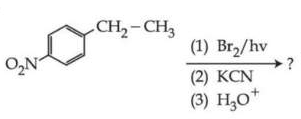
What is the product formed in the following reaction sequence?
What will be the product formed when cyclohexanone undergoes Aldol condensation?
Match the chemical conversion in List-I to the appropriate reagent in List-II:
List-I List-II (A) 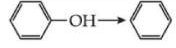
(I) Na2Cr2O7 in presence of H2SO4 (B) CH3CH2OH → C2H5OC2H5 (II) H2SO4 at 443 K (C) 
(III) Zn (D) CH3CH2OH → CH2 = CH2 (IV) H2SO4 at 413 K Choose the correct answer from the options given below:


