
What will be the product formed when cyclohexanone undergoes Aldol condensation?
(d)
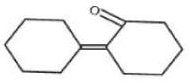
Understanding Cyclohexanone Aldol Condensation
The question asks us to identify the product formed when cyclohexanone undergoes Aldol condensation. Aldol condensation is a fundamental reaction in organic chemistry where an enolate ion reacts with a carbonyl compound (aldehyde or ketone) to form a $\beta$-hydroxy carbonyl compound (an aldol product). Under suitable conditions, this aldol product can undergo dehydration to yield an $\alpha,\beta$-unsaturated carbonyl compound.
What is Aldol Condensation?
Aldol condensation typically involves:
- A carbonyl compound with alpha hydrogens.
- A base (or acid) that helps form the enolate or enol.
- Reaction of the enolate/enol with another molecule of a carbonyl compound.
When the same carbonyl compound reacts with itself, it's called self-condensation.
Self-Condensation of Cyclohexanone: Step-by-Step
Cyclohexanone is a cyclic ketone with alpha hydrogens on the carbons adjacent to the carbonyl group. In the presence of a base, it can undergo self-condensation.
Step 1: Enolate Formation
A strong base removes an acidic alpha hydrogen from one molecule of cyclohexanone, forming a resonance-stabilized enolate ion.
Step 2: Nucleophilic Attack
The enolate ion, acting as a nucleophile, attacks the carbonyl carbon of another molecule of cyclohexanone (the electrophile).
Step 3: Formation of $\beta$-Hydroxy Ketone (Aldol Product)
The alkoxide intermediate formed in Step 2 is protonated by the solvent (usually water) to give the $\beta$-hydroxy ketone. This product contains both a carbonyl group and a hydroxyl group on the carbon that is beta to the carbonyl carbon.
In the case of cyclohexanone self-condensation, this intermediate is a molecule containing two six-membered rings linked by a single bond, with one ring having a ketone carbonyl and the other having a hydroxyl group on a carbon that is beta to the first carbonyl.
Step 4: Dehydration to Form $\alpha,\beta$-Unsaturated Ketone
Under the basic or acidic conditions and often with heating, the $\beta$-hydroxy ketone readily loses a molecule of water. This dehydration forms a double bond between the alpha carbon and the beta carbon relative to the original carbonyl group, resulting in a conjugated $\alpha,\beta$-unsaturated ketone.
Analyzing the Product Structure
The final product of cyclohexanone self-condensation followed by dehydration will be an $\alpha,\beta$-unsaturated ketone. It will be a dimer of cyclohexanone, meaning it contains two six-membered rings. One ring will contain the original carbonyl group. The carbon adjacent to this carbonyl group (the alpha carbon) will be double-bonded to the carbon that was originally the carbonyl carbon of the second cyclohexanone molecule (which becomes the beta carbon). This beta carbon is part of the second six-membered ring.
Looking at the provided options, Option (d) shows a molecule with two cyclohexanone rings linked together. One ring clearly contains the carbonyl group. The carbon next to this carbonyl group is involved in a double bond. This double bond connects the alpha carbon of the carbonyl-containing ring to a carbon in the second ring. This carbon in the second ring is the beta carbon relative to the carbonyl and was the site of the original nucleophilic attack (and bore the OH group before dehydration). This structure perfectly matches the expected $\alpha,\beta$-unsaturated ketone product formed by the dehydrated Aldol condensation of cyclohexanone.
Why Other Options Are Not the Dehydrated Aldol Product
Options (a), (b), and (c) depict structures that do not match the characteristic $\alpha,\beta$-unsaturated ketone dimer expected from cyclohexanone self-condensation followed by dehydration. Option (b) likely represents the intermediate $\beta$-hydroxy ketone before dehydration. Options (a) and (c) show different linkages or arrangements that are not consistent with the standard Aldol condensation pathway of cyclohexanone.
| Concept | Description |
|---|---|
| Reactants | Carbonyl compounds with $\alpha$-hydrogens |
| Conditions | Base (e.g., NaOH) or acid catalysis, sometimes with heat |
| Intermediate Product | $\beta$-Hydroxy carbonyl compound (Aldol) |
| Final Product (Dehydrated) | $\alpha,\beta$-Unsaturated carbonyl compound |
| Self-Condensation | Reaction between identical carbonyl molecules |
Additional Information: Crossed Aldol and Intramolecular Aldol
While we discussed the self-condensation of cyclohexanone, Aldol reactions can also occur between different carbonyl compounds (crossed Aldol condensation) or within the same molecule if it contains two carbonyl groups (intramolecular Aldol condensation). Crossed Aldol can lead to a mixture of products unless one reactant lacks alpha hydrogens or is used in excess. Intramolecular Aldol condensation is particularly useful for forming five- or six-membered rings, as these are often thermodynamically favorable.
Important Questions from Aldehydes, Ketones and Carboxylic Acids
Phenol is brominated in solvent CS₂ at low temperature. The product formed are:
What is not true regarding compound [B]?
(A) They are higher boiling liquids than aldehydes and ketones due to extensive H bonding
(B) They are soluble in Benzene
(C) They produce alkane when heated with soda lime
(D) Produces CO₂ when treated with NaHCO₃
Choose the correct answer from the options given below:
Which of the following is the correct statement for hybridization of C-atom and number of π bonds in the Carbonyl group?
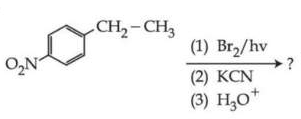
What is the product formed in the following reaction sequence?
Match the chemical conversion in List-I to the appropriate reagent in List-II:
List-I List-II (A) 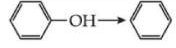
(I) Na2Cr2O7 in presence of H2SO4 (B) CH3CH2OH → C2H5OC2H5 (II) H2SO4 at 443 K (C) 
(III) Zn (D) CH3CH2OH → CH2 = CH2 (IV) H2SO4 at 413 K Choose the correct answer from the options given below:


