
(A) Holes are minority carriers and pentavalent atoms are the dopants.
(B) Electrons are majority carriers and trivalent atoms are the dopants.
(C) Holes are majority carriers and trivalent atoms are the dopants.
(D) Electrons are minority carriers and pentavalent atoms are the dopants.
Choose the correct answer from the options given below:
Understanding p-type Semiconductors
A p-type semiconductor is a semiconductor material that has been doped with an impurity atom that has fewer valence electrons than the semiconductor atom. This process creates an excess of positively charged "holes".
Key Characteristics
- Dopants: The dopants used are typically elements from Group III of the periodic table, which have three valence electrons (trivalent atoms). Examples include Boron, Gallium, and Indium.
- Charge Carriers: When a trivalent atom replaces a semiconductor atom (e.g., Silicon, which has four valence electrons) in the crystal lattice, it can only form three covalent bonds. The absence of an electron in the fourth bond position creates a vacancy, referred to as a hole.
- Majority Carriers: These holes are positively charged and are responsible for carrying electric current. In a p-type semiconductor, holes are the majority carriers (i.e., they are more numerous than electrons).
- Minority Carriers: Electrons, generated either from the intrinsic semiconductor material or through thermal excitation, exist in smaller quantities and are known as the minority carriers.
Analysis of Statements
Let's analyze each statement provided in the options:
- Statement (A): "Holes are minority carriers and pentavalent atoms are the dopants."
- This is incorrect. In p-type semiconductors, holes are the majority carriers.
- Pentavalent atoms (like Phosphorus or Arsenic, with five valence electrons) are used to create n-type semiconductors, where electrons are the majority carriers.
- Statement (B): "Electrons are majority carriers and trivalent atoms are the dopants."
- This is incorrect. Electrons are the majority carriers in n-type semiconductors.
- While trivalent atoms are correct dopants for p-type semiconductors, the statement incorrectly identifies the majority charge carriers.
- Statement (C): "Holes are majority carriers and trivalent atoms are the dopants."
- This statement is correct. As established, the doping process with trivalent atoms leads to an increase in the number of holes, making them the majority carriers in a p-type semiconductor.
- Statement (D): "Electrons are minority carriers and pentavalent atoms are the dopants."
- This statement is incorrect. While electrons are indeed the minority carriers in a p-type semiconductor, pentavalent atoms are used for doping n-type semiconductors, not p-type.
Summary
Based on the analysis, statement (C) is the only one that accurately describes the characteristics of a p-type semiconductor, namely that holes are the majority charge carriers and trivalent atoms are used as dopants.
Important Questions from Semiconductor and Electronic Devices
Silicon can be doped using one of the following elements as dopant:
(A) Arsenic
(B) Indium
(C) Phosphorus
(D) BoronTo get an n-type semiconductor, the dopants that can be used are:
Let iE, iC, and iB represent the emitter current, collector current, and the base current respectively in a transistor. Choose the correct statement:
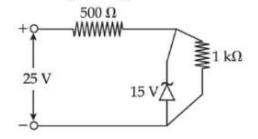
A Zener diode is used in a voltage regulator circuit as shown below. Its breakdown voltage is 15 V. What is the current flowing through the Zener diode?
Choose the correct experimental circuit arrangement for studying V-I characteristics of a p-n junction diode in forward bias:
During the p-n junction formation, when an electron diffuses from n → p, it leaves behind an:


