
For an electric dipole in a non-uniform electric field with dipole moment parallel to the direction of the field, the force F and torque τ on the dipole respectively are:
F ≠ 0, τ = 0
Analyzing Force and Torque on an Electric Dipole in a Non-uniform Field
Let's break down the behavior of an electric dipole when placed in a non-uniform electric field, especially when its dipole moment vector is aligned parallel to the field direction.
Understanding Electric Dipoles
An electric dipole consists of two equal and opposite charges, \(+q\) and \(-q\), separated by a small distance \(d\). The electric dipole moment is a vector quantity, denoted by \(\vec{p}\), pointing from the negative charge to the positive charge. Its magnitude is \(p = qd\).
Electric Fields: Uniform vs. Non-uniform
- A uniform electric field is one where the electric field vector \(\vec{E}\) is the same in magnitude and direction at all points in space.
- A non-uniform electric field is one where the electric field vector \(\vec{E}\) varies in magnitude, direction, or both from point to point.
Force on an Electric Dipole in a Non-uniform Field
The net force on the electric dipole is the vector sum of the forces on the individual charges. Let \(\vec{E}_+\) be the electric field at the location of the \(+q\) charge and \(\vec{E}_-\) be the electric field at the location of the \(-q\) charge.
The force on \(+q\) is \(\vec{F}_+ = +q \vec{E}_+\).
The force on \(-q\) is \(\vec{F}_- = -q \vec{E}_-\).
The net force on the dipole is \(\vec{F} = \vec{F}_+ + \vec{F}_- = q \vec{E}_+ - q \vec{E}_-\).
In a uniform electric field, \(\vec{E}_+ = \vec{E}_-\), so \(\vec{F} = q\vec{E} - q\vec{E} = \vec{0}\). The net force is zero.
In a non-uniform electric field, \(\vec{E}_+\) is generally different from \(\vec{E}_-\). The field strength varies across the small distance \(d\) separating the charges. Therefore, \(q\vec{E}_+\) is different from \(q\vec{E}_-\). This means the net force \(\vec{F} = q \vec{E}_+ - q \vec{E}_-\) will typically not be zero.
For the case where the dipole moment \(\vec{p}\) is parallel to the field \(\vec{E}\) and the field strength varies along this direction, the force can be approximated as \(F \approx p \frac{dE}{dx}\), where \(\frac{dE}{dx}\) is the rate of change of the electric field strength along the direction of the dipole moment. Since the field is non-uniform, \(\frac{dE}{dx} \ne 0\), and thus \(F \ne 0\).
Torque on an Electric Dipole in an Electric Field
The torque \(\vec{\tau}\) on an electric dipole in an electric field \(\vec{E}\) is given by the cross product of the dipole moment vector \(\vec{p}\) and the electric field vector \(\vec{E}\):
\(\vec{\tau} = \vec{p} \times \vec{E}\)
The magnitude of the torque is given by:
\(\tau = pE \sin\theta\)
where \(\theta\) is the angle between the direction of \(\vec{p}\) and \(\vec{E}\).
The question states that the dipole moment is parallel to the direction of the field. This means the angle between \(\vec{p}\) and \(\vec{E}\) is \(\theta = 0^\circ\). For \(\theta = 0^\circ\), \(\sin\theta = \sin(0^\circ) = 0\).
Therefore, the magnitude of the torque is:
\(\tau = pE \sin(0^\circ) = pE(0) = 0\)
The torque on the dipole is zero when the dipole moment is parallel to the electric field, regardless of whether the field is uniform or non-uniform.
Conclusion for the given scenario
For an electric dipole in a non-uniform electric field with its dipole moment parallel to the field:
- The net force \(F\) is non-zero (\(F \ne 0\)) because the field strength varies across the dipole's length.
- The torque \(\tau\) is zero (\(\tau = 0\)) because the dipole moment is parallel to the field (\(\sin 0^\circ = 0\)).
Thus, the force \(F\) and torque \(\tau\) are \(F \ne 0\) and \(\tau = 0\), respectively.
Electric Dipole Force and Torque Summary
| Scenario | Force (\(F\)) | Torque (\(\tau\)) |
|---|---|---|
| Uniform Electric Field, \(\vec{p}\) at any angle | \(F = 0\) | \(\tau = pE \sin\theta\) (\(\ne 0\) unless \(\theta = 0^\circ\) or \(180^\circ\)) |
| Uniform Electric Field, \(\vec{p}\) parallel/anti-parallel to \(\vec{E}\) | \(F = 0\) | \(\tau = 0\) |
| Non-uniform Electric Field, \(\vec{p}\) parallel to \(\vec{E}\) (as in question) | \(F \ne 0\) (due to field gradient) | \(\tau = 0\) (since \(\vec{p}\) is parallel to \(\vec{E}\)) |
| Non-uniform Electric Field, \(\vec{p}\) at angle to \(\vec{E}\) | \(F \ne 0\) (due to field gradient) | \(\tau = pE \sin\theta\) (\(\ne 0\) unless \(\theta = 0^\circ\) or \(180^\circ\)) |
Revision Table: Key Concepts for Electric Dipoles
| Concept | Description | Formula |
|---|---|---|
| Electric Dipole Moment | Vector from -q to +q | \(\vec{p} = q\vec{d}\) (where \(\vec{d}\) is separation vector) |
| Force on Dipole (Uniform Field) | Net force is zero | \(\vec{F} = 0\) |
| Force on Dipole (Non-uniform Field) | Net force is generally non-zero | \(\vec{F} = q(\vec{E}_+ - \vec{E}_-)\) (depends on field gradient) |
| Torque on Dipole | Tendency to rotate the dipole | \(\vec{\tau} = \vec{p} \times \vec{E}\) or \(\tau = pE \sin\theta\) |
| Potential Energy of Dipole | Energy stored due to orientation in field | \(U = -\vec{p} \cdot \vec{E}\) or \(U = -pE \cos\theta\) |
Additional Information on Electric Dipole Behavior
Besides force and torque, another important aspect of an electric dipole in an electric field is its potential energy. The potential energy (\(U\)) of an electric dipole in an electric field is given by \(U = -\vec{p} \cdot \vec{E} = -pE \cos\theta\).
- When the dipole moment is parallel to the field (\(\theta = 0^\circ\)), \(\cos 0^\circ = 1\), so \(U = -pE\). This is the minimum potential energy state, corresponding to stable equilibrium.
- When the dipole moment is anti-parallel to the field (\(\theta = 180^\circ\)), \(\cos 180^\circ = -1\), so \(U = +pE\). This is the maximum potential energy state, corresponding to unstable equilibrium.
- When the dipole moment is perpendicular to the field (\(\theta = 90^\circ\)), \(\cos 90^\circ = 0\), so \(U = 0\).
Even in a non-uniform field, the concept of potential energy can be extended, but the force calculation becomes more complex, related to the gradient of the potential energy: \(\vec{F} = -\nabla U\). Since \(U = -\vec{p} \cdot \vec{E}\), if \(\vec{p}\) is constant, \(\vec{F} = \nabla (\vec{p} \cdot \vec{E})\). If \(\vec{p}\) is parallel to \(\vec{E}\) (let's say along x-axis), then \(\vec{F} = \nabla (p_x E_x) = p_x \nabla E_x\), which confirms the force is related to the gradient of the field.
Important Questions from Semiconductor and Electronic Devices
Silicon can be doped using one of the following elements as dopant:
(A) Arsenic
(B) Indium
(C) Phosphorus
(D) BoronTo get an n-type semiconductor, the dopants that can be used are:
Let iE, iC, and iB represent the emitter current, collector current, and the base current respectively in a transistor. Choose the correct statement:
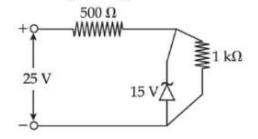
A Zener diode is used in a voltage regulator circuit as shown below. Its breakdown voltage is 15 V. What is the current flowing through the Zener diode?
Choose the correct experimental circuit arrangement for studying V-I characteristics of a p-n junction diode in forward bias:
During the p-n junction formation, when an electron diffuses from n → p, it leaves behind an:


