
(A) $Br_2/FeBr_3$
(B) Mg, dry Ether
(C) $CO_2$, $H_3O^+$
(D) Methanol, Conc. $H_2SO_4$
Choose the correct answer from the options given below:
Benzene Conversion Pathway Explained
The question asks to identify the reagents necessary for the conversion of benzene ($C_6H_6$) into methyl benzoate ($C_6H_5COOCH_3$). This transformation involves multiple steps, and each listed reagent plays a crucial role in a specific stage of the synthesis.
Step-by-Step Reagent Analysis
Let's break down the conversion process step-by-step, examining the function of each reagent group provided in the options:
Step 1: Benzene Bromination
The first step often involves introducing a functional group that allows further modification of the benzene ring. Reagents (A) are used for this.
- Reagent: $Br_2/FeBr_3$ (Bromine in the presence of Iron(III) bromide)
- Reaction Type: Electrophilic Aromatic Substitution
- Transformation: Benzene is converted into bromobenzene ($C_6H_5Br$).
- Explanation: $FeBr_3$ acts as a Lewis acid catalyst, polarizing the $Br_2$ molecule to generate a strong electrophile ($Br^+$), which then attacks the electron-rich benzene ring.
Step 2: Grignard Reagent Formation
The intermediate bromobenzene is then converted into a more reactive species, a Grignard reagent, using reagent (B).
- Reagent: Mg, dry ether (Magnesium metal in anhydrous diethyl ether)
- Reactant: Bromobenzene ($C_6H_5Br$)
- Transformation: Bromobenzene reacts with magnesium to form phenylmagnesium bromide ($C_6H_5MgBr$).
- Explanation: This is a standard method for preparing Grignard reagents, which are potent nucleophiles and bases. The use of dry ether is critical as Grignard reagents react vigorously with water.
Step 3: Carboxylation Reaction
The Grignard reagent is then used to introduce a carboxyl group ($COOH$) onto the benzene ring, utilizing reagent (C).
- Reagent: $CO_2$, $H_3O^+$ (Carbon dioxide followed by aqueous acid workup)
- Reactant: Phenylmagnesium bromide ($C_6H_5MgBr$)
- Transformation: Phenylmagnesium bromide reacts with $CO_2$ to form a magnesium carboxylate salt, which upon acidification ($H_3O^+$) yields benzoic acid ($C_6H_5COOH$).
- Explanation: The nucleophilic carbon of the Grignard reagent attacks the electrophilic carbon of $CO_2$. Acid hydrolysis then protonates the carboxylate intermediate to give the carboxylic acid.
Step 4: Esterification Process
Finally, the carboxylic acid (benzoic acid) is converted into the target ester (methyl benzoate) using reagent (D).
- Reagent: Methanol ($CH_3OH$), Conc. $H_2SO_4$ (Concentrated sulfuric acid)
- Reactant: Benzoic acid ($C_6H_5COOH$)
- Transformation: Benzoic acid reacts with methanol in the presence of a strong acid catalyst to form methyl benzoate ($C_6H_5COOCH_3$).
- Explanation: This is known as Fischer esterification. Sulfuric acid protonates the carbonyl oxygen of the carboxylic acid, making the carbonyl carbon more susceptible to nucleophilic attack by the alcohol (methanol).
Conclusion on Reagents
To achieve the conversion of benzene to methyl benzoate, the sequence of reactions utilizing reagents (A), (B), (C), and (D) is necessary. Therefore, all the listed reagent sets are required for this synthesis pathway.
Important Questions from Aldehydes, Ketones and Carboxylic Acids
Phenol is brominated in solvent CS₂ at low temperature. The product formed are:
What is not true regarding compound [B]?
(A) They are higher boiling liquids than aldehydes and ketones due to extensive H bonding
(B) They are soluble in Benzene
(C) They produce alkane when heated with soda lime
(D) Produces CO₂ when treated with NaHCO₃
Choose the correct answer from the options given below:
Which of the following is the correct statement for hybridization of C-atom and number of π bonds in the Carbonyl group?
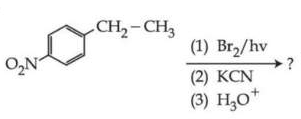
What is the product formed in the following reaction sequence?
What will be the product formed when cyclohexanone undergoes Aldol condensation?


