Which of the following options is correct by using Coulomb's law?
(if the product of q1q2 is negative)

Understanding Coulomb's Law and Electrostatic Forces
Coulomb's Law describes the fundamental interaction between electrically charged particles. It states that the force between two point charges is directly proportional to the product of the magnitudes of the charges and inversely proportional to the square of the distance between them. The force acts along the line joining the two charges.
Mathematically, the magnitude of the electrostatic force \(F\) between two point charges \(q_1\) and \(q_2\) separated by a distance \(r\) is given by:
\[ F = k \frac{|q_1 q_2|}{r^2} \]where \(k\) is Coulomb's constant.
While the formula above gives the magnitude, the direction of the force depends on the signs of the charges \(q_1\) and \(q_2\). The product \(q_1 q_2\) is crucial for determining the nature of the force:
- If \(q_1\) and \(q_2\) have the same sign (both positive or both negative), the product \(q_1 q_2\) is positive (\(q_1 q_2 > 0\)). In this case, the force is repulsive. This means the force on each charge is directed away from the other charge, pushing them apart.
- If \(q_1\) and \(q_2\) have opposite signs (one positive and one negative), the product \(q_1 q_2\) is negative (\(q_1 q_2 < 0\)). In this case, the force is attractive. This means the force on each charge is directed towards the other charge, pulling them together.
The question asks which option correctly uses Coulomb's Law regarding the product \(q_1 q_2\). Let's analyze the conditions and corresponding force types:
- If \(q_1 q_2\) is positive, the force is repulsive.
- If \(q_1 q_2\) is negative, the force is attractive.
The options also include images that are likely diagrams showing the force vectors. We need to find the option where the stated condition on \(q_1 q_2\) correctly matches the type of force depicted in the accompanying image.
Considering the fundamental principle of electrostatic interaction based on charge signs, attractive forces occur when the charges are opposite (product \(q_1 q_2\) is negative), and repulsive forces occur when the charges are the same (product \(q_1 q_2\) is positive).
Let's examine the correct option provided:
It states "if the product of \(q_1 q_2\) is negative" and includes an image (data-src-id="67b56eb888477a714ae107f9"). When \(q_1 q_2\) is negative, the force is attractive. An image depicting attractive forces would show the force vectors on each charge pointing towards the other charge.
This aligns with the principles of Coulomb's Law. Therefore, the option stating the product \(q_1 q_2\) is negative and showing an image representing attractive forces is correct.
Revision Table: Charge Product and Force Direction
| Product of Charges (\(q_1 q_2\)) | Nature of Force | Direction of Force Vectors |
|---|---|---|
| Positive (\(q_1 q_2 > 0\)) | Repulsive | Pointing Away from each other |
| Negative (\(q_1 q_2 < 0\)) | Attractive | Pointing Towards each other |
Additional Information on Electrostatic Force
Coulomb's law is a vector law. The force \(\vec{F}_{12}\) exerted on charge \(q_1\) by charge \(q_2\) is equal in magnitude and opposite in direction to the force \(\vec{F}_{21}\) exerted on charge \(q_2\) by charge \(q_1\). This is consistent with Newton's third law of motion.
The constant \(k\) in Coulomb's Law is also known as the electrostatic constant or Coulomb constant, and its value depends on the medium in which the charges are placed. In a vacuum, \(k \approx 8.9875 \times 10^9 \, \text{N m}^2/\text{C}^2\). It is often written as \(k = \frac{1}{4\pi\epsilon_0}\), where \(\epsilon_0\) is the permittivity of free space.
Coulomb's Law is valid for stationary point charges. For continuous charge distributions or charges in motion, the calculation of electrostatic force requires integration or considering more complex concepts like electric fields.
Important Questions from Electric Charges and Fields
Two charged particles, placed at a distance d apart in vacuum, exert a force F on each other. Now, each of the charges is doubled. To keep the force unchanged, the distance between the charges should be changed to:
When a slab of insulating material 4 mm thick is introduced between the plates of a parallel plate capacitor of separation 4 mm, it is found that the distance between the plates has to be increased by 3.2 mm to restore the capacity to its original value. The dielectric constant of the material is:
Match List - I with List - II.
List - I List - II (A) Electric Field (I) [LTA] (B) Electric Flux (II) [L2] (C) Electric Dipole Moment (III) [ML3T−3A−1] (D) Area Vector Element (IV) [MLT−3A−1] Choose the correct answer from the options given below:
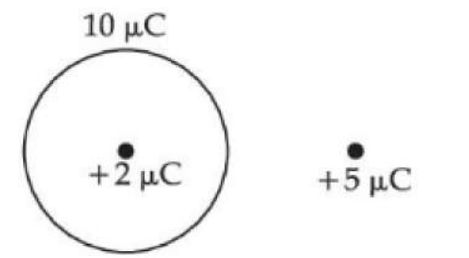
A thin metallic spherical shell contains a charge +10 μC on it. A point charge +2 μC is placed at the centre of the shell and another charge +5 μC is placed outside it as shown. The force on the charge +2 μC at the centre is:
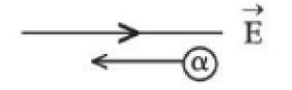
In the figure, an α-particle moves a distance l in a uniform electric field E as shown. Does the Electric Field do a positive or a negative work on the α-particle? Does the electric potential energy of the α-particle increase or decrease?