
In the figure, an α-particle moves a distance l in a uniform electric field E as shown. Does the Electric Field do a positive or a negative work on the α-particle? Does the electric potential energy of the α-particle increase or decrease?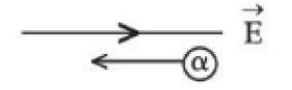
Negative, increases
An α-particle (positively charged) moves opposite to the direction of the electric field. The electric force acting on it is in the direction of the field, meaning the field does negative work on the particle. Since work done by the field is negative, the electric potential energy of the α-particle increases. Thus, the correct answer is (a).
Important Questions from Electric Charges and Fields
When a slab of insulating material 4 mm thick is introduced between the plates of a parallel plate capacitor of separation 4 mm, it is found that the distance between the plates has to be increased by 3.2 mm to restore the capacity to its original value. The dielectric constant of the material is:
Match List - I with List - II.
List - I List - II (A) Electric Field (I) [LTA] (B) Electric Flux (II) [L2] (C) Electric Dipole Moment (III) [ML3T−3A−1] (D) Area Vector Element (IV) [MLT−3A−1] Choose the correct answer from the options given below:
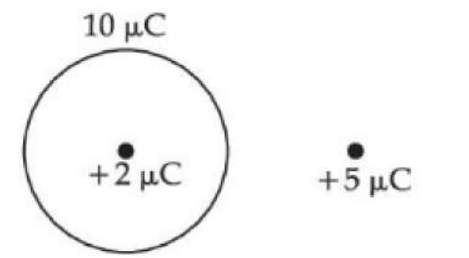
A thin metallic spherical shell contains a charge +10 μC on it. A point charge +2 μC is placed at the centre of the shell and another charge +5 μC is placed outside it as shown. The force on the charge +2 μC at the centre is:
The force between two electric charges is expressed by the equation:
F = (k q1 q2) / r2
Which of the following is a correct statement?
Electrostatics deals with the study of forces, fields, and potential arising from static charges. Which of the following statements are correct?
- (A) Electrostatic force is a conservative force
- (B) Charge is quantized because only an integral number of electrons can be transferred from one body to the other
- (C) In a uniform electric field E, an electric dipole experiences a torque and a net force F
- (D) The electric field lines start from positive charges and end at negative charges. If there is a single charge, these may start or end at infinity.
Choose the correct answer from the options given below:


